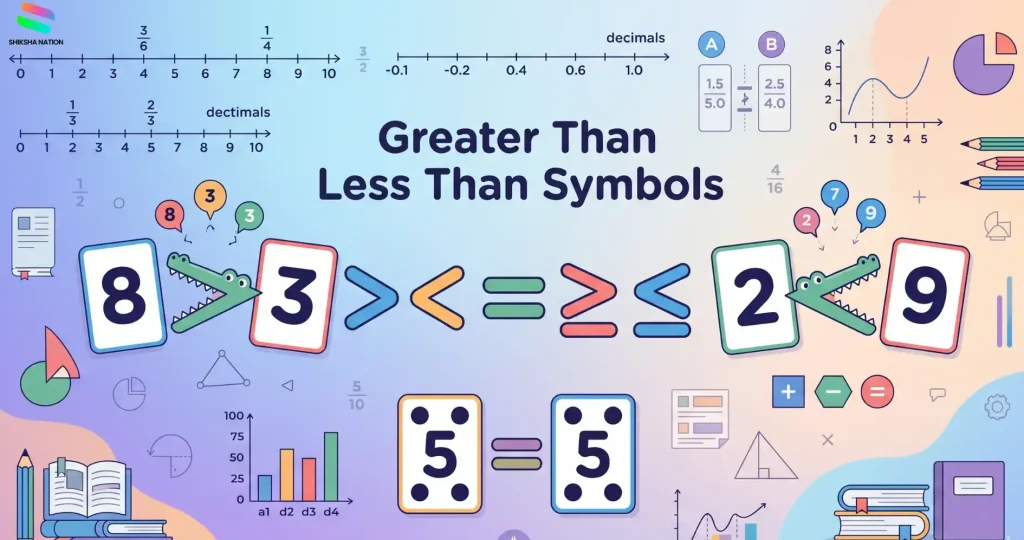
Numbers are everywhere around us. We compare marks, prices, heights, ages, scores, temperatures, and even mobile storage daily. In maths, these comparisons are shown using greater than less than symbols. These symbols help students quickly identify which value is bigger, smaller, or equal.
The greater than less than symbols are among the first mathematical signs students learn because they build the foundation for algebra, inequalities, decimals, fractions, and higher-level maths concepts. Once you understand how these symbols work, solving comparison questions becomes much easier.
In this guide, you’ll learn:
- meaning of each symbol
- easy tricks to remember them
- comparison rules
- examples with answers
- common mistakes students make
- practice questions for revision
Whether you’re a school student, parent, or beginner learner, this explanation will help you understand the topic step-by-step in a simple way.

What Are Greater Than Less Than Symbols?
The greater than less than symbols are mathematical comparison signs used to compare two numbers or values.
- The greater than symbol ( > ) shows that the number on the left is bigger.
- The less than symbol ( < ) shows that the number on the left is smaller.
- The equal to sign ( = ) shows both values are the same.
Also Check: Whole Numbers | Maths Revision Notes | Mathematics Formulas
Symbols Table
| Symbol |
Meaning |
Example |
| > |
Greater than |
9 > 4 |
| < |
Less than |
3 < 8 |
| = |
Equal to |
7 = 7 |
These symbols are used in arithmetic, algebra, inequalities, programming, and daily-life comparisons.
Greater Than Less Than Symbols at a Glance
Understanding symbols becomes easier when you see everything together in one chart.
| Symbol |
Name |
Meaning |
Read As |
Example |
Used For |
| > |
Greater Than |
Left value is bigger |
Greater than |
8 > 3 |
Comparing larger numbers |
| < |
Less Than |
Left value is smaller |
Less than |
2 < 7 |
Comparing smaller numbers |
| = |
Equal To |
Both values are same |
Equal to |
5 = 5 |
Showing equality |
| ≥ |
Greater Than or Equal To |
Bigger or equal |
Greater than or equal to |
x ≥ 4 |
Algebra and inequalities |
| ≤ |
Less Than or Equal To |
Smaller or equal |
Less than or equal to |
y ≤ 6 |
Inequalities |
This chart is useful for quick revision before exams and practice sessions.
Where Are Greater Than Less Than Symbols Used?
Students often think these symbols are only used in maths textbooks, but actually they are used in many real-life situations too.
In Mathematics
- comparing numbers
- solving inequalities
- algebraic equations
- decimals and fractions
- integers and number systems
In Daily Life
- comparing prices
- checking marks
- age comparison
- sports scores
- distance and measurements
In Technology
- coding and programming
- spreadsheet formulas
- computer calculations
- logical conditions
For example:
- ₹500 > ₹300 means ₹500 is more expensive.
- 18°C < 25°C means 18 degrees is colder.
This is why understanding greater than less than symbols is important from an early stage.
Understanding Each Symbol Step-by-Step
Greater Than Symbol ( > )
The greater than symbol shows that the value on the left side is larger than the value on the right side.
Examples
| Example |
Meaning |
| 10 > 4 |
10 is greater than 4 |
| 25 > 12 |
25 is bigger than 12 |
| 0.9 > 0.3 |
0.9 is greater than 0.3 |
How to Read It
- 10 > 4 is read as “10 is greater than 4”.
Real-Life Example
If Rahul scored 92 marks and Aman scored 78 marks:
92 > 78
Rahul scored higher marks.
Less Than Symbol ( < )
The less than symbol shows that the left-side value is smaller than the right-side value.
Examples
| Example |
Meaning |
| 2 < 9 |
2 is less than 9 |
| 15 < 20 |
15 is smaller than 20 |
| 0.1 < 0.7 |
0.1 is less than 0.7 |
How to Read It
- 2 < 9 is read as “2 is less than 9”.
Real-Life Example
If a pencil costs ₹5 and a notebook costs ₹20:
5 < 20
The pencil is cheaper.
Equal To Symbol ( = )
The equal to sign means both values are exactly the same.
Examples
| Example |
Meaning |
| 7 = 7 |
Both numbers are equal |
| 12 = 12 |
Same values |
| 0.5 = 0.5 |
Equal decimals |
How to Read It
- 7 = 7 is read as “7 equals 7”.
Equal signs are very common in arithmetic and algebra.
Greater Than or Equal To ( ≥ )
This symbol means:
- the value is either greater
- or exactly equal
Examples
| Example |
Meaning |
| x ≥ 5 |
x is greater than or equal to 5 |
| 10 ≥ 10 |
Equal condition accepted |
| 12 ≥ 8 |
Greater condition accepted |
This symbol is mostly used in algebra and inequalities.
Less Than or Equal To ( ≤ )
This means:
- the value is smaller
- or equal
Examples
| Example |
Meaning |
| y ≤ 7 |
y is less than or equal to 7 |
| 4 ≤ 4 |
Equal value accepted |
| 2 ≤ 9 |
Smaller value accepted |
Greater Than Less Than Symbols Easy Tricks to Remember
Many students confuse the direction of the symbols. These simple tricks make remembering them much easier.
Trick 1: Hungry Alligator Method
Imagine the symbol as the mouth of a hungry alligator.
The alligator always wants to eat the bigger number.
Example
8 > 3
The open mouth faces 8 because 8 is larger.
This is one of the easiest memory tricks for younger students.
Trick 2: L Method
The less than symbol (<) looks similar to the letter “L”.
- Less starts with L
- < also looks like L
So:
3 < 9
means 3 is less than 9.
Trick 3: Open Side Faces Bigger Number
The wider opening of the symbol always points toward the larger number.
Example
15 > 7
The open side faces 15 because 15 is bigger.
Common Confusions Students Face
Some comparison questions become confusing when decimals, fractions, or negative numbers are involved.
Here are the most common mistakes.
| Confusion |
Correct Understanding |
| 0.25 > 0.5 |
Incorrect. 0.25 is smaller |
| -7 > -2 |
Incorrect. -2 is greater |
| 1/2 > 3/4 |
Incorrect. 3/4 is greater |
| Wrong symbol direction |
Open side faces bigger number |
Understanding these mistakes early helps avoid errors in exams.
Rules to Compare Numbers Faster
These rules can save time during tests and MCQs.
- Numbers with more digits are usually larger
- Compare digits from left to right
- For decimals, compare place values carefully
- In negative numbers, the number closer to zero is greater
- Convert fractions into decimals when needed
Example
-1 > -5
Even though 5 is bigger than 1, negative numbers work differently.
Greater Than Less Than Examples by Number Type
Integer Comparison Examples
| Example |
Explanation |
| 9 > 2 |
9 is bigger |
| -3 < 1 |
Negative number is smaller |
| 15 > -4 |
Positive number is greater |
Decimal Comparison Examples
| Example |
Explanation |
| 0.8 > 0.3 |
8 tenths is larger |
| 0.25 < 0.5 |
25 hundredths is smaller |
| 1.2 > 1.02 |
1.2 has greater value |
Fraction Comparison Examples
| Example |
Explanation |
| 3/4 > 1/2 |
0.75 is greater than 0.5 |
| 2/5 < 4/5 |
Same denominator comparison |
| 5/6 > 2/6 |
Numerator is larger |
Real-Life Examples of Greater Than Less Than Symbols
Students understand concepts faster when examples feel real.
| Situation |
Comparison |
| ₹500 compared to ₹300 |
500 > 300 |
| 2 hours compared to 5 hours |
2 < 5 |
| 98 marks compared to 81 marks |
98 > 81 |
| 18°C compared to 30°C |
18 < 30 |
These comparisons are used daily without even noticing.
Can You Identify the Correct Symbol?
Try solving these quickly.
| Comparison |
Correct Symbol |
| 12 ___ 9 |
> |
| 4 ___ 15 |
< |
| 0.9 ___ 0.3 |
> |
| -2 ___ 5 |
< |
| 7 ___ 7 |
= |
Practicing regularly improves speed and accuracy.
Practice Quiz
Fill in the blanks
- 15 ___ 20
- 7 ___ 3
- -5 ___ -1
- 0.45 ___ 0.5
- 2/3 ___ 1/3
Answers
- <
- <
- <
Why Are Greater Than Less Than Symbols Important?
The greater than less than symbols are used in almost every area of mathematics.
They help students:
- compare values quickly
- solve inequalities
- understand algebra
- work with fractions and decimals
- improve logical thinking
These symbols also appear in:
- Olympiad exams
- NTSE
- coding basics
- aptitude questions
- data interpretation
So, mastering them early gives students a strong maths foundation.
Key Takeaways
- “>” means greater than
- “<” means less than
- “=” means equal to
- Open side faces the bigger number
- These symbols are used in maths, coding, and daily comparisons
- Negative numbers and decimals need careful comparison
- Regular practice improves speed and accuracy
Conclusion
The greater than less than symbols are simple but extremely important mathematical signs used to compare numbers and values. From basic arithmetic to algebra and competitive exams, these symbols appear everywhere in maths.
Once students understand the meaning, tricks, and comparison rules, solving questions becomes much easier. The best way to master these symbols is through regular practice using decimals, fractions, integers, and real-life examples.
Keep revising the rules, practice comparison questions daily, and these symbols will start feeling natural very quickly.
Greater Than Less Than Symbols related FAQ’s