
Energy and power are two important concepts in Physics that help students understand how work is done in daily life and scientific applications. From running machines and moving vehicles to electric appliances and industrial systems, energy and power are used everywhere. Students studying CBSE, ICSE, State Boards, JEE, and NEET often learn different energy formulas, power formulas, and physics equations to solve numerical problems easily.
The study of energy formulas in Physics helps students understand motion, electricity, mechanics, and thermodynamics. Similarly, the power formula in Physics explains how quickly work is completed. These concepts are useful in both theoretical and practical applications.
Here, Students will learn the important energy equations in Physics, kinetic energy formula, potential energy formula, electrical power formula, SI units, derivations, solved examples, and the difference between energy and power.
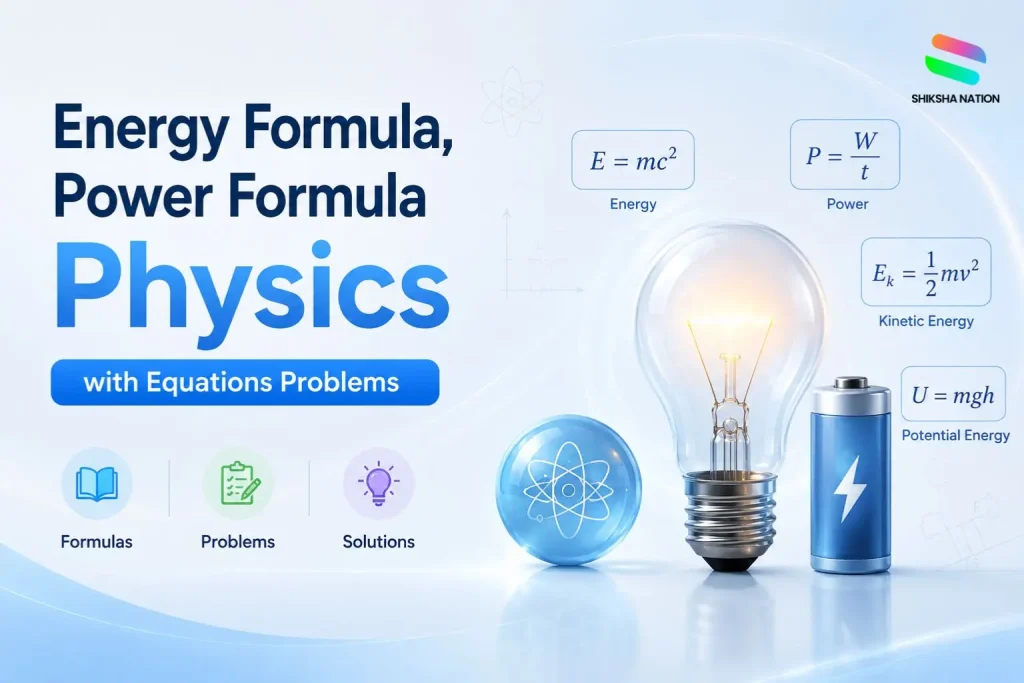
What is Energy in Physics?
Energy is defined as the ability to do work. Any object that can perform work possesses energy. Energy can neither be created nor destroyed, but it can change from one form to another. This principle is known as the law of conservation of energy.
Different forms of energy include:
- Mechanical Energy
- Kinetic Energy
- Potential Energy
- Electrical Energy
- Heat Energy
- Chemical Energy
- Sound Energy
- Light Energy
For example, a moving car has kinetic energy, while water stored in a dam has potential energy.
SI Unit of Energy
The SI unit of energy is Joule (J). It is named after the scientist James Prescott Joule.
| Unit | Symbol | Value |
|---|---|---|
| Joule | J | SI Unit of Energy |
| Calorie | cal | 1 cal = 4.184 J |
| Kilowatt-hour | kWh | 1 kWh = 3.6 × 10⁶ J |
The joule formula is commonly used in Physics equations and numerical problems.
Do Check – Complete Class 12 Physics Formulas
Energy Formula in Physics
Energy formulas in Physics are used to calculate different forms of energy. The formula depends on the type of energy involved.
General Energy Equation:
Energy = Power × Time
E = P × t
Where:
- E = Energy
- P = Power
- t = Time
Another important relation between work and energy is:
W = F × d
Where:
- W = Work Done
- F = Force
- d = Displacement
These energy equations in Physics are widely used in mechanics and electricity.
Kinetic Energy Formula
Kinetic energy is the energy possessed by an object because of its motion. Any moving object has kinetic energy.
Kinetic Energy Formula:
KE = 1/2 mv2
Where:
- KE = Kinetic Energy
- m = Mass of the object
- v = Velocity of the object
Derivation of Kinetic Energy Formula
We know that:
Work Done = Force × Displacement
Using Newton’s second law:
F = ma
Using the equation of motion:
v2 – u2 = 2as
For an object starting from rest, u = 0.
After substitution and simplification:
KE = 1/2 mv2
Example of Kinetic Energy
If a car of mass 1000 kg moves with a velocity of 20 m/s, then:
KE = 1/2 × 1000 × 202
KE = 200000 J
This is one of the most important formulas of work power and energy.
Potential Energy Formula
Potential energy is the energy stored in an object because of its position or height.
Potential Energy Formula:
PE = mgh
Where:
- PE = Potential Energy
- m = Mass
- g = Acceleration due to gravity
- h = Height
Explanation of Potential Energy Equation
When an object is lifted above the ground, work is done against gravity. This work gets stored in the form of gravitational potential energy.
Example of Potential Energy
If a body of mass 5 kg is raised to a height of 10 m:
PE = 5 × 9.8 × 10
PE = 490 J
The potential energy formula is important in mechanics and motion chapters.
Mechanical Energy Formula
Mechanical energy is the sum of kinetic energy and potential energy.
Mechanical Energy Formula:
ME = KE + PE
Where:
- ME = Mechanical Energy
- KE = Kinetic Energy
- PE = Potential Energy
The conservation of mechanical energy states that the total mechanical energy of a system remains constant if no external force acts on it.
What is Power in Physics?
Power is defined as the rate of doing work. It tells us how quickly work is completed. For example, two students may climb the same staircase, but the student who climbs faster produces more power.
Power is an important topic in mechanics and electricity.
Power Formula in Physics
The standard power formula in Physics is:
P = W/t
Where:
- P = Power
- W = Work Done
- t = Time Taken
This formula shows that power depends on the amount of work done and the time required.
Electrical Power Formula
In electricity, power can also be calculated using:
P = VI
Where:
- P = Electrical Power
- V = Voltage
- I = Current
Other important electrical power formulas are:
P = I2R
P = V2/R
These formulas are commonly used in electrical energy calculations and circuit problems.
SI Unit of Power
The SI unit of power is Watt (W). One watt is equal to one joule of work done in one second.
| Unit | Symbol | Conversion |
|---|---|---|
| Watt | W | 1 W = 1 J/s |
| Kilowatt | kW | 1 kW = 1000 W |
| Horsepower | hp | 1 hp = 746 W |
The watt formula Physics concept is important in electricity and engineering.
Difference Between Energy and Power
| Basis | Energy | Power |
|---|---|---|
| Definition | Ability to do work | Rate of doing work |
| SI Unit | Joule | Watt |
| Formula | E = P × t | P = W/t |
| Quantity Type | Scalar | Scalar |
| Example | Stored battery energy | Power of a motor |
Students often confuse energy with power, but both concepts are different.
Relationship Between Work, Energy and Power
Work, energy, and power are closely related in Physics.
- Work done on an object changes its energy.
- Energy helps an object perform work.
- Power measures how fast the work is done.
Important Relations:
- Work Done = Change in Energy
- Power = Work Done / Time
- Energy = Power × Time
The work-energy theorem states that the work done by a force is equal to the change in kinetic energy of the object.
Energy and Power – Important Physics Equations
| Formula Name | Equation |
|---|---|
| Kinetic Energy | KE = 1/2 mv2 |
| Potential Energy | PE = mgh |
| Mechanical Energy | ME = KE + PE |
| Power Formula | P = W/t |
| Electrical Power | P = VI |
| Electrical Energy | E = P × t |
| Work Done | W = F × d |
Solved Practice Examples on Energy and Power Formulas
Problem 1: Find Kinetic Energy
A body of mass 4 kg moves with a velocity of 5 m/s.
Solution:
KE = 1/2 mv2
KE = 1/2 × 4 × 52
KE = 50 J
Problem 2: Find Potential Energy
A 2 kg object is raised to 20 m height.
Solution:
PE = mgh
PE = 2 × 9.8 × 20
PE = 392 J
Problem 3: Calculate Power
A machine does 500 J of work in 10 seconds.
Solution:
P = W/t
P = 500/10
P = 50 W
Problem 4: Electrical Power Formula
An electric bulb operates at 220 V and draws 2 A current.
Solution:
P = VI
P = 220 × 2
P = 440 W
Problem 5: Calculate Kinetic Energy of a Moving Bike
A bike of mass 150 kg moves with a velocity of 12 m/s. Find its kinetic energy.
Solution:
Given:
- Mass (m) = 150 kg
- Velocity (v) = 12 m/s
Using the kinetic energy formula:
KE = 1/2 mv2
KE = 1/2 × 150 × 122
KE = 75 × 144
KE = 10800 J
Problem 6: Find Potential Energy of an Object
A 10 kg object is placed at a height of 15 m. Calculate its potential energy.
Solution:
Given:
- Mass (m) = 10 kg
- Height (h) = 15 m
- g = 9.8 m/s2
Using the potential energy formula:
PE = mgh
PE = 10 × 9.8 × 15
PE = 1470 J
Problem 7: Calculate Mechanical Energy
An object has kinetic energy of 500 J and potential energy of 300 J. Find its mechanical energy.
Solution:
Using the mechanical energy formula:
ME = KE + PE
ME = 500 + 300
ME = 800 J
Problem 8: Find Power Produced by a Machine
A machine does 2000 J of work in 25 seconds. Calculate the power.
Solution:
Given:
- Work Done (W) = 2000 J
- Time (t) = 25 s
Using the power formula:
P = W/t
P = 2000 / 25
P = 80 W
Problem 9: Calculate Electrical Power
An electric heater works at 240 V and draws 5 A current. Find the electrical power.
Solution:
Given:
- Voltage (V) = 240 V
- Current (I) = 5 A
Using the electrical power formula:
P = VI
P = 240 × 5
P = 1200 W
Problem 10: Find Electrical Energy Consumed
A fan uses 100 W power for 6 hours. Calculate the electrical energy consumed.
Solution:
Given:
- Power (P) = 100 W
- Time (t) = 6 hours
Convert hours into seconds:
6 × 3600 = 21600 s
Using the energy formula:
E = P × t
E = 100 × 21600
E = 2160000 J
Problem 11: Find Work Done
A force of 50 N moves an object through a distance of 8 m. Calculate the work done.
Solution:
Given:
- Force (F) = 50 N
- Distance (d) = 8 m
Using the work done formula:
W = F × d
W = 50 × 8
W = 400 J
Problem 12: Calculate Velocity Using Kinetic Energy
A body of mass 2 kg has kinetic energy of 100 J. Find its velocity.
Solution:
Given:
- KE = 100 J
- Mass (m) = 2 kg
Using the kinetic energy equation:
KE = 1/2 mv2
100 = 1/2 × 2 × v2
100 = v2
v = √100
v = 10 m/s
Problem 13: Find Height Using Potential Energy Formula
A body of mass 4 kg has potential energy of 784 J. Find the height.
Solution:
Given:
- PE = 784 J
- Mass (m) = 4 kg
- g = 9.8 m/s2
Using:
PE = mgh
784 = 4 × 9.8 × h
784 = 39.2h
h = 784 / 39.2
h = 20 m
Problem 14: Calculate Current Using Electrical Power Formula
An electric bulb consumes 880 W power at 220 V. Find the current flowing through it.
Solution:
Given:
- Power (P) = 880 W
- Voltage (V) = 220 V
Using:
P = VI
I = P / V
I = 880 / 220
I = 4 A
Problem 15: Find Time Taken Using Power Formula
A machine with power 250 W performs 5000 J of work. Find the time taken.
Solution:
Given:
- Power (P) = 250 W
- Work Done (W) = 5000 J
Using:
P = W/t
t = W / P
t = 5000 / 250
t = 20 s
Applications of Energy and Power in Daily Life
Energy and power concepts are used in many real-life applications.
Applications of Energy
- Running vehicles
- Generating electricity
- Operating machines
- Cooking food
- Charging batteries
Applications of Power
- Electric motors
- Water pumps
- Home appliances
- Industrial machines
- Power stations
Renewable energy sources like solar energy and wind energy also use these Physics equations.