
The radius of Earth is one of the most important measurements in geography, physics, astronomy, and earth science. It helps scientists understand the size, structure, gravity, and movement of our planet. The Earth is not a perfect sphere, so its radius is not exactly the same at every location. However, scientists use an average value for most calculations and scientific studies.
The average radius of Earth is approximately 6,371 kilometers or 6.371 × 10⁶ meters. This value is widely used in schools, competitive exams, satellite studies, navigation systems, and scientific formulas. The radius of Earth is also important for understanding gravitational force, satellite motion, planetary science, and Earth’s rotation.
In simple words, the radius of Earth is the distance from the center of Earth to its surface. Since Earth is slightly flattened at the poles and bulged at the equator, scientists use terms such as mean radius of Earth, equatorial radius, and polar radius.
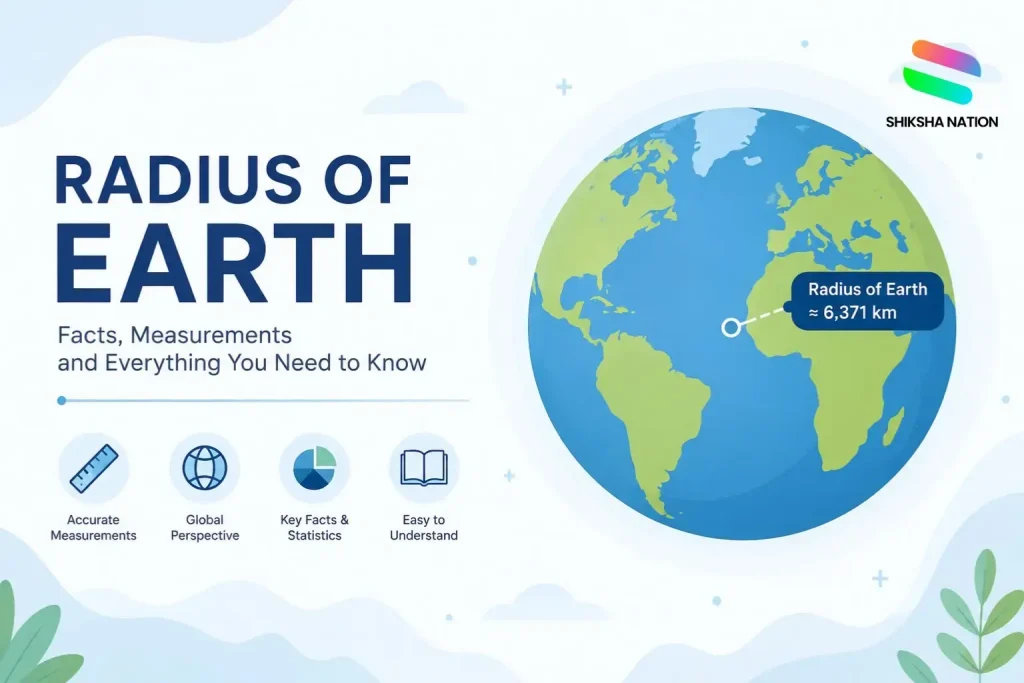
What is the Radius of Earth?
The radius of Earth refers to the distance from the center of Earth to any point on its outer surface. Since Earth is not a perfect sphere, the radius changes slightly depending on the location.
The accepted average radius of Earth is: 6,371 km
This value is commonly used in geography, physics, astronomy, and engineering calculations.
Important Radius Values of Earth
| Type of Radius | Approximate Value |
|---|---|
| Mean Radius of Earth | 6,371 km |
| Equatorial Radius | 6,378 km |
| Polar Radius | 6,357 km |
| Radius in Meters | 6.371 × 10⁶ m |
| Radius in Miles | 3,959 miles |
The radius of Earth in kilometers is often rounded to 6,400 km in school-level numerical problems.
Difference Between Radius and Diameter of Earth
Many students confuse the radius of Earth with the diameter of Earth. Both measurements are related, but they are different.
- Radius: Distance from the center of Earth to the surface.
- Diameter: Distance from one side of Earth to the opposite side through the center.
The relationship between diameter and radius is:
D = 2R
Where:
- D = Diameter
- R = Radius
The diameter of Earth is approximately 12,742 kilometers.
Radius of Earth in Different Units
The radius of Earth can be expressed in different units according to the field of study. Scientists, engineers, astronomers, and students often use different measurement systems.
Radius of Earth in Kilometers
The standard radius of Earth in kilometers is:
6,371 km
This value is commonly used in geography and earth science.
Radius of Earth in Meters
The radius of Earth in meters is:
6.371 × 10⁶ m
This unit is mostly used in physics formulas and scientific calculations.
Radius of Earth in Centimeters
The radius of Earth in centimeters is approximately:
637,100,000 cm
This unit is mainly used in conversion-based questions.
Radius of Earth in Miles
The radius of Earth in miles is approximately:
3,959 miles
This measurement is widely used in countries that follow the imperial system.
Radius of Earth in Scientific Notation
Scientific notation is useful for representing large values in a shorter form.
The scientific notation of Earth’s radius is:
6.371 × 10⁶ m
The order of magnitude of the radius of Earth is 106.
Equatorial Radius and Polar Radius of Earth
Earth is slightly flattened at the poles and bulged at the equator. Because of this shape, the radius of Earth is not exactly the same everywhere.
Equatorial Radius of Earth
The equatorial radius is the distance from the center of Earth to the equator.
Equatorial Radius = 6,378 km
Polar Radius of Earth
The polar radius is the distance from the center of Earth to the poles.
Polar Radius = 6,357 km
Why are the Two Radii Different?
Earth rotates continuously around its axis. Due to this rotation, centrifugal force acts more strongly near the equator. As a result, Earth bulges outward slightly at the equator and becomes flattened near the poles.
Difference Between Equatorial and Polar Radius
| Feature | Equatorial Radius | Polar Radius |
|---|---|---|
| Approximate Value | 6,378 km | 6,357 km |
| Location | Equator | Poles |
| Shape Effect | Bulged | Flattened |
| Main Cause | Rotation | Compression |
The difference between these two values is small but important in satellite navigation, astronomy, and earth measurement studies.
Radius of Earth in Physics
The radius of Earth is widely used in physics formulas related to gravity, planetary motion, and satellite science.
Gravitational Force Formula
Newton’s law of gravitation uses Earth’s radius in calculations.
F = GMm / R2
Where:
- F = Gravitational force
- G = Universal gravitational constant
- M = Mass of Earth
- m = Mass of object
- R = Radius of Earth
This formula shows that gravitational force depends on the square of Earth’s radius.
Acceleration Due to Gravity
The formula for acceleration due to gravity is:
g = GM / R2
This equation explains how Earth’s mass and radius determine the value of gravity.
Escape Velocity
Escape velocity is the minimum speed required to leave Earth’s gravitational field.
The formula is:
v = √(2GM / R)
This formula also includes the radius of Earth.
Satellite Motion
Satellites revolve around Earth at a certain orbital radius measured from Earth’s center. Therefore, the radius of Earth is important in communication systems, GPS technology, weather forecasting, and space missions.
Mass and Radius of Earth
The mass and radius of Earth are connected in many scientific calculations related to gravity and planetary science.
Standard Values
| Quantity | Value |
|---|---|
| Mass of Earth | 5.97 × 1024 kg |
| Mean Radius of Earth | 6.371 × 10⁶ m |
| Density of Earth | 5.51 g/cm3 |
Scientists use these values to calculate gravity, density, orbital motion, and planetary structure.
Radius of Earth Related Numerical Problems
Questions related to Earth’s radius are common in school exams and competitive examinations. These problems mainly involve gravity, density, escape velocity, and planetary motion.
If Radius of Earth Shrinks
If the radius of Earth becomes smaller while the mass remains constant, gravity on Earth increases.
According to the formula:
g ∝ 1 / R2
This means:
- If radius decreases, gravity increases.
- If radius increases, gravity decreases.
Example Concept
If the radius of Earth shrinks to half its original value, gravity becomes four times stronger because gravity depends on the square of the radius.
Radius and Density Relationship
Density is related to mass and volume.
The density formula is:
ρ = M / V
Since the volume of a sphere depends on radius, changes in Earth’s radius also affect its density.
Radius Contraction Problems
Some conceptual problems ask what happens if the radius of Earth contracts by a small amount. These questions help students understand the relationship between gravity, density, and planetary structure.
Radius of Earth Compared with Other Celestial Bodies
Comparing Earth’s radius with other planets and celestial bodies helps scientists understand planetary size and structure.
Radius of Earth and Moon
| Celestial Body | Approximate Radius |
|---|---|
| Earth | 6,371 km |
| Moon | 1,737 km |
The Moon’s radius is much smaller than Earth’s radius.
Earth Compared with Other Planets
| Planet | Approximate Radius |
|---|---|
| Mercury | 2,440 km |
| Venus | 6,052 km |
| Earth | 6,371 km |
| Mars | 3,390 km |
| Jupiter | 69,911 km |
Jupiter is the largest planet in the solar system, while Earth is considered a medium-sized planet.
Radius of Earth’s Core
Earth is made of different internal layers. These layers include the crust, mantle, outer core, and inner core.
Layers of Earth
| Layer | Approximate Thickness |
|---|---|
| Crust | 5–70 km |
| Mantle | 2,900 km |
| Outer Core | 2,200 km |
| Inner Core | 1,220 km |
Scientists study Earth’s internal structure using seismic waves generated during earthquakes.
Importance of Earth’s Radius
The radius of Earth is important in many scientific and practical applications.
Uses in Geography
- Helps in map-making
- Used in measuring Earth’s surface
- Helps calculate distances between places
Uses in Physics
- Used in gravity calculations
- Important for satellite motion
- Used in escape velocity formulas
Uses in Astronomy
- Helps compare planets
- Used in orbital calculations
- Important in space missions
Uses in Navigation and Engineering
- GPS systems depend on Earth’s measurements
- Aviation calculations use Earth’s radius
- Satellite communication requires accurate Earth data