
Exams are a major part of every student’s life. From school tests to competitive entrance exams like JEE, NEET, UPSC, and SSC, students regularly go through different types of examinations. But one question that almost every student has asked at least once is, who invented exams?
The concept of exams is commonly linked to Henry Fischel, but the real history of exams is much older and more interesting. Ancient China played a huge role in developing the first examination system in the world. In this article, you will learn who invented exams, how exams started, why they were created, and how the examination system reached India.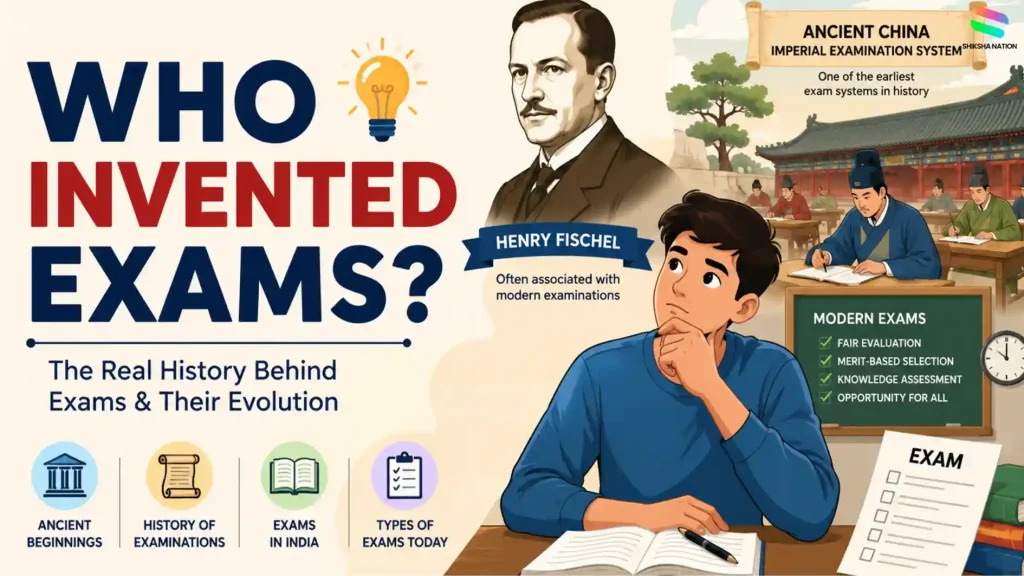
Who Invented Exams?
The question “who invented exams” is often answered with the name Henry Fischel, an American businessman and philanthropist who is popularly associated with modern examinations. However, historians believe that examination systems already existed much earlier in ancient China.
The earliest known examination system was the Imperial Examination System of China. It was used to select government officials based on merit and knowledge. This system later influenced many countries and eventually shaped the modern examination process used today.
So, while Henry Fischel is widely connected with the idea of modern exams, the actual history of exams started centuries earlier.
Do Check: Class 9th Maths Notes | Score Good Marks in Exam
Every Student Has Asked “Who Invented Exams”?
At some point during school life, almost every student wonders who invented exams and why students have to give so many tests. During board exams, unit tests, entrance preparation, and result season, this question becomes even more relatable.
Indian students deal with:
- Exam pressure
- Marks competition
- Parent expectations
- School rankings
- Entrance exam stress
Because of this, students often search for the history of exams out of frustration, curiosity, or general interest. Some students even search this topic for assignments, debates, projects, and school presentations.
The truth is that exams were not originally created to stress students. They were introduced as a way to evaluate knowledge, skills, and capability fairly among large groups of people.
Did Henry Fischel Really Invent Exams?
When searching who invented exams, the name Henry Fischel appears on most websites. But there is an important detail many articles miss.
There is no strong historical proof that Henry Fischel created the very first exam system in the world. He is mainly associated with modern examination practices and educational reforms. Many educational websites simplified the answer over time, which created confusion among students.
The real origin of exams can actually be traced back to ancient China.
The Chinese Imperial Examination System existed more than a thousand years ago. It was developed to select talented candidates for government jobs. Instead of choosing people based only on family background or wealth, candidates had to pass exams to prove their abilities.
This system became one of the earliest examples of merit based selection in education and administration.
So if someone asks who created exams, the more accurate answer is:
- Ancient China developed the earliest examination system
- Henry Fischel is popularly associated with modern exams
This balanced explanation is historically more accurate.
Who Invented Exams in India?
The history of exams in India became more organized during British rule. Before that, traditional Indian education mostly focused on oral learning, practical knowledge, and teacher-based evaluation systems.
Modern competitive examinations were introduced in India during the 19th century.
In 1853, the British government started a competitive examination system for civil services. Earlier, many officials were selected through nominations, but later exams became an important method for recruitment.
The Indian Civil Services Examination was heavily inspired by the British examination system, which itself had roots connected to the Chinese Imperial Examination model.
Over time, the examination system in India expanded rapidly.
Today, India conducts some of the largest competitive exams in the world, including:
- UPSC
- JEE
- NEET
- SSC
- CUET
- CAT
- GATE
So when students search who invented exams in India, the answer is closely linked to the British administration and the introduction of civil service examinations.
How Exams Started in Ancient China
The real history of exams began in ancient China through the Imperial Examination System. This examination system became popular during the Sui Dynasty and later expanded under the Tang Dynasty.
The purpose of these exams was to recruit skilled and educated individuals for government administration.
Candidates were tested on subjects like:
- Writing
- Philosophy
- Law
- Governance
- Literature
The examination process was extremely competitive. Students spent years preparing for these tests because passing the exam could completely change their social status and career opportunities.
The Imperial Examination System introduced several ideas that are still used in modern exams:
- Merit based selection
- Written testing
- Standard evaluation
- Competitive ranking
- Government recruitment exams
Many historians believe this was the foundation of modern examination systems used around the world today.
That is why the discussion around who invented exams cannot be completed without mentioning ancient China.
Interesting Facts About Exams
Here are some surprising facts related to the history of exams and study systems.
| Fact | Details |
|---|---|
| First examination system | Ancient China introduced one of the earliest known exam systems |
| Most competitive exams | India conducts some of the world’s largest exams like UPSC and JEE |
| Oldest purpose of exams | Government recruitment and merit based selection |
| Early exam subjects | Philosophy, governance, writing, and literature |
| Modern exam influence | Chinese examination methods influenced many countries |
| Competitive exam growth | Competitive exams increased rapidly during British rule |
| Largest student participation | Indian board and entrance exams involve millions of students every year |
These facts make the topic who invented exams much more interesting than it first appears.
Why Were Exams Created in the First Place?
Many students think exams exist only to increase stress, but the original purpose of examinations was different.
Exams were created to:
- Measure knowledge
- Compare performance
- Select qualified candidates
- Improve educational standards
- Create fair recruitment systems
Without exams, it becomes difficult for schools, colleges, and organizations to evaluate students fairly on a large scale.
For example:
- Schools use exams to track learning progress
- Universities use entrance exams for admissions
- Government jobs use competitive exams for selection
- Professional institutions use tests to check skills and qualifications
The examination system was designed to create structured academic evaluation rather than random selection.
Even though exam pressure is a real issue for many students today, exams still play an important role in educational development and career opportunities.
Different Types of Exams in India
India has different categories of examinations for schools, colleges, careers, and government recruitment.
Here are some major types of exams in India.
| Exam Type | Purpose | Conducted By |
|---|---|---|
| Board Exams | School evaluation for Class 10 and 12 | CBSE, ICSE, State Boards |
| JEE | Engineering admissions | National Testing Agency |
| NEET | Medical admissions | National Testing Agency |
| UPSC | Civil services recruitment | UPSC |
| SSC | Government job recruitment | Staff Selection Commission |
| CUET | University admissions | NTA |
| CAT | MBA admissions | IIMs |
| GATE | Postgraduate engineering admissions | IITs |
Competitive exams have become a major part of the Indian education system. Every year, millions of students prepare for these exams to secure college admissions and government jobs.
Because of this, many students again start wondering who invented exams after spending months preparing for them.
Are Exams Important for Students?
Exams can be stressful, but they also help students develop discipline, preparation habits, time management, and problem solving skills.
A good examination system helps:
- Identify strengths and weaknesses
- Improve focus
- Encourage consistent learning
- Prepare students for future competition
At the same time, excessive pressure and unhealthy competition can negatively affect students mentally and emotionally.
That is why modern education systems are slowly focusing on:
- Skill based learning
- Concept understanding
- Practical knowledge
- Reduced rote learning
The future of examinations may become more balanced, flexible, and student friendly.