
Ever wondered how many minutes in a day?
The answer is simple:
There are 1,440 minutes in a day.
This is calculated by multiplying:
- 24 hours in a day
- 60 minutes in one hour
Formula:
24 × 60 = 1,440 minutes
So, a full day contains exactly 1,440 minutes. This basic time conversion is useful in maths, productivity tracking, study planning, screen-time calculation, and daily scheduling.
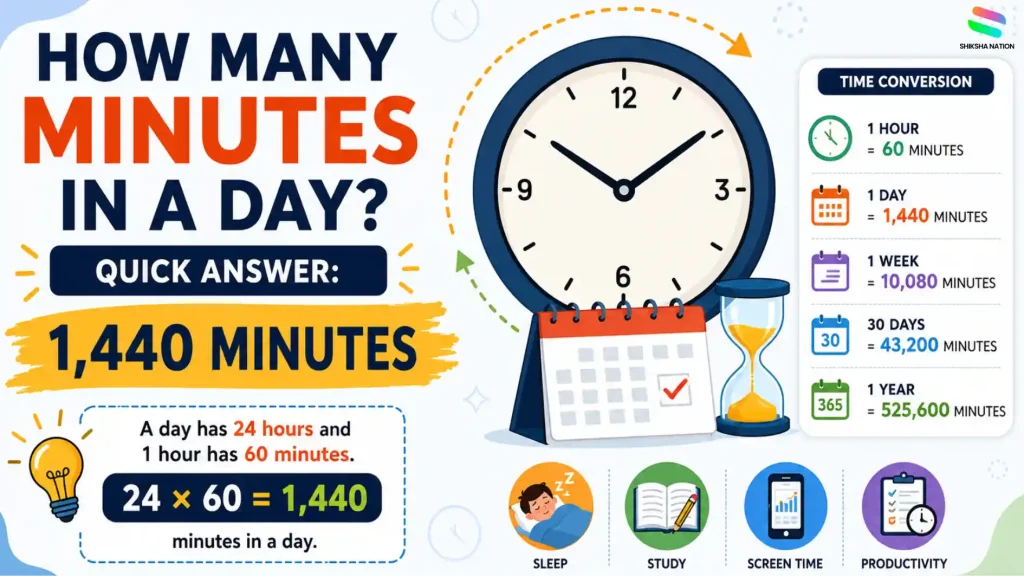
Time Conversion Table
| Time Unit | Value |
|---|---|
| 1 Day | 24 Hours |
| 1 Day | 1,440 Minutes |
| 1 Day | 86,400 Seconds |
| Half Day | 720 Minutes |
| 1 Week | 10,080 Minutes |
Time conversion becomes easy when you understand the relationship between hours, minutes, and seconds. Since every hour contains 60 minutes, multiplying the total hours in a day gives the total minutes in a day.
How to Calculate Minutes in a Day
If you want to understand how many minutes are in a day instead of just memorizing the answer, follow this easy step-by-step method.
Step 1: Know the Number of Hours in a Day
A standard day contains:
24 hours
Step 2: Know the Number of Minutes in One Hour
Every hour has:
60 minutes
Step 3: Multiply Both Values
Now multiply:
24 × 60
Calculation:
24 × 60 = 1,440
So, there are:
1,440 minutes in one day
This formula is one of the most common examples of time conversion used in schools and daily life. Once you understand this method, converting hours into minutes becomes very easy.
Why Does a Day Have 1,440 Minutes?
Most people know the answer, but very few know why a day has 1,440 minutes.
The concept of dividing time into 60-minute units comes from the ancient Babylonian number system. Thousands of years ago, Babylonians used a base-60 system instead of the modern base-10 system we use today.
That is why:
- 1 hour = 60 minutes
- 1 minute = 60 seconds
Later, clocks and calendars were designed around this system because 60 is easy to divide into smaller equal parts like:
- 2
- 3
- 4
- 5
- 6
- 10
- 12
A full day was divided into:
- 24 hours
- each hour into 60 minutes
Which finally gives:
24 × 60 = 1,440 minutes
Interesting thing is, even after so many centuries, the same time system is still used worldwide today.
Real-Life Examples of 1,440 Minutes
We usually don’t think about minutes in a full day, but they actually affect almost every part of our routine.
Sleep Example
Doctors often recommend around 8 hours of sleep daily.
Convert it into minutes:
8 × 60 = 480 minutes
That means you spend around 480 minutes sleeping every day.
School Study Example
Suppose a student studies for:
- 5 hours in school
- 2 hours at home
Total study time:
7 × 60 = 420 minutes
So, a student may spend around 420 minutes studying daily.
Screen Time Example
Mobile phones now show daily screen-time reports.
If your screen time is:
6 hours
Then in minutes:
6 × 60 = 360 minutes
Sometimes people don’t realize how quickly minutes add up during the day.
Productivity Planning
Many productivity experts divide the entire day into blocks of minutes instead of hours because minutes feel more practical and measurable.
For example:
- 30-minute workout
- 45-minute class
- 15-minute break
- 25-minute Pomodoro sessions
This makes daily planning easier and more realistic.
Minutes in Other Time Periods
After understanding how many minutes in a day, many students also want to know conversions for weeks, months, and years.
Minutes Conversion Table
| Time Period | Minutes |
|---|---|
| 1 Hour | 60 Minutes |
| 1 Day | 1,440 Minutes |
| 1 Week | 10,080 Minutes |
| 30 Days | 43,200 Minutes |
| 1 Year | 525,600 Minutes |
How Many Minutes in a Week?
A week contains:
7 days
So:
7 × 1,440 = 10,080 minutes
How Many Minutes in a Year?
A normal year has:
365 days
Calculation:
365 × 1,440 = 525,600 minutes
That’s actually a huge number when you think about it.
Common Mistakes Students Make in Time Conversion
Time conversion looks easy, but small mistakes happen very often.
1. Forgetting to Multiply by 60
Some students directly write:
24 minutes
instead of multiplying by 60.
Correct method:
24 × 60 = 1,440
2. Confusing Minutes and Seconds
Many students accidentally use:
24 × 100
because they think time follows the decimal system. But time uses a 60-based system.
3. Wrong Week Calculations
Sometimes students calculate weekly minutes incorrectly by multiplying only hours.
Correct formula:
7 × 1,440
Facts About Minutes in a Day
- A full day contains 1,440 minutes
- A half day contains 720 minutes
- One hour contains 60 minutes
- One day also contains 86,400 seconds
- One week has 10,080 minutes
- 12 hours equal 720 minutes
- 48 hours equal 2,880 minutes
These small facts are useful in maths problems, competitive exams, and daily calculations.
How Many Minutes in a Day related FAQ’s
How many minutes are in 24 hours?
There are 1,440 minutes in 24 hours. You can calculate it by multiplying 24 hours by 60 minutes.
Why are there 1,440 minutes in a day?
A day has 1,440 minutes because one day contains 24 hours and each hour contains 60 minutes. The system comes from the ancient base-60 time system.
How many seconds are in a day?
There are 86,400 seconds in a day.
Formula:
24 × 60 × 60 = 86,400
How do you convert days into minutes?
To convert days into minutes, multiply the number of days by 1,440.
Example:
2 days × 1,440 = 2,880 minutes
How many minutes are in half a day?
Half a day means 12 hours.
Calculation:
12 × 60 = 720 minutes
So, half a day contains 720 minutes.
How many minutes are in a week?
There are 10,080 minutes in a week.
Formula:
7 × 1,440 = 10,080
Conclusion
Now you know exactly how many minutes in a day and how to calculate it easily.
A standard day contains:
1,440 minutes
using the formula:
24 × 60 = 1,440
Understanding time conversion is useful not just in maths, but also in daily life, productivity planning, study schedules, workouts, and even screen-time management. Instead of memorizing the answer only, try understanding the logic behind it. That makes calculations much easier later.