11 Questions Available
Showing 11 questions on this page
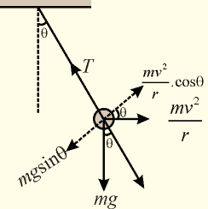
An electric bulb suspended from the roof of a railway train by a flexible wire shifts through an angle of 19°48’, when the train goes horizontally round a curved path of 200 m radius. Find the speed of the trains.
An aeroplane flying in the sky dives with a speed of 360 kmh–1 in a vertical circle of radius 200m. The weight of the pilot sitting in it is 75 kg. Calculate the force with which the pilot presses his seat when the aeroplane is
(i) at the highest position and
(ii) at the lowest position of the circle. Take g = 10 ms–2
A lift of mass 2000 kg is supported by thick steel ropes. If maximum upward acceleration of the lift be 1.2 ms–2, and the breaking stress for the ropes be 2.8 × 10⁸ Nm–2, what should be the minimum diameter of rope?
In terms of masses m1, m2 and g, find the acceleration of both the blocks shown in figure. Neglect all friction and masses of the pulley.
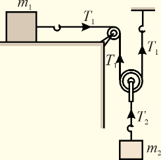
A body m1 of mass 10 kg is placed on a smooth horizontal table. It is connected to a string which passes over a frictionless pulley and carries at the other end, a body m2 of mass 5 kg. What acceleration will be produced in the bodies when the nail fixed on the table is removed? What will be the tension in the string during the motion of the bodies? What when the bodies stop? Take g = 9.8N kg–1
Two blocks of masses 50 kg and 30 kg connected by a massless string pass over a light frictionless pulley and rest on two smooth planes inclined at angles 30° and 60° respectively with the horizontal. Determine the acceleration of the two blocks and the tension in the string. Take g = 10 ms–2.
What is the acceleration of the block and the trolley system shown in figure, if the coefficient of kinetic friction between the trolley and the surface is 0.04? What is the tension in the string? Take g = 10 ms–2. Neglect the mass of the string.
A ball moving with a momentum of 5 kg ms–1 strikes against a wall at an angle of 45° and is reflected at the same angle. Calculate the change in momentum.
A body of mass 1 kg initially at rest explodes and breaks into three fragments of masses in the ratio 1:1:3. The two pieces of equal mass fly off perpendicular to each other with a speed of 30ms–1 each. What is the velocity of the heavier fragment?
A balloon with mass M is descending down with an acceleration a, where a < g What mass m of its contents must be removed so that it starts moving up with acceleration a?
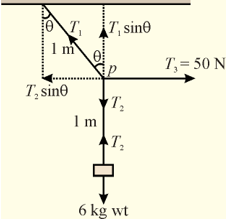
A mass of 6 kg is suspended by a rope of length 2 m from a ceiling. A force of 50N in the horizontal direction is applied at the midpoint of the rope as shown in figure. What is the angle the rope makes with the vertical in equilibrium? Take g = 10ms–2. Neglect mass of the rope.