An electric bulb suspended from the roof of a railway train by a flexible wire shifts through an angle of 19°48’, when the train goes horizontally round a curved path of 200 m radius. Find the speed of the trains.
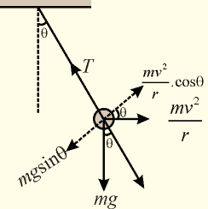
Various forces acting on the bulb are shown in figure. Resolving the forces along the length and perpendicular to the wire, we get
mg sin θ = (mv² / r) cos θ
or
tan θ = v² / (rg)
or
v = √(rg tan θ) = √(200 × 9.8 × tan 19° 48′)
= √(200 × 9.8 × 0.3600) = √705.6
= 26.56 ms⁻¹

