10 Questions Available
Showing 10 questions on this page
An apple of mass 0.25 kg falls from a tree. What is the acceleration of the apple towards the Earth? Also calculate the acceleration of the Earth towards the apple. Given: Mass of Earth = 5.983 × 1024 kg, Radius of Earth = R = 6.378 × 10⁶ metre, G = 6.67 × 10⁻¹¹ N m2 kg-2.
Find the % decrease in weight of a body, when taken 16 km below the surface of earth. Take radius of earth = 6400 km.
Mass of a body is m on the surface of earth. What will be its weight on surface of earth and at height h = R/100 above the surface of earth.
Calculate the force of attraction between two bodies, each of mass 100 kg and 1 m apart on the surface of the Earth. Will the force of attraction be different if the same bodies are taken on the Moon, their separation remaining constant.
A sphere of mass 40 kg is attracted by another sphere of mass 15 kg with a force of 1 / 10 mg wt. Find the value of constant of gravitation if centres of spheres are 0.2 m apart.
Find the work done in bringing three particles, each having a mass of 0.1 kg from large distance to the vertices of an equilateral triangle of 10 cm in a gravity free region. Assume that no change of kinetic energy is involved in the bringing particles.
The work done in lifting a body of mass ‘m’ from the earth’s surface, through a height ‘h’ is mg R/3 where ‘g’ is the acceleration due to gravity on the earth’s surface and ‘R’ is the radius of the earth. Calculate the value of h.
Three identical solid spheres each of mass “m” and radius “R” are released from positions as shown in the figure (assume no external gravitation). What would be the speed of any of three spheres just before they collide.
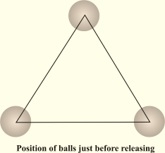
Three mass points each of mass ‘m’ are placed at the vertices of an equilateral ∆ of side l. What is the gravitational field & potential due to three masses at the centroid of ∆ ?

