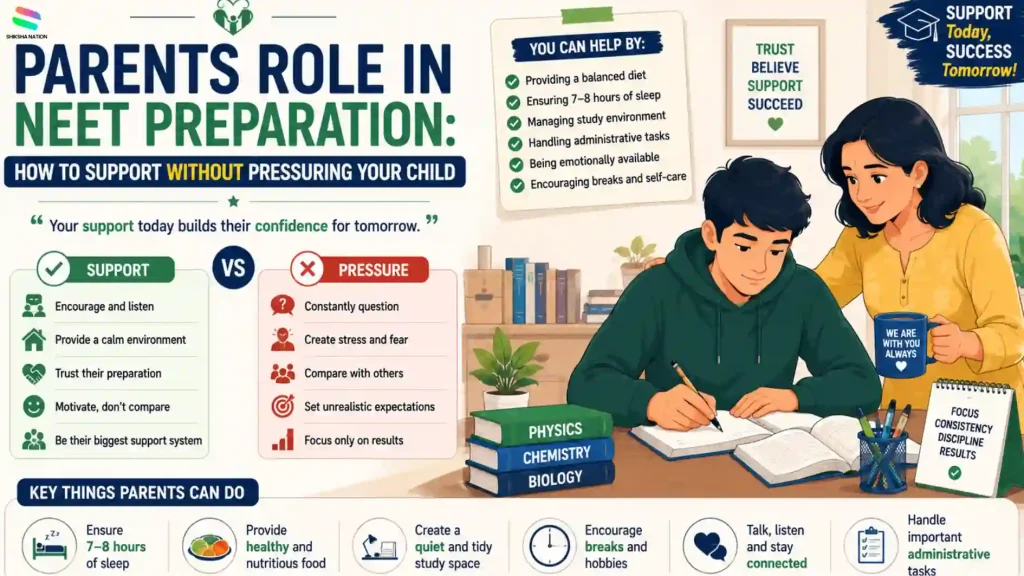
Parents can support a NEET aspirant most effectively by managing the logistics (meals, sleep, a quiet study space, and household calm) while staying out of academic micromanagement. The role is to create the conditions for focus, not to control the process. That shift, from manager to supporter, is what protects both the child’s performance and your relationship with them.

Why Parental Involvement Matters (And Where It Usually Goes Wrong)
NEET is one of the most competitive entrance exams in India. Roughly 20 lakh candidates appear each year for a limited pool of MBBS seats, which means the margin for error feels very thin and the stakes feel very high, especially at home.
Your child spends far more hours at home than at coaching. You are the emotional baseline they return to every single day. When that baseline is calm and steady, it acts like a cushion against the exam’s natural anxiety. When it is charged with worry, comparison, or unspoken expectation, it adds another layer of stress on top of an already demanding process.
The issue is rarely that parents care too much. Caring is good. The issue is that caring often gets expressed in ways that feel controlling to the student: checking study hours, questioning every mock score, making every dinner conversation about NEET, or comparing your child to a neighbor’s son who “scored 670 last year.” None of these behaviors come from bad intentions, but they tend to produce the same outcome. A student who feels watched rather than supported.
Do Check: Eligibility of NEET 2026 / Check NEET Result 2026 Scorecard, AIR, Cutoff, Result Link and other latest things / How AIR – 1 2026 Prepared for NEET / Know how to balance NEET coaching and School / NEET 2026 Toppers List / State Quota NEET Eligibility
The Difference Between Support and Pressure
This is the most important distinction to understand. Support increases a student’s sense of confidence and autonomy. Pressure increases their sense of being monitored and judged. They often look identical on the surface, which is why parents are sometimes genuinely puzzled when their child pulls away.
The same sentence, said in the wrong tone or at the wrong moment, can cross from support into pressure instantly.
| Situation | Pressuring Behavior | Supportive Behavior |
| After a bad mock score | “How did you score so low? You studied all week.” | “That was a tough one. What felt hardest, Physics or Bio?” |
| Before the exam | “You have to get into AIIMS. We’ve invested so much.” | “You’ve worked hard. Go in and give it your best shot.” |
| During study time | Checking in every hour, asking if they’ve covered X chapter | Making sure the space is quiet, and stepping out |
| At the dinner table | “Beta, tell me what you revised today.” | Keeping dinner conversation light and exam-free |
| When they want a break | “You can relax after NEET, not now.” | “Take your 30 minutes. You’ve been at it for three hours.” |
| Seeing a peer’s result | “Look at Sharma uncle’s son, he got 680 last attempt.” | Saying nothing about other students unless your child brings it up |
| During a motivation dip | “Others aren’t sleeping. You need to push harder.” | “What’s feeling heavy right now? Can I help with something?” |
The right column doesn’t mean pretending NEET doesn’t exist. It means engaging with your child’s actual experience rather than reacting to your own anxiety about the outcome.
Practical Ways Parents Can Help Without Micromanaging Academics
There is real, concrete support parents can offer that makes a measurable difference in a student’s preparation quality. None of it involves reviewing their notes or quizzing them on chapters.
| Support Category | What Parents Can Do |
| Physical and Logistics | Ensure 7-8 hours of sleep by keeping the household quiet after a set time. Plan meals with adequate protein and complex carbohydrates. Reduce errand-running and extra household duties during peak prep months. |
| Study Environment | Set up a dedicated, low-distraction workspace. Manage sibling noise and household activity levels. Limit TV and loud conversations in common areas during study hours. |
| Emotional Availability | Check in once a day with a single, low-pressure question like “How are you feeling about things?” Be available to listen without immediately jumping to solutions. |
| Social and Mental Health | Allow one social outing or leisure activity per week. Avoid guilt-tripping short breaks. Treat rest as part of preparation, not the opposite of it. |
| Academic Boundaries | Do not ask for subject-by-subject progress updates. Trust the coaching faculty and the student’s own revision plan. Resist the urge to buy extra books or enroll them in additional courses unless they specifically ask. |
| Administrative Tasks | Handle exam registration deadlines, fee payments, and document requirements yourself. This is real, tangible support that lifts cognitive load from the student. |
The practical truth is this: most students who clear NEET aren’t being lectured by their parents every evening. They’re being given stability, space, and the quiet confidence that someone at home is on their side regardless of how the exam goes.
How to Talk About NEET at Home
Language matters more than most parents realize. A single sentence said in the wrong moment can sit in a student’s head for days and surface at the exact moment they need focus.
Five phrases to stop using at home:
- “If you don’t clear NEET, your future is over.” (This is factually incorrect and builds catastrophic thinking that is hard to undo.)
- “We’ve sacrificed so much for this. Don’t waste it.” (This transfers the emotional weight of your investment onto your child’s shoulders, where it does not belong.)
- “Why are you so slow? Other students finish faster.” (Comparison almost always destroys motivation during exam prep rather than building it.)
- “You’re clearly not studying enough. I can tell.” (Unsolicited judgments about effort breed defensiveness, not effort.)
- “Just tell me your mock score. I promise I won’t react.” (And then reacting. Students stop sharing entirely after this happens once.)
What works instead is staying curious rather than evaluative. “What went well this week?” lands completely differently from “Why haven’t you finished Genetics yet?” Asking what they need, rather than telling them what to do, preserves both the relationship and the trust.
If NEET dominates every family conversation, consider a deliberate policy: one meal per day is exam-free territory. Talk about anything else. Sports, a film, family news, something funny that happened. It reduces ambient pressure without signaling that you’ve stopped caring about the preparation.
Handling a Bad Mock Score or a Dip in Motivation
Every NEET aspirant hits at least one stretch where nothing clicks. Mock scores fall, motivation disappears, and the gap between current performance and the target feels impossible to close. How you respond in that window has a lasting effect.
Steps to take when your child gets a bad mock score:
- Don’t react in the first few hours. Your initial reaction sets the emotional tone for how your child processes the result.
- Ask one open question: “Do you want to talk it through, or do you need some space first?”
- If they want to talk, help them approach it analytically. Which subjects pulled the score down? Was it time management, a gap in a specific chapter, or careless errors under pressure?
- Remind them what mock tests are actually for: finding gaps before the real exam, not predicting the final result. A 530 in a mock in February says almost nothing about the May score.
- Let them lead the adjustment. Ask “What does your plan look like for this week?” rather than prescribing what they should fix.
Motivation dips are normal and cyclical. A student preparing for 12 to 18 months cannot sustain the same energy level throughout. A flat week or two is not a sign of failure. It is a sign they are human. Your role during those weeks is to reduce friction, not increase urgency.
The Emotional Weight of a Single-Day Exam
One thing that makes NEET uniquely stressful is its compressed, all-or-nothing format. Everything the student has prepared comes down to roughly three hours on a single morning. Students feel this acutely, and it builds in intensity as the exam date approaches.
Parents can help by gently reframing this without minimizing it. Acknowledge, out loud, that the exam matters and the competition is genuinely tough. Then follow that with a concrete reminder: one attempt is rarely the end of the road. NEET allows multiple attempts. Many practicing doctors cleared it on their second or third try, and that path is fully legitimate.
Avoid catastrophizing in front of your child, and avoid it in conversations with other family members too. Adolescents hear and absorb far more of what adults say around them than parents tend to assume.
When to Involve a Counselor or Professional Support
Parental support has real limits, and recognizing those limits is itself a form of good parenting. Some signs that your child may need professional help rather than just a supportive parent:
- They have stopped eating regularly or their sleep has dramatically shifted (far too much or barely at all for more than a week).
- They have expressed hopelessness, phrases like “what’s the point” or “I can’t do this anymore.”
- They are isolating from everyone, including you, and the isolation is getting more pronounced.
- Physical symptoms like frequent headaches, stomach aches, or visible panic before study sessions are appearing regularly.
- Severe mood swings have been consistent for more than two consecutive weeks.
In any of these situations, a counselor or psychologist is the appropriate next step. Many coaching institutes have in-house support. If yours doesn’t, a therapist who works with adolescents under academic pressure is worth finding. Frame it to your child as a resource, not a red flag: “A lot of serious NEET aspirants use counseling during prep. It is like having a coach for the mental side of preparation.”
What If Your Child Wants to Quit or Change Direction?
This is the conversation most NEET parents dread, and it is often handled poorly because of the emotional weight it carries. If your child says they want to stop, resist the reflex to talk them out of it immediately.
Listen first. Understand whether this is a temporary crash in motivation (which is common and manageable) or a genuine shift in what they want from their life (which is also valid). There is a real difference between “I can’t face another mock test this week” and “I don’t actually want to be a doctor.”
If it is the former, acknowledge the exhaustion and let them rest before making any decisions. If it is the latter, have a calm, unhurried conversation about alternative paths. BSc Biotechnology, Pharmacy, Physiotherapy, Veterinary Science, BDS, and paramedical sciences are all healthcare careers that don’t require the same NEET cutoff. Hospital management and healthcare research are respected fields too.
The worst outcome is not a student who changes direction. It is a student who stays on a path they don’t want because they never felt safe enough to have an honest conversation at home about it.
Setting Realistic Expectations as a Family
NEET is a single exam, but it is not a single chance, and treating it as one is one of the most damaging framings a family can adopt. Multiple attempts are common. Many dedicated medical students cleared it on their second or third try, and that is a widely accepted and normal path.
Realistic expectations to establish as a family, before the exam:
- A first attempt may not produce the target result. That is a common outcome for many well-prepared students and is not a sign of inadequate effort.
- The number of government MBBS seats is limited by design. Private medical college options exist, though they involve different financial decisions.
- If MBBS is not the immediate outcome, strong adjacent healthcare careers exist and deserve genuine consideration rather than being treated as consolation prizes.
- Your child’s self-worth and your relationship with them must not be conditional on a score. Setting that expectation before the result comes in is far more effective than trying to repair the relationship after.
Saying these things out loud, as a family, before the exam, tells your child something that no coaching class can: that your support does not have a score requirement attached to it. That clarity, more than any study tip or revision strategy, may be the single most valuable thing you can give them during NEET preparation.