Step 1: Map Your Fixed Time Blocks First
Before you plan a single study hour, lock down everything that isn’t negotiable. These are your constraints. Ignoring them is precisely how well-intentioned timetables collapse in week two.
Your fixed blocks are:
-
- School hours: Most Indian schools run from 8:00 or 8:30 AM to 2:30 or 3:30 PM on weekdays. Mark this as a solid, unbreakable block.
- Coaching hours: Whether it’s weekday evening batches (4:30-7:30 PM), Saturday/Sunday sessions, or your DLP lecture schedule, write it in.
Commute time: Be brutally honest here. A 45-minute one-way commute isn’t just 90 minutes on a clock; it’s also mental fatigue. Include it.
- Meals: Breakfast, lunch, dinner. Budget 20-30 minutes each, and don’t skip breakfast to squeeze in study time.
- Sleep: 7 to 8 hours, every night. This is not where you find extra hours. More on why in Step 6.
Add up all your fixed blocks. Whatever remains is your real, usable study bandwidth. For most Class 11 and 12 students, this works out to between 3 and 5 hours on a weekday – not 8 or 10, which is what students optimistically pencil in and then feel guilty about never hitting.
Also Check: Know Eligibility Criteria NEET 2026 / NEET 2026 Scorecard, Result link, Cut off, AIR and Latest Updates / Syllabus of NEET 2026
Step 2: Identify Your Coaching Setup: It Changes Everything
Your timetable structure depends almost entirely on which of three coaching models you’re enrolled in. The gap between setups is significant enough that a single generic schedule serves none of them well.
Setup A: Integrated School-Coaching Program. Coaching is embedded into your school day extended periods, a dedicated NEET block after school hours, or a school that operates as an integrated coaching centre. Your school-plus-coaching block can run from 8:00 AM to 5:00 PM or longer. The upside is no separate commute. The downside is that your only independent study window is the evening (roughly 6:00-10:00 PM), and it has to carry real weight.
Setup B: Separate Evening/Weekend Offline Coaching. School ends around 2:30-3:30 PM; coaching runs 4:30-7:30 PM on weekdays, with longer weekend sessions (3-6 hours each day on Saturday and Sunday). Your study windows are the gap between school and coaching (roughly 90 minutes) and the post-coaching slot from 8:00-10:30 PM. Weekends are your heaviest workload by far.
Setup C: Online/DLP (Distance Learning Programme). No fixed coaching slots. You work with recorded lectures, printed materials, and self-set deadlines. This is the most flexible model and the most dangerous – without external structure, DLP students drift. Your job is to impose the structure yourself: assign “lecture hours” as a fixed daily block and treat them exactly like a live coaching class. No pausing to scroll, no doing them at different times each day.
Step 3: Find Your Peak Focus Hours
Not all hours are equal. Two hours of focused study at 6:30 AM outperform four hours of passive re-reading after 10:00 PM when your brain is running on empty.
Most students find their best focus falls into one of these patterns:
- Early morning (5:30-7:30 AM): Sharp, quiet, no distractions. The strongest slot for Biology NCERT reading or working through Chemistry numericals.
- Post-school, pre-coaching gap (3:30-4:15 PM): Short but useful for one targeted MCQ set or a quick NCERT chapter review.
- Post-coaching evening (8:00-10:30 PM): Good for consolidating what coaching covered that day, not for starting new topics from scratch.
Whatever your sharpest hour is, put your hardest subject there. For most NEET aspirants that means Biology or Physics not administrative tasks, not copying notes, and definitely not “planning tomorrow’s schedule.”
Step 4: Build Your Weekday Timetable
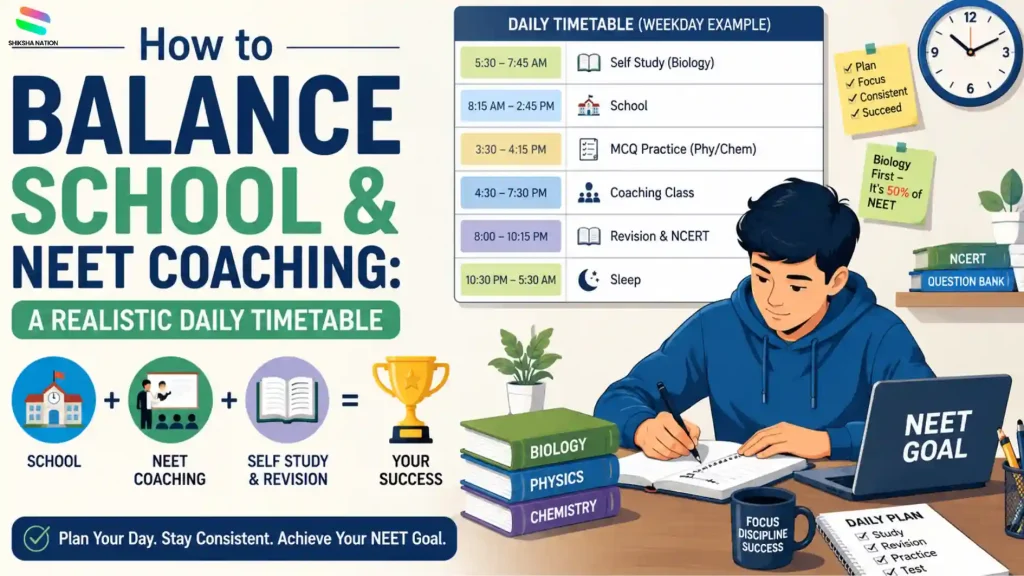
The table below is a sample weekday timetable for a Setup B student (separate evening offline coaching). If you’re in Setup A or C, see the notes below the table for how to adapt it.
| Time |
Activity |
| 5:30 – 6:30 AM |
Wake up, freshen up, 20-minute walk or light exercise |
| 6:30 – 7:45 AM |
NEET self-study Biology NCERT reading or revision (peak focus slot) |
| 7:45 – 8:15 AM |
Breakfast + commute preparation |
| 8:15 AM – 2:45 PM |
School (attend fully boards matter for NEET eligibility) |
| 2:45 – 3:30 PM |
Travel home + lunch |
| 3:30 – 4:15 PM |
Self-study Physics or Chemistry MCQ practice (45 min) |
| 4:15 – 4:30 PM |
Travel to coaching |
| 4:30 – 7:30 PM |
Coaching class (3 hours) |
| 7:30 – 8:00 PM |
Travel home + dinner |
| 8:00 – 9:30 PM |
Review coaching notes + same-day consolidation |
| 9:30 – 10:15 PM |
NCERT reading rotate subject each night (Bio / Phy / Chem) |
| 10:15 – 10:30 PM |
Tomorrow’s plan + wind down |
| 10:30 PM – 5:30 AM |
Sleep (7 hours) |
Total independent NEET study time on a weekday: 3.5 to 4 hours. That’s across three slots morning, pre-coaching, and post-coaching evening. It’s realistic. And it’s enough, if used without distraction.
Setup A adaptation: Replace the 4:30-7:30 PM coaching block with independent evening study from 6:00-10:00 PM. Use the 6:30-7:45 AM morning slot for fresh reading, not revision you’ll cover new ground faster when you’re alert.
Setup C (DLP) adaptation: Schedule recorded lectures from 4:30-6:30 PM as a fixed daily block. Treat them like a live class. Sit at your desk, no phone, take notes as you go. Use 7:30-10:00 PM for MCQ practice and consolidation on the same material.
Step 5: Build Your Weekend Timetable
Weekends are not a break they’re your biggest study window of the week. For offline coaching students in particular, Saturday and Sunday carry extended coaching sessions, weekly tests, and the kind of deep revision that 45-minute weekday slots can’t hold.
| Time |
Saturday |
Sunday |
| 5:30 – 6:30 AM |
Wake up + light exercise |
Wake up + light exercise |
| 6:30 – 8:00 AM |
Self-study: Biology (NCERT + MCQs) |
Weak-area revision one subject only |
| 8:00 – 8:30 AM |
Breakfast |
Breakfast |
| 8:30 AM – 1:00 PM |
Extended coaching session (4-4.5 hrs) |
Full-length mock test (timed, 180 Qs, 3 hrs) |
| 1:00 – 2:00 PM |
Lunch + genuine rest |
Lunch + break |
| 2:00 – 4:00 PM |
Coaching test or practice paper (timed) |
Mock test analysis every wrong answer reviewed |
| 4:00 – 5:00 PM |
Travel home + snack |
Update error log (notebook of recurring mistakes) |
| 5:00 – 7:00 PM |
Deep revision: Physics (theory + numericals) |
Chemistry revision (Inorganic = NCERT only) |
| 7:00 – 7:30 PM |
Dinner |
Dinner |
| 7:30 – 9:30 PM |
Biology: Mixed chapter MCQ practice |
Weekly review – completed vs. planned |
| 9:30 – 10:15 PM |
Wind down: light NCERT re-read |
Set next week’s targets |
| 10:15 PM onward |
Sleep |
Sleep |
Weekend independent study time: 8-10 hours across both days, on top of coaching. This is where real separation between students happens not in how many coaching hours they attend, but in how deliberately they use the time around those hours.
Step 6: Protect Sleep and Recovery – Non-Negotiable
Seven to eight hours of sleep is when memory consolidation actually happens. NEET is a recall exam under speed pressure: 180 questions in 3 hours, which is one question per minute. The Biology diagram you revised at 6:30 AM has to be retrievable at 11:45 AM on exam day under pressure. That retrievability is built during sleep, not during a sixth hour of night-time studying.
Here are five signs your timetable is breaking down at the recovery level:
- You regularly sleep after midnight and wake before 5:30 AM.
- You fall asleep during coaching classes more than once a week.
- You feel mentally foggy before 8:00 PM most evenings.
- You’re using caffeine to stay awake during post-coaching self-study.
- You feel more exhausted on Monday morning than on Friday evening.
If three or more of these are true, your timetable is unsustainable. The fix isn’t motivation or discipline it’s cutting study time, not sleep.
Step 7: Sync With Board Exams – Two Targets, One Calendar
Most timetable guides skip this entirely, which is a real problem. You’re not just preparing for NEET. You’re simultaneously preparing for Class 11 and Class 12 board exams and NEET requires a minimum of 50% aggregate in Physics, Chemistry, and Biology in Class 12 boards for eligibility. Fall below that cutoff and your NEET score becomes irrelevant.
The practical solution: NCERT is your shared resource. NEET’s entire syllabus is drawn from Class 11 and 12 NCERT. Every time you revise an NCERT chapter for NEET, you’re also revising for boards. The content isn’t in conflict the testing format is. Boards require long-answer writing, labelled diagrams, and derivations. NEET requires MCQ speed and elimination under a -1 negative marking system.
Dedicate one weekly slot Sunday evening works well specifically to board-format practice: Write out full answers, draw and label diagrams, practise Physics derivations by hand. Keep this separate from MCQ practice rather than mixing them in the same session.
During board exam months (typically January-March in Class 12), reduce full NEET mock test frequency temporarily and shift that time toward board-format writing. Resume full mock cadence as soon as boards end the NEET exam window gives you a few weeks to re-sharpen MCQ speed.
Step 8: Review, Adjust, and Repeat Weekly
A timetable is a working draft, not a finished document. The one you write today will need revision by next Sunday and that’s not a failure, it’s the process working correctly.
Every Sunday evening, run a 15-minute timetable audit using these five questions:
- What did I actually complete versus what I planned? Be honest not self-critical.
- Which subject got skipped or shortchanged most often? That’s your protected slot for next week.
- Did I average at least 7 hours of sleep? If not, what ran over and was it worth it?
- What was my biggest time leak? Unplanned phone use, extended commute, long meal breaks name the actual culprit.
- What one thing will I change in next week’s timetable? One adjustment is sustainable. Overhauling everything every week isn’t.
Keep the review under 15 minutes. The goal isn’t a forensic post-mortem it’s a slightly better timetable for the week ahead.
How to Balance School and NEET Coaching related FAQs