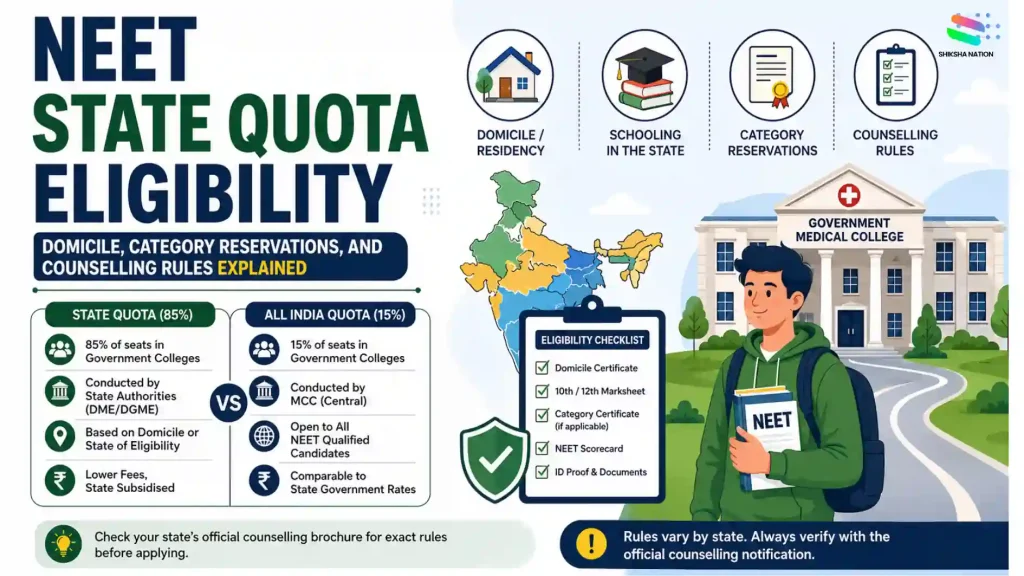
State quota in NEET refers to 85% of government medical college seats reserved for candidates eligible in that specific state. Eligibility is determined by either domicile (residency) or state of eligibility (schooling history), depending on which state you’re applying to. Category reservations (OBC, SC, ST, EWS) apply within that state’s quota, with exact percentages set by state law.
You’ve cleared NEET. Now comes the part nobody warned you about: figuring out which seats you’re actually allowed to apply for.
The exam score is just the beginning. Before counselling opens, you need to answer a more complicated set of questions. Which state’s merit list will you appear on? Do you qualify as a state quota candidate, or do you fall under All India Quota? Is your “state of eligibility” the same as the state you’ve been living in? Does any of this change for private medical colleges?
These aren’t minor details. They determine which seats you can compete for, what rank you’ll need, and how your category certificate actually affects your chances. Getting any of it wrong means missing counselling rounds you were always entitled to enter, or wasting time applying where you simply don’t qualify.
If you’ve already read our earlier piece on private medical college fees and whether the investment makes sense, think of this as its companion: now that you know what seats cost, let’s figure out which seats you can actually reach.

What Is State Quota in NEET, and How Is It Different from All India Quota?
Every MBBS and BDS seat in a government medical college in India is divided between two pools: state quota and All India Quota (AIQ). Understanding how they split is the first thing to get right.
State quota accounts for 85% of available seats. These seats fill through each state’s own counselling process, run by the state’s Directorate of Medical Education (DME), Directorate of General Medical Education (DGME), or an equivalent body. To compete for them, you must meet that state’s eligibility criteria.
AIQ accounts for the remaining 15% of seats in government colleges. The Medical Counselling Committee (MCC) runs AIQ counselling centrally, and any NEET-qualified candidate from anywhere in India can participate. There’s no state-based eligibility restriction for AIQ seats.
That distinction matters in practice. A candidate from Rajasthan who studied in Delhi might not qualify for Rajasthan’s state quota or Delhi’s state quota, but they’re free to compete in AIQ counselling for seats across the country.
Also Read: NEET UG 2026 Topper Lists / NEET Scorecard, Result download Link, Cut off, AIR & all latest updates
State Quota vs All India Quota:
| Feature |
State Quota |
All India Quota (AIQ) |
| Seat share |
85% of government college seats |
15% of government college seats |
| Conducted by |
State DME / DGME / equivalent |
MCC (Medical Counselling Committee) |
| Eligibility basis |
Domicile or state of eligibility (state-specific) |
Open to all NEET-qualified candidates |
| Domicile requirement |
Yes, determined per state rules |
No |
| Category reservation |
Applicable (state-defined percentages) |
Applicable (central reservation policy) |
| Fee structure |
Generally lower, state-subsidised |
Comparable to state government rates |
| Private college inclusion |
Varies; some private seats fill through state counselling |
Not included in AIQ (private colleges run their own) |
Central institutions (AIIMS, JIPMER, and other centrally funded colleges) run their own separate counselling and sit outside this 85/15 split entirely.
Who Is Eligible for State Quota Seats?
This is the question most students get wrong, often because they assume the answer is obvious. It isn’t. States don’t all use the same definition of eligibility, and some are more restrictive than others.
In broad terms, a state generally qualifies you for its quota based on one or more of the following:
- Residency (domicile): You’ve lived in the state continuously for a defined period, often three to seven years, proven through residence certificates, ration cards, voter ID, property records, or continuous school records.
- Schooling-based eligibility: You studied Class 10, Class 12, or both at a recognised institution within that state. Some states treat this as the primary or sole criterion, regardless of where you currently live.
- Birth in the state: A smaller number of states accept proof of birth as one eligibility route, though this isn’t universal.
- Parent’s service record: Some states allow eligibility through a parent employed in state government service posted there, particularly relevant for defence or central government families.
Most students qualify under one criterion, but not always the one they assume. Verify your eligibility against the official counselling notification of the specific state before you count on it.
Is “State of Eligibility” the Same as Domicile? Not Exactly.
This is one of the most commonly confused points in NEET counselling, and the confusion costs students real opportunities. They’re related concepts, but not the same thing, and mixing them up can mean applying to the wrong state or missing one you were actually entitled to enter.
- Domicile is a residency concept. It means you’ve been ordinarily resident in a state for a defined period, proven with a domicile certificate issued by a state authority such as a tehsildar or SDM. A student born in Maharashtra, schooled there, and still living there clearly holds Maharashtra domicile.
- State of eligibility, as used in NEET counselling, refers to the state whose quota you’re entitled to compete in. In many states, this is decided by where you studied, specifically which board or institution awarded your Class 10 or Class 12 certificate, not simply where you live now.
Here’s a practical illustration: a student from Punjab who moved to Himachal Pradesh for Class 11 and 12 and studied at an HP Board school might be considered eligible for HP’s state quota based on schooling, even without an HP domicile certificate. That same student might not qualify for Punjab’s quota if they didn’t complete schooling there. (This is illustrative only always confirm against the current HP and Punjab DME notifications, since rules shift year to year.)
Some states even split the two definitions by seat type, requiring domicile for government seats but accepting schooling-based eligibility for a share of private college state quota seats.
Never assume your state of eligibility automatically matches your domicile or your home state. Check the current counselling notification for every state where you might plausibly qualify.
How to Check Your State Quota Eligibility: 7 Steps
- List every state where you might have a claim. Think through where you were born, where you’ve lived for three-plus consecutive years, and where you studied Classes 10 and 12.
- Download the official counselling notification for each state. Go directly to that state’s DME, DGME, or health department website – skip third-party summaries.
- Read the eligibility criteria section carefully. Note whether the state uses domicile, schooling, birth, or a combination, and which documents satisfy each.
- Gather your documents early. Typical requirements: Class 10 and 12 mark sheets, school leaving certificate, domicile or residence certificate, category certificate (if applicable), nativity or birth certificate.
- Apply for missing certificates well ahead of time. Domicile certificates in particular can take weeks to process through state authorities.
- Check category certificate validity for that state. OBC, SC, ST, and EWS certificates usually need to match the exact format the state specifies – a certificate valid in one state isn’t automatically accepted in another.
- Register for counselling in every state where you qualify, not just one. You’re not locked into a single state, and registering widely matters most when your rank sits near a cutoff.
Category Reservation in State Quota: How It Works
Within state quota seats, a portion is reserved for candidates from specific categories. The central government’s reservation framework provides the broad structure. Scheduled Castes (SC), Scheduled Tribes (ST), Other Backward Classes (OBC), and Economically Weaker Sections (EWS) all get reserved seats, but how these apply in NEET state quota counselling is a state-level function, not a central one.
Each state sets its own reservation percentages within the framework of state law and applicable court orders. A state with a larger tribal population might carry a higher ST reservation than one where tribal communities are a smaller share. Some states run additional sub-categories, including state-specific OBC lists that differ from the central OBC list.
EWS reservation, introduced in 2019 for economically weaker sections of the general category, applies in state quota counselling too. Income and asset criteria are set centrally (annual family income below ₹8 lakh, with land and property conditions), but states can add requirements around certificate format or issuing authority.
Category ranks matter here. Your NEET merit list rank and your category rank are two different numbers. When you compete for reserved seats, you’re ranked against other candidates in your category, not the open merit list, and your category rank can be considerably better than your overall rank. Know both before counselling opens; it changes your strategy.
Two points worth repeating: reservation percentages vary by state and shouldn’t be assumed from national figures, and your category certificate must be issued by the competent authority in the state you’re applying to, in the format that state requires. A mismatched certificate format is one of the most avoidable reasons candidates lose reserved seats.
Private Medical Colleges: Do Domicile and Eligibility Rules Still Apply?
They do, with variations worth understanding separately, especially if your rank falls outside government college cutoffs.
Private medical college seats generally split into three categories:
- Management quota: Filled at the college’s discretion within regulatory limits, usually without state-specific eligibility restrictions, and priced considerably higher.
- NRI quota: Reserved for NRI candidates or their relatives, with fees typically set in US dollars or equivalent.
- State quota seats in private colleges: Many states extend their counselling process to cover a portion of private college seats, sometimes 50% or more. These seats carry the same state-specific eligibility rules as government seats, you need to qualify for that state’s counselling to compete for them.
Some states run more “open” private sectors, where seats aren’t restricted to state-eligible candidates and draw applicants nationally. Tamil Nadu, Karnataka, and Maharashtra have historically had large private medical education sectors that pull students from across the country, though which seats are open versus state-restricted shifts over time and needs verification for the current year.
The fee gap between government seats, state quota private seats, and management quota seats is substantial. If you’ve read our earlier post on what private medical education actually costs across your MBBS years, you already know those numbers. This section adds the missing filter: your fee calculation only matters for seats you can actually reach, and that depends entirely on which states you’re eligible for.
NEET State Quota Eligibility related FAQs