21 Questions Available
Showing 20 questions on this page
Discuss the subjectivity of the following functions.
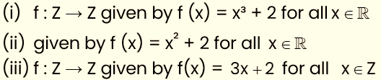
Give examples of relation which are
(i) Neither reflexive nor symmetric nor transitive.
(ii) symmetric and reflexive but not transitive.
(iii) Reflexive and transitive but not symmetric.
Check the injectivity and subjectivity of the following functions:
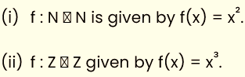
Prove that the relation R defined on set N of natural numbers by x Ry ⟺2x² – 3xy + y² = 0 i.e., by
Show that the relation R in R defined as R ={(a, b); a ≤ b} is reflexive and transitive but not symmetric
Find whether the following functions are one-one:
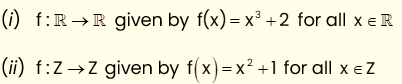
Let Z be the set of all integers. A relation R is defined on Z by x R y to mean x – y is divisible by 5. Show that R is an equivalence relation on Z.
Determine which of the following binary operations on the set N are associative and which are commutative.
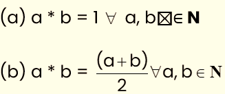
Show that the Modulus function f : R → R given by f(x) = |x|, is neither one one nor onto, where |x| is x, if x is positive or 0 and |x| is –x, if x is negative.
Let A, B are two sets, show that f : A × B → B × A. Show that f(a, b) = (b, a) is bijective function.
Let L be the set of all lines in XY plane and R be the relation in L defined as R = {(L1, L2): L1 is parallel to L2}. Show that R is an equivalence relation. Find the set of all lines related to the line y = 2x + 4.
Show that the relation R in the set A of point in a plane given by R = {(P, Q)}: distance of the point P from the origin is same as the distance of the point Q from the origin}, is an equivalence relation. Further, show that the set of all points related to a point P ≠ (0, 0) is the circle passing through P with origin as centre.
Give examples of relation which are
(i) Symmetric but neither reflexive nor transitive.
(ii) Transitive but neither reflexive nor symmetric.
(iii) Reflexive and symmetric but not transitive.
(iv) Reflexive and transitive but not symmetric
Let A = R – {3} and B = R – {1}. Consider the function f: a → B defined by

f one-one and onto? Justify your answer.
Let f : N → N be defined by
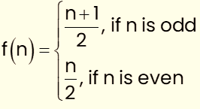
for all n ∈ N, state whether the function f is bijective. Justify your answer.
Prove that the greatest integer function f : R → R given by f(x) = [x], is neither one one nor onto, where [x]denotes the greatest integer less than or equal to x.
Show that *: R × R ⊠⊠ R given by a * b ⊠⊠ a + 2b is not associative.
Let f : N → Y be a function defined as f (x) = 4x + 3, where, Y = {y ∈ N: y = 4x + 3 for some x∈ N}. Show that f is invertible. Find the inverse.
If ‘*’ is defined on the set R of real numbers by a*b = 3ab/7, find the identity element in R for the binary operation ‘*’.
Give an example of a relation. Which is
(i) Symmetric but neither reflexive nor transitive.
(ii) Transitive but neither reflexive nor symmetric.
(iii) Reflexive and symmetric but not transitive.
(iv) Reflexive and transitive but not symmetric.
(v) Symmetric and transitive but not reflexive.

