Find whether the following functions are one-one:
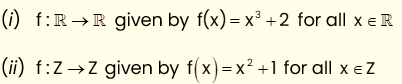
(i) Let x, y be two arbitrary elements of R (domain of f) such that f (x) = f (y).
Then, f (x) = f (y)
⇒ x³ + 2 = y³ + 2 ⇒ x³ = y³ ⇒ x = y
Hence, f is a one-one function from R to itself.
(ii) Let x, y be two arbitrary elements of Z. Then, f (x) = f (y)
x² + 1 = y² + 1
⇒ x² = y² x = ±y
Here, f (x) = f (y) does not provide the unique solution x = y but it provides x =±y. So, f is not a one-one function.
In fact, f(2) = 2² + 1 = 5 and f(-2) = (-2)² + 1 = 5. So, 2 and –2 are two distinct elements having the same image.

