
10 Questions Available
Showing 10 questions on this page
Differentiate between the principle of estimation of nitrogen in an organic compound by
(i) Dumas method
(ii) Kjeldahl’s method.
Which of the two : O2NCH2CH2O– or CH3CH2O– is expected to be more stable and why ?
Give the IUPAC names of the following compounds :
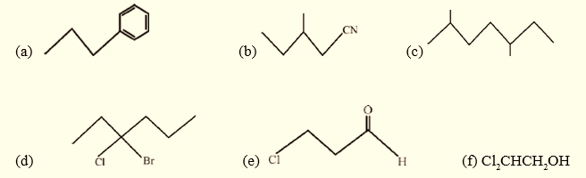
Why is nitric acid added to sodium extract before adding silver nitrate for testing halogens ?
Classify the following reactions in one of the reaction type studied in this unit.
(a) CH3CH2Br + HS− → CH3CH2SH + Br−
(b) (CH3)2C = CH2 + HCl → (CH3)2CCl—CH3
(c) CH3CH2Br + HO− → CH2 = CH2 + H2O + Br−
(d) (CH3)3C — CH2OH + HBr → (CH3)2CBrCH2CH3 + H2O
Name a suitable technique of separation of the components from a mixture of calcium sulphate and camphor.
Write bond-line formulas for : Isopropyl alcohol, 2, 3- Dimethylbutanal, Heptan-4-one
Draw the resonance structures for the following compounds. Show the electron shift using curved- arrow notation. .
(a) C6H5NO2
(b) CH3CH = CHCHO
(c) C6H5—CHO
(d) CH3CH = C+H CH2
What are hybridisation states of each carbon atom in the following compounds?
CH2 = C = O, CHCH = CH, (CH3)2CO, CH2 = CHCN, C6H6.
Indicate the s-and p-bonds in the following molecules
C6H6, C6H12, CH2Cl2, CH2 = C = CH2, CH3NO2, HCONHCH3