Two masses as shown in figure are released from heir their positions. Calculate the velocity with which the mass of 5 kg touches the surface if its initial height from the surface is 4 m. Also, show that the gain in KE of the system is equal to loss its P.E. Take g = 10 ms–2.
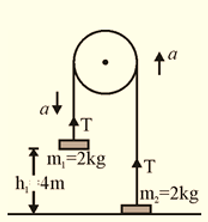
Acceleration of the system,
a =(m1 − m2)g/m1 + m2
=(5 − 2) × 10/5 + 2
= 4.28m/s2
Velocity with which 5 kg mass touches the ground (v) is obtained from
v2 − u2 = 2as
v2 − 0 = 2 × 4.28 × 4
v = √2 × 4.28 × 4 = 5.85 ms−1.
Initially, both the masses are at rest
∴ Initially KE of the system = 0
Final K.E. of the system = 1/2(m1 + m2)v2
= 1/2(5 + 2)(5.85)2 = 119.8J
Gain in K.E. = 119.8 − 0 = 119.8J
Initial P.E. of the system = m1gh1 + m2gh2
= 5 × 10 × 4 + 0 = 200J
Final P.E. of the system = m1gh1 + m2gh2
= 0 + 2 × 10 × 4 = 80J
Loss in P.E. = 120 − 80 = 120 J.
Thus Gain in K.E. = Loss in P.E.

