Figure a show the field lines of a single positive and negative charge respectively.
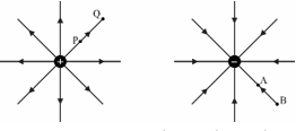
(a) Give the signs of potential difference (VP – VQ) and (VB – VA).
(b) Give the sign of potential energy difference of a small negative charge between the points Q and P; A and B.
(c) Give the sign of the work done by the field in moving a small positive charge from Q to P.
(d) Give the sign of the work done by external energy in moving a small negative from B to A.
(e) Does the kinetic energy of a small negative charge increase in going B to A?
(a) As V ∝ 1/r ∴ VP > VQ or (VP -VQ) ⇒ positive
Also, VB less negative than VA (∵ distance of B is more than distance of A)
Thus, VB > VA ∴ (VB - VA) ⇒ positive
(b) A negative charge held at Q would move towards P. As charge moves from higher potential energy to lower potential energy. ∴(P.E)Q > (P.E)P
Therefore, sign of potential energy difference of a small negative charge between Q and P is positive.
Similarly, (P.E)A > (P.E)B
Sign of potential energy difference is positive.
(c) In moving a small positive charge from Q to P, work has to be done by as against the electric field. Therefore, work done by the field is negative.
(d) In moving a small negative charge from B to A, work has to be done by us against the field. Therefore, work done by external agency is positive.
(e) Due to force of repulsion on the negative charge, velocity decreases and hence K.E. decreases in going from B to A.

