6 Questions Available
Showing 6 questions on this page
Explain why
(i) the dipole moment of chlorobenzene is lower than that of cyclohexyl chloride?
(ii) Alkyl halides, though polar, are immiscible with water?
(iii) Grignard reagents should be prepared under anhydrous conditions?
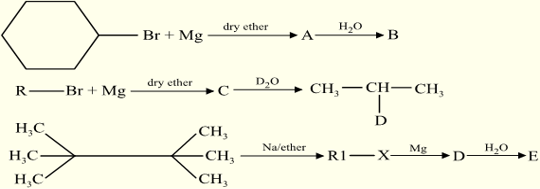
Identify A, B, C, D, E, R and R1 in the following :
Which of the following has highest dipole moment?
(i) CH2Cl2
(ii) CHCl3
(iii) CCl4
A hydrocarbon C5H10 does not react with chlorine but gives a single monochloro compound, C5H9Cl in bright sunlight. Identify the hydrocarbon.
Predict the order of reactivity of the following compounds in SN1 and SN2 reactions:
(i) The four isomeric bromobutanes
(ii) C6H5CH2Br, C6H5CH(C6H5)Br, C6H5CH(CH3)Br, C6H5C(CH3)(C3H5)Br.
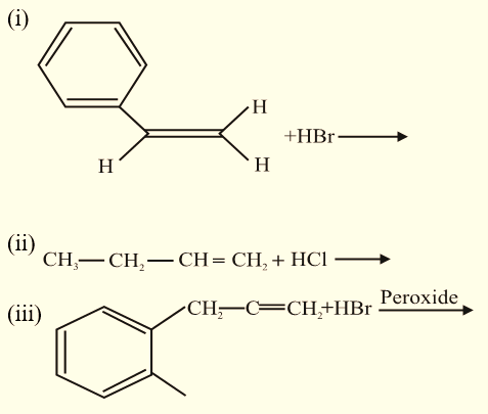
Write the products of the following reactions: