6 Questions Available
Showing 6 questions on this page
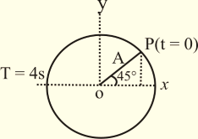
Figure as given depicts circular motions. The radius of the circle, the period of revolution, the initial position and the sense of revolution are indicated in the figure. Obtain the simple harmonic motions of the x-projection of the radius vector of the rotating particle P in each case.
On an average a human eye blinks 30 times in a minute. Calculate its frequency and period.
A body oscillates with SHM according to the equation (in SI units), x = 10 cos[4πt + π/2]. At t = 0.5 s, calculate the (a) Displacement (b) Speed (c) Acceleration of the body.
A block whose mass is 1 kg is fastened to a spring. The spring has a spring constant of 100 N m-1. The block is pulled to a distance x = 2 cm from its equilibrium position at x = 0 on a frictionless surface from rest at t = 0. Calculate the kinetic, potential and total energies of the block when it is 1 cm away from the mean position.
For the damped oscillator, the mass m of the block is 200 g, k = 90 N m-1 and the damping constant b is 40 g s-1. Calculate (a) the period of oscillation, (b) time taken for its amplitude of vibrations to drop to half of its initial value and (c) the time taken for its mechanical energy to drop to half its initial value.
Which of the following functions of time represent (a) periodic and (b) non-periodic motion. Give the period for each case of periodic motion (ω is any positive constant).
(i) sin ωt + cos ωt
(ii) sin ωt + cos 2ωt + sin 4ωt
(iii) e-ωt
(iv) log(ωt)

