16 Questions Available
Showing 16 questions on this page
How will you convert benzene into
(i) p-nitrobromobenzene
(ii) m-nitrochlorobenzene
(iii) p-nitrotoluene
(iv) acetophenone ?
Write the structures and IUPAC names of different structural isomers of alkenes corresponding to C5H10.
Draw the structures of cis-and trans-isomers of the following compounds. Also write their IUPAC names.
(i) CHCI = CHCI
(ii) C2H5C(CH3) = C (CH3)C2H5
Why does benzene undergon electrophilic substitution reaction easily and nucleophilic substitutions with difficulty?
Arrange benzene, n-hexane and ethyne in decreasing order of acidic behaviour. Also give reason for this behaviour.
What effect does branching of an alkene chain has on its boiling point ?
Explain why the following systems are not aromatic ?

Why is benzene extraordinarily stable though it contains three double bonds ?
How will you convert ethanoic acid into benzene ?
Prove that:
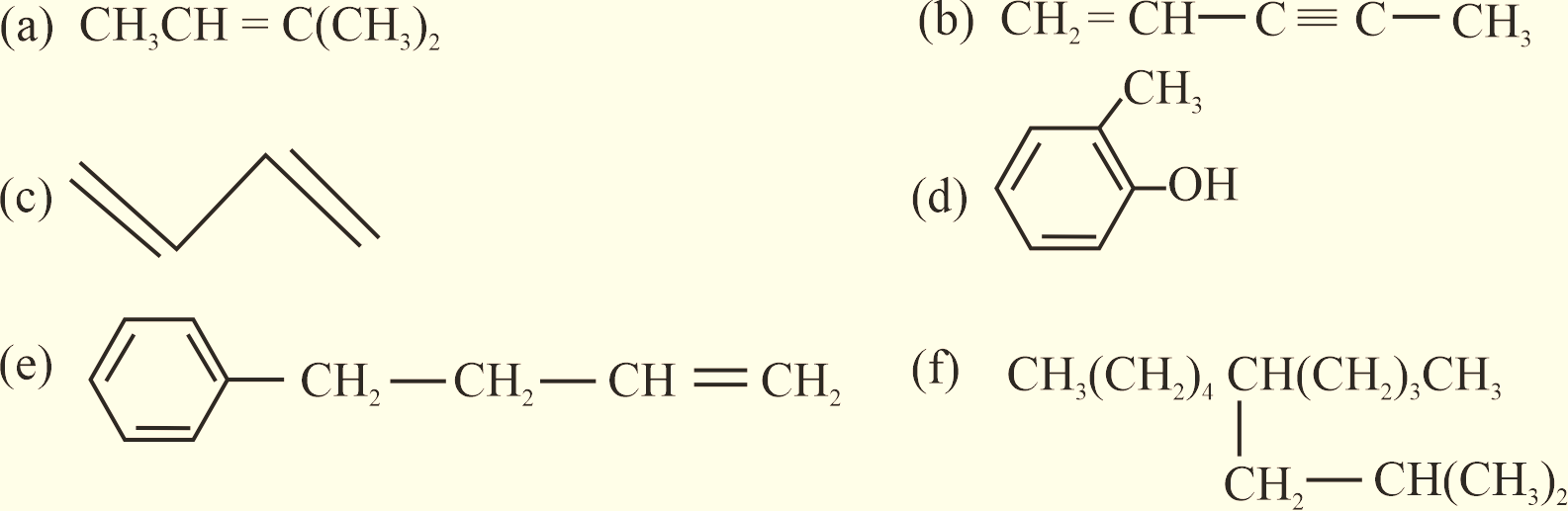
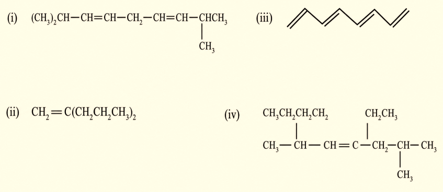
Write the names of the following compounds:
Write structural formulas of the following compound.
(i) 3, 4, 4, 5-Tetramethylheptane (ii) 2, 5-Dimethylhexane.
Write IUPAC names of the following compounds.
(i) (CH3)3 CCH2C(CH3)3
(ii) (CH3)2C(C2H5)2
(iii) Tetra-tert-butylmethane.
What are the necessary conditions for any system to be aromatic ?
Write IUPAC names of the products obtained by the ozonolysis of the following compounds:
(i) Pent-2-ene
(ii) 3, 4-Dimethylhept-3-ene
(iii) 2-Ethylbut-1-ene
(iv) 1-Phenylbut-1-ene.
An alkene ‘A’ contians three C—C, eight C—H, s-bonds, and one C—C p-bond. ‘A’ on ozonolysis gives two moles of an aldehyde of molar mass 44 u write the IUPAC name of ‘A’.

