An aeroplane of an airline can carry a maximum of 200 passengers. A profit of Rs 400 is made on each first-class ticket. The airline reserves at least 20 seats for first class. However, at least 4 times as many passengers prefer to travel by economy class than by first class. Determine how many of each type of tickets must be sold in order to maximize the profit for the airline. What is the maximum profit?
Let x tickets of first class and y tickets of economy class be sold to maximize the profit. Then,
x ≥ 20, y ≥ 4x, y ≥ 80 "and" x + y ≤ 200
The profit function is given by Z = 400x + 300y
Draw the graphs of the lines x = 20, y = 4x, y = 80 "and" x + y = 200 as shown below.
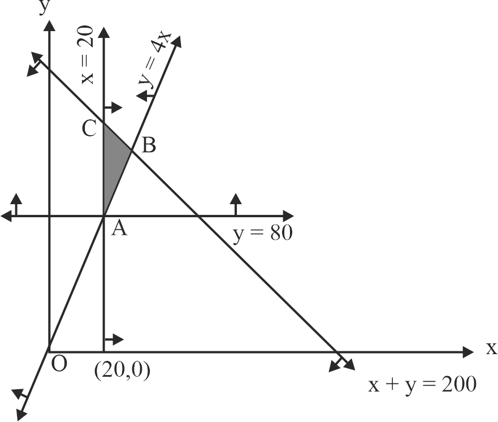
Graph of the inequation x ≥ 20
Since (0, 0) does not satisfy x ≥ 20, the line x = 20 together with the region to its right-hand side, not containing (0, 0), represents the region x ≥ 20.
Graph of the inequation y ≥ 4x
Clearly, since (20, 0) does not satisfy the inequation y ≥ 4x., the line y = 4x together with the region to its left, not containing (20, 0), represents y ≥ 4x.
Graph of the inequation y ≥ 80
Clearly, the line y = 80 and the region above this line represents y ≥ 80.
Graph of the inequation x + y ≤ 200
Clearly, (0, 0) satisfies x + y ≤ 200. So, the line x + y = 200 together with the region containing (0, 0) represents x + y ≤ 200.
Thus, the shaded region in the given figure is the feasible region, whose vertices are A, B and C, A. is the point of intersection of x = 20 and y = 80.
So, its coordinates are A(20, 80).
On solving y = 4x and x + y= 200, we get B(40, 160).
On solving x = 20 and x + y = 200, we get C(20, 180).
The values of Z = 400x + 300y at A(20, 80), B(40, 160) and C(20, 180) are respectively Rs 32000, Rs 64000 and Rs 62000.
Z is maximum at x = 40, y = 160

