A rod of length 1.05 m having negligible mass is supported at its ends by two wires of steel (wire A) and aluminium (wire B) of equal lengths as shown in figure. The cross-sectional areas of wires A and B are 1.0 mm² and 2.0 mm², respectively. At what point along the rod should a mass m be suspended in order to produced (a) equal stresses and (b) equal strains in both steel and aluminium wires.
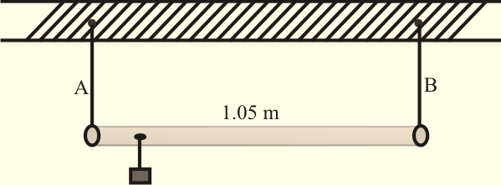
From tables of standards we know that for steel γA = 2×10¹¹ Nm−2 and for aluminium
γB = 7×10¹⁰ Nm−2, AA = 1.0 mm2 and AB = 2.0 mm2.
(a) Let for equal stress in two wires the load m be suspended at x distance from end A.
As stress =F/A, hence FA/FB= AA/AB
= 1.00 mm2/2.00 mm2
= 1/2
and from principle of moments, we have FA × x = FB × (1.05 − x)
∴ FA/FB= (1.05 − x)/x
Combining two results, we have (1.05 − x)/x= 1/2
or 2.1 − 2x = x or 2.1 = 3x ⇒ x = 2.1/3 = 0.7 m
(b) Let for equal strains in two wires the load m be suspended at x′ distance from end A.
As strain = stress/Y = F/A.Y = same for two wires, hence
FA/FB= AA YA/AB YB
= 1.00 × 2 × 1011/2.00 × 7 × 1010
= 10/7
and from principle of moments, we have
FA × x′ = FB × (1.05 − x′) or
FA/FB= (1.05 − x′)/x′
Combining the two results, we have
10/7 = (1.05 − x′)/x′ or 10x′ = 7.35 − 7x ;
17x′ = 7.35 or x′ = 7.35/17 = 0.43m.

