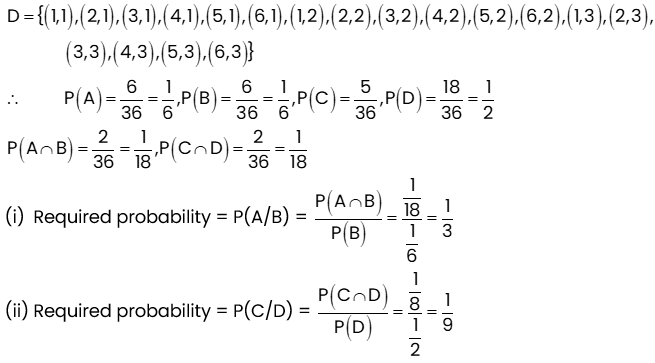
A black and a red die are rolled.
(i) Find the conditional probability of obtaining a sum greater than 9, given that the black die resulted in a 5.
(ii) Find the conditional probability of obtaining the sum 8, given that the red die resulted in a number less than 4.
Consider the following events: A = Getting a sum greater than 9; B = Getting 5 on black die
C = Getting 8 as the sum; D = Getting a number less than 4 on red die.
We have, A = {(4,6), (6,4), (5,5), (6,5), (5,6), (6,6)}
B = {(5,1), (5,2), (5,3), (5,4), (5,5), (5,6)}
C = {(2,6), (6,2), (4,4), (3,5), (5,3)}
and