
Before thermometers existed, doctors, scientists, and researchers could only guess whether something was hot or cold. There was no accurate way to measure temperature. The invention of the thermometer completely changed science, medicine, weather forecasting, and modern technology.
Today, when people search who invented thermometer, they usually expect one name. But the real history is more interesting. The thermometer was not invented by a single scientist. Instead, it evolved over time through the contributions of multiple inventors and scientific improvements.
Who Invented Thermometer?
The thermometer developed gradually through several scientists over many years. Galileo Galilei invented the thermoscope in 1593, Santorio Santorio added a temperature scale in 1612, and Daniel Gabriel Fahrenheit created the first reliable mercury thermometer in 1714. Because of this major advancement, Fahrenheit is widely known as the Father of Thermometer.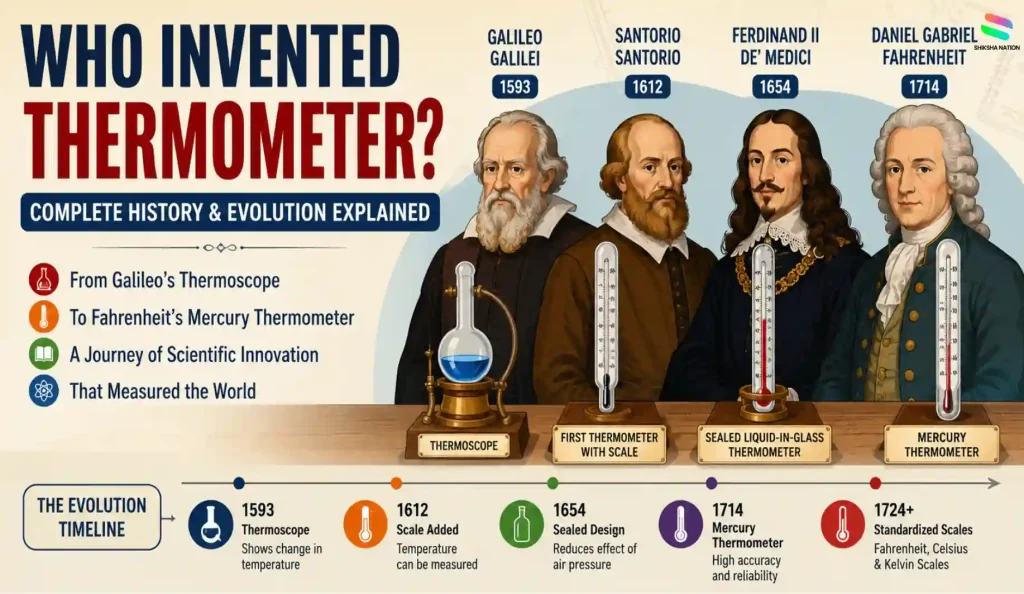
Thermometer Invention Timeline
| Year | Scientist | Contribution |
|---|---|---|
| 1593 | Galileo Galilei | Invented the thermoscope |
| 1612 | Santorio Santorio | Added a measurement scale |
| 1654 | Ferdinand II de Medici | Developed sealed liquid thermometer |
| 1714 | Daniel Gabriel Fahrenheit | Invented mercury thermometer |
| 1742 | Anders Celsius | Introduced Celsius scale |
| 1848 | Lord Kelvin | Developed Kelvin scale |
Also Check: Sir C.V. Raman Biography
Who Actually Invented the Thermometer?
The answer to who invented thermometer is not completely straightforward because different scientists improved the instrument at different stages.
Historians generally credit:
- Galileo Galilei for creating the thermoscope
- Santorio Santorio for adding a numerical scale
- Daniel Gabriel Fahrenheit for inventing the first accurate mercury thermometer
This is why multiple scientists are linked to the invention of the thermometer.
Galileo Galilei and the First Thermoscope
One of the earliest names connected to who invented thermometer is Galileo Galilei.
In 1593, Galileo developed a device called the thermoscope, which became the foundation of modern thermometers.
What Was Galileo’s Thermoscope?
A thermoscope was an early temperature-measuring device that showed temperature changes but could not measure exact temperatures.
The instrument worked using:
- air expansion
- contraction caused by heat changes
- liquid movement inside a tube
When temperature increased, the air expanded and pushed the liquid downward. When temperature decreased, the liquid moved upward.
Although simple, this invention became an important scientific breakthrough.
Do Check: Dr. Manmohan Singh
Difference Between Thermoscope and Thermometer
Many students become confused while learning who invented thermometer because the thermoscope and thermometer are not exactly the same.
| Thermoscope | Thermometer |
|---|---|
| Shows temperature changes only | Measures exact temperature |
| No calibrated scale | Includes measurement scale |
| Less accurate | More accurate |
| Affected by atmospheric pressure | More reliable readings |
The thermoscope was the precursor to the modern thermometer.
Santorio Santorio and the First True Thermometer
Another major scientist in the history of who invented thermometer was Santorio Santorio, an Italian physician.
Around 1612, Santorio improved Galileo’s thermoscope by adding a calibrated measurement scale.
Why Was Santorio’s Contribution Important?
Adding a scale allowed:
- temperature comparison
- recorded observations
- medical use
- more scientific accuracy
Because of this improvement, many historians consider Santorio Santorio the inventor of the first true thermometer.
However, the instrument still had one major problem:
- atmospheric pressure affected the readings
This reduced accuracy.
Ferdinand II and the Sealed Liquid Thermometer
In 1654, Ferdinand II de Medici created the first sealed liquid-in-glass thermometer.
This invention became an important step in the evolution of who invented thermometer because sealing the glass reduced the effects of atmospheric pressure.
Key Improvements
- sealed glass structure
- alcohol-filled tube
- more stable readings
- better scientific reliability
This development improved precision measurement significantly.
Daniel Gabriel Fahrenheit and the Mercury Thermometer
When people ask who invented thermometer, the most widely accepted modern answer is Daniel Gabriel Fahrenheit.
In 1714, Fahrenheit invented the first reliable mercury thermometer.
This invention transformed temperature measurement forever.
What Is a Mercury Thermometer?
A mercury thermometer is a temperature measuring instrument that uses mercury expansion inside a sealed glass tube to measure temperature accurately.
Mercury became highly useful because:
- it expands evenly
- it responds quickly to temperature changes
- it provides accurate readings
- it works across a wide temperature range
Why Fahrenheit’s Thermometer Was Revolutionary
Daniel Gabriel Fahrenheit’s invention solved many problems found in earlier thermometers.
Advantages of Mercury Thermometers
- More accurate readings
- Better calibration
- Faster response time
- Improved scientific consistency
- Reliable temperature measurement
Scientific records show that Fahrenheit’s invention greatly improved precision thermometry and modern scientific measurement.
Because of this contribution, Fahrenheit is widely called the Father of Thermometer.
Why Is Fahrenheit Called the Father of Thermometer?
Daniel Gabriel Fahrenheit is called the Father of Thermometer because he invented the first successful mercury thermometer in 1714 and introduced a standardized temperature scale.
His thermometer became:
- more accurate
- scientifically reliable
- widely accepted across Europe
This changed the future of:
- medicine
- chemistry
- weather science
- laboratories
The Fahrenheit Temperature Scale
In 1724, Fahrenheit introduced the Fahrenheit temperature scale.
Important Points of the Fahrenheit Scale
| Temperature Point | Fahrenheit Value |
|---|---|
| Freezing point of water | 32°F |
| Boiling point of water | 212°F |
The standardized temperature scale helped scientists record temperature more consistently.
Even today, the Fahrenheit scale is still used in several countries.
Anders Celsius and the Celsius Scale
While studying who invented thermometer, it is also important to understand the development of temperature scales.
In 1742, Swedish scientist Anders Celsius introduced the Celsius scale.
Celsius Scale Values
| Temperature Point | Celsius Value |
|---|---|
| Freezing point of water | 0°C |
| Boiling point of water | 100°C |
Today, the Celsius scale is the most commonly used temperature system worldwide.
Lord Kelvin and the Kelvin Scale
In 1848, Lord Kelvin developed the Kelvin scale, also known as the absolute temperature scale.
The Kelvin scale is widely used in:
- physics
- chemistry
- advanced scientific research
Absolute zero on the Kelvin scale represents the lowest possible temperature where molecular motion nearly stops.
How Early Thermometers Worked
Early thermometers worked using the principle of thermal expansion.
Basic Working Principle
When temperature changes:
- air expands or contracts
- liquids like alcohol or mercury expand
- the liquid level moves inside the glass tube
Scientists then used calibrated scales to measure the temperature precisely.
This principle remains important even in many modern thermometers.
Evolution of Thermometers Over Time
The story of who invented thermometer continued far beyond mercury thermometers.
Over centuries, scientists developed more advanced temperature measuring instruments.
Major Types of Thermometers
| Type | Main Use |
|---|---|
| Alcohol Thermometer | Early scientific experiments |
| Mercury Thermometer | Accurate temperature readings |
| Clinical Thermometer | Medical diagnosis |
| Digital Thermometer | Fast electronic readings |
| Infrared Thermometer | Contactless temperature checking |
| Smart Thermometer | Advanced health monitoring |
Modern thermometers are safer, faster, and much more accurate than earlier versions.
Who Invented Clinical Thermometer?
Another common question related to who invented thermometer is about the clinical thermometer.
The modern clinical thermometer was developed by Sir Thomas Allbutt in 1867.
His invention improved medical diagnosis because:
- it was smaller
- readings became faster
- it was practical for hospitals and doctors
Did Galileo Invent the Thermometer?
This is one of the most searched questions related to who invented thermometer.
The answer is partially yes, but not completely.
Galileo invented the thermoscope, which became the foundation of the thermometer. However:
- Santorio added the scale
- Ferdinand II improved the design
- Fahrenheit created the accurate mercury thermometer
So, the modern thermometer evolved through multiple scientific contributions.
Why Was the Thermometer Invented?
Scientists needed accurate temperature measurement for:
- medical treatment
- scientific experiments
- weather observation
- industrial processes
Before thermometers existed, temperature estimation was unreliable and inconsistent.
The invention of the thermometer improved:
- healthcare
- laboratories
- engineering
- physics
- meteorology
Interesting Facts About Who Invented Thermometer
- Galileo’s thermoscope did not have a measurement scale.
- Early thermometers were heavily affected by atmospheric pressure.
- Mercury was preferred because of its uniform thermal expansion.
- Fahrenheit’s thermometer became one of the first reliable scientific thermometers.
- Modern digital thermometers use electronic sensors instead of liquids.
Conclusion
If you are searching for who invented thermometer, the complete answer involves multiple scientists instead of one inventor alone.
- Galileo Galilei developed the thermoscope in 1593.
- Santorio Santorio added a calibrated scale in 1612.
- Ferdinand II improved thermometer design in 1654.
- Daniel Gabriel Fahrenheit invented the first reliable mercury thermometer in 1714.
Because of his accurate and standardized invention, Fahrenheit is widely recognized as the Father of Thermometer.
The thermometer evolved gradually through scientific innovation and became one of the most important instruments used in medicine, science, weather forecasting, and daily life.