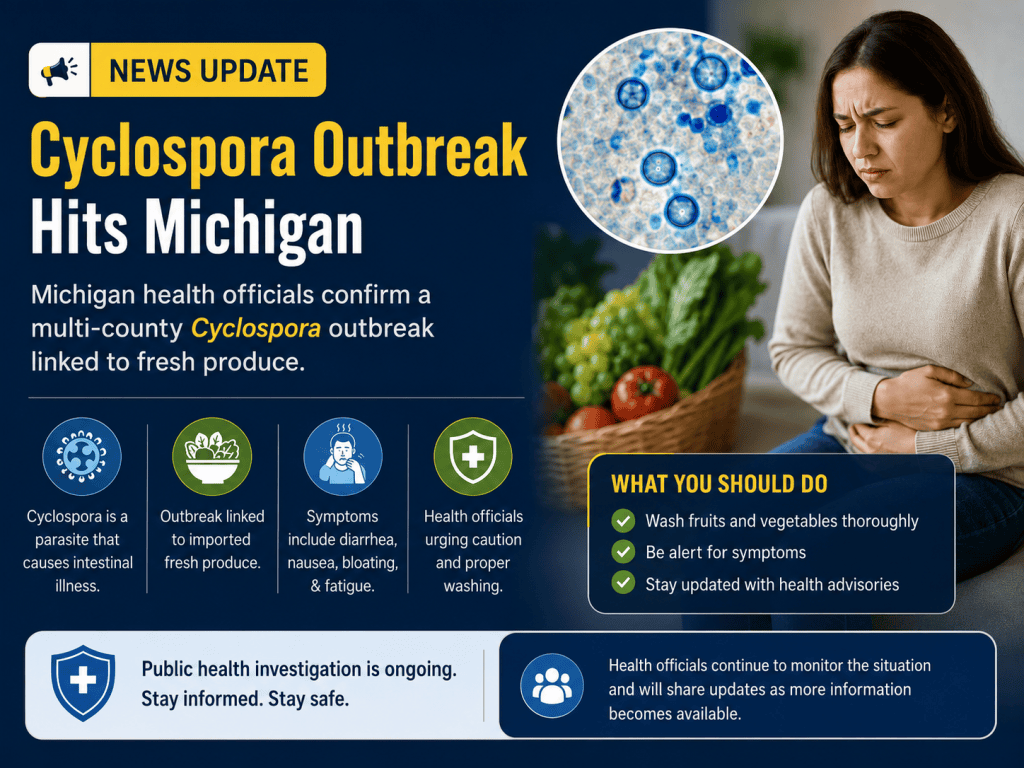
Cyclospora at a Glance
| Feature |
Detail |
| Parasite type |
Coccidian protozoan (single-celled) |
| Scientific name |
Cyclospora cayetanensis |
| Illness name |
Cyclosporiasis |
| Where it lives |
Small intestine |
| Transmission |
Ingesting sporulated oocysts via contaminated food or water |
| Incubation period |
About 1 week (range: 2–14 days) |
| Common symptoms |
Watery diarrhea, cramping, nausea, fatigue, loss of appetite |
| Typical duration |
A few days to several weeks (sometimes longer if untreated) |
| Standard treatment |
Trimethoprim-sulfamethoxazole (TMP-SMX) |
| Key prevention |
Safe food handling, clean water, avoiding fecally contaminated produce |
| Common geographic risk |
Tropical and subtropical regions; also linked to imported produce globally |
Cyclospora vs. Cyclosporiasis: What’s the Difference?
These two words are related but not interchangeable.
Cyclospora cayetanensis is the parasite itself a tiny, spherical, single-celled organism classified as a coccidian protozoan, which puts it in the same biological family as Cryptosporidium and Toxoplasma.
Cyclosporiasis is the name of the illness that results when a person is infected with Cyclospora. So you could say: Cyclospora is the cause; cyclosporiasis is the disease it produces.
Think of it this way the flu virus is influenza; the illness you get is influenza (the flu). Same relationship here.
How Cyclospora Infects Humans
Cyclospora doesn’t infect anyone straight out of the gate. That’s one of the quirks that makes it different from many other pathogens.
When Cyclospora oocysts (the egg-like stage of the parasite) are first shed in feces, they’re not yet infectious. They need time days to weeks in the right environmental conditions to sporulate, meaning they develop into a form capable of infecting a new host. That’s why person-to-person transmission is extremely unlikely: the parasite isn’t ready to infect when it’s just been passed.
Once sporulated, though, if those oocysts contaminate food, water, or soil and someone ingests them, the oocysts travel to the small intestine. There, the parasite invades the cells lining the intestinal wall and begins reproducing, disrupting normal absorption and triggering the inflammation that causes symptoms.
The whole process from ingestion of sporulated oocysts to illness takes about a week on average, though it can range from 2 to 14 days.
Common Symptoms of Cyclospora Infection
Cyclospora doesn’t announce itself gently. For most people, the illness starts with:
- Watery diarrhea often explosive, frequent, and urgent
- Abdominal cramps and bloating sometimes severe
- Nausea with or without vomiting
- Loss of appetite significant enough to cause noticeable weight loss
- Fatigue persistent and disproportionate to the illness’s apparent severity
- Low-grade fever not always present, but common
- Muscle aches similar to what you’d feel with a mild flu
Watery diarrhea is the hallmark symptom. Some people describe it as happening several times a day, to the point where they’re afraid to leave home.
That said, not everyone who’s infected gets sick. Some people carry the parasite asymptomatically no symptoms at all which can make it harder to track and contain outbreaks.
How Long Do Cyclospora Symptoms Last?
Longer than most gut bugs. That’s one of the features that makes cyclosporiasis stand out.
Untreated, symptoms can drag on for weeks sometimes more than a month. And one of the more disorienting aspects of this infection is that symptoms can cycle. They improve for a few days, you think you’re getting better, then they return. This relapsing pattern is a recognizable feature of cyclosporiasis and can help distinguish it from other causes of diarrhea.
With appropriate treatment, most people recover significantly faster usually within a few days of starting antibiotics. Without treatment, you’re looking at a prolonged, uncomfortable stretch, and for people with weakened immune systems, recovery can take even longer.
How Cyclospora Spreads
Cyclospora spreads through the fecal-oral route which sounds alarming but simply means the parasite’s oocysts leave an infected person’s body in their stool and enter a new host through the mouth, via contaminated food or water.
It doesn’t spread directly from one person to another. You can’t catch it from a sick person’s cough, touch, or even from casual contact. The oocysts need that environmental sporulation window first, so even if you were directly exposed to fresh feces, the risk of transmission is extremely low.
The more likely route is contaminated irrigation water. In many growing regions, particularly in tropical and subtropical countries, produce is irrigated with water that may contain inadequately treated sewage. That water coats the surface of fresh herbs, leafy greens, and soft fruits. The oocysts cling to the produce, survive refrigeration, and reach consumers’ tables still viable.
Contaminated drinking water is another route, especially in areas without reliable water treatment infrastructure.
Foods Most Commonly Linked to Cyclospora Outbreaks
Fresh produce particularly imported, ready-to-eat produce is the primary vehicle for Cyclospora in the United States and other developed countries where the parasite isn’t endemic.
The foods most frequently implicated in documented outbreaks include:
- Fresh cilantro repeatedly linked to large U.S. outbreaks, often imported from Mexico
- Fresh basil implicated in multiple restaurant-related cluster outbreaks
- Raspberries one of the earliest well-documented outbreak vehicles in the 1990s
- Bagged salad mixes and pre-cut lettuce a high-risk category because contamination can affect large volumes distributed across multiple states
- Snow peas and sugar snap peas linked to outbreaks in certain years
- Mesclun lettuce and mixed greens associated with restaurant outbreaks
The global food supply has changed the risk landscape. Produce that’s grown in endemic regions, harvested and packed under conditions where water sanitation may be inadequate, and then distributed widely across supply chains can carry Cyclospora oocysts across thousands of miles before landing on someone’s plate.
Does washing produce remove Cyclospora?
Unfortunately, no not reliably. Rinsing produce under running water is always a good food-safety habit, but standard washing doesn’t eliminate Cyclospora oocysts. Cooking does kill the parasite, so cooked produce carries no risk. The vulnerability sits squarely with raw, ready-to-eat items.
How Cyclospora Is Diagnosed
Diagnosing Cyclospora requires a stool test specifically, a stool sample examined under a microscope for oocysts. That sounds straightforward, but it’s where things get complicated.
Standard stool ova-and-parasite tests used routinely in clinical labs may not reliably detect Cyclospora. The oocysts are small (8–10 micrometers), and they require specific staining techniques like acid-fast or modified safranin staining to become visible. Cyclospora also has a distinctive autofluorescence under ultraviolet light that can help confirm identification, but not every lab performs this.
A few more challenges:
- Oocyst shedding is intermittent. A single stool sample collected on the wrong day can come back negative even when infection is present. Multiple samples, collected on different days, often improve accuracy.
- Many labs don’t test for it unless specifically requested. Clinicians have to think to order the right test. Given how little public awareness exists about Cyclospora, it’s frequently not on the differential diagnosis list.
- Molecular testing (PCR) is becoming more widely available and is more sensitive than microscopy, but it’s not yet universally standard.
This is why cyclosporiasis is significantly underdiagnosed. Many people with prolonged, unexplained diarrhea never get tested for Cyclospora specifically, and some recover (slowly) without ever knowing what caused their illness.
If you’ve had watery diarrhea lasting more than a few days especially after international travel or after eating large amounts of fresh herbs or salad greens it’s reasonable to tell your provider you’d like to be specifically tested for Cyclospora.
Treatment and Recovery
The good news: cyclosporiasis responds well to antibiotics when caught and treated.
The standard treatment is trimethoprim-sulfamethoxazole (TMP-SMX), commonly known by the brand names Bactrim or Septra. It’s typically prescribed as a twice-daily course for 7 to 10 days. Most people start feeling meaningfully better within a few days of starting the medication.
There’s no proven effective alternative for people who can’t take sulfa drugs this is a genuine limitation, and researchers are still working on it.
What about hydration?
Dehydration is the most immediate risk with any diarrheal illness, and Cyclospora is no exception. Frequent, watery diarrhea can deplete fluids and electrolytes rapidly. Drinking plenty of water and fluids with electrolytes (sports drinks, oral rehydration solutions) is essential throughout recovery, regardless of whether antibiotics are prescribed.
Can Cyclospora go away on its own?
Technically yes the infection is self-limiting in most healthy adults, meaning it will eventually resolve without treatment. But “eventually” can mean weeks of misery, and in the meantime, the ongoing diarrhea puts you at real risk for dehydration and significant weight loss. Treatment makes recovery much faster and more comfortable.
Possible Complications
Most healthy adults recover fully from cyclosporiasis with no lasting effects.
But not everyone is a healthy adult. People at greater risk of prolonged, severe, or complicated illness include:
- Individuals with weakened immune systems including people with HIV/AIDS, organ transplant recipients, or those on immunosuppressive medications. In immunocompromised individuals, cyclosporiasis can become chronic, severe, and difficult to treat.
- Older adults who may have less immune reserve and greater vulnerability to dehydration.
- Young children who can dehydrate more rapidly.
- Malnourished individuals who have less metabolic buffer against prolonged illness.
Even in otherwise healthy people, extended dehydration from untreated cyclosporiasis can lead to electrolyte imbalances that affect heart and muscle function. This is uncommon, but it’s a real reason not to tough out a prolonged diarrheal illness without medical attention.
Prevention and Produce Safety
You can’t eliminate the risk of Cyclospora entirely when you eat fresh produce, but you can meaningfully reduce it.
- Cook fresh herbs and produce when possible. Heat kills Cyclospora oocysts. If you’re making a dish where cilantro or basil can be added during cooking rather than as a raw garnish, that’s a lower-risk option.
- Stay aware of food recalls. When public health agencies identify a contaminated product, they issue recalls and public advisories. Check the FDA and CDC websites periodically, especially during late spring and summer when Cyclospora outbreaks tend to peak.
- Discard recalled produce immediately. Don’t wash and try to salvage it when a product is recalled for possible Cyclospora contamination, discard it and sanitize surfaces it contacted.
- Drink treated water. In regions where water treatment is unreliable, drink bottled water or water that’s been boiled or treated with an appropriate filter.
- Practice safe food handling. Wash your hands thoroughly before preparing food, and keep raw produce away from other food-preparation surfaces.
- If you’re traveling to tropical or subtropical regions, be cautious about raw produce, salads, and drinks with ice made from local tap water even in settings that appear clean and upscale.
A note on washing produce: Rinsing fruits and vegetables under cool running water is always a good habit for removing dirt, pesticides, and some surface pathogens. But it won’t reliably remove Cyclospora oocysts. Don’t skip washing but don’t rely on it as your primary protection either.
Outbreaks, Investigations, and Public Health
Cyclospora outbreaks tend to cluster in late spring and summer roughly May through August in the United States and they follow a frustrating pattern: a wave of illnesses gets reported, investigators scramble to identify the source, and tracing the contamination back through the supply chain proves remarkably difficult.
Here’s why outbreak tracing is hard:
- Fresh produce has a short shelf life. By the time enough illnesses are reported to trigger an investigation, the original contaminated product may be long gone eaten, discarded, or expired.
- People don’t always remember exactly what they ate. Two weeks after eating a bagged salad, most people can’t recall the brand, lot number, or where they bought it.
- The supply chain is complex. A single bag of mixed greens might contain lettuce from one farm, herbs from another, and be assembled at a third facility each with its own suppliers and irrigation sources.
- Oocysts on produce can be hard to detect. Testing produce for Cyclospora isn’t as simple as it sounds; standard methods may not recover oocysts reliably from food surfaces.
Public health agencies primarily the CDC, FDA, and state health departments investigate outbreaks by interviewing patients about their food histories, looking for overlapping exposures, and working backward through distribution records when a common product is identified. When a contaminated product is confirmed, a recall is issued.
Outbreaks are also substantially underreported. Many people with cyclosporiasis either don’t seek medical care, don’t get the right test, or get better before a diagnosis is made. This means the true burden of Cyclospora illness in the U.S. is likely larger than official case counts suggest.
Where Is Cyclospora Found and Who Is Most at Risk?
Cyclospora cayetanensis is found worldwide, but it’s most common in tropical and subtropical regions of Latin America, South and Southeast Asia, and parts of Africa. In these endemic areas, local residents can develop some degree of immunity from repeated early-childhood exposure though immunity isn’t complete or guaranteed.
For people in higher-income countries, two main routes of exposure exist:
- International travel: Travelers to endemic regions who drink local water or eat raw produce and street food are at elevated risk. Cyclospora is one of the recognized causes of traveler’s diarrhea, alongside more familiar culprits like E. coli.
- Imported produce: This is the route that matters most for people who haven’t left their home country. The globalization of the food supply means that produce grown in regions where Cyclospora is endemic can reach supermarkets and restaurants in the United States, Canada, Europe, and Australia. An outbreak in a midwestern U.S. state can often be traced to herbs grown in Mexico or Central America.
Aside from geography, the main risk factor for serious illness (as opposed to simply getting infected) is immune status. A healthy immune system typically limits how severe cyclosporiasis becomes. For immunocompromised individuals, the parasite can cause a much more persistent and dangerous infection.
When to Seek Medical Care
Don’t tough out a prolonged diarrheal illness on your own, especially if it’s not improving.
See a healthcare provider if you experience:
- Diarrhea that’s lasted more than 3 days without improvement
- Signs of dehydration: extreme thirst, dark urine, dizziness, or very little urination
- Diarrhea that seemed to improve and then returned
- Significant unintentional weight loss
- High fever alongside diarrhea
- Recent international travel, particularly to tropical or subtropical regions
- Recent consumption of large amounts of fresh herbs, raspberries, or bagged salad mixes especially during a period when outbreaks have been reported
When you see a provider, mention that you’d like to be tested specifically for Cyclospora if you think it could be relevant. It’s not a standard part of routine stool testing at many labs, so asking for it directly helps ensure the right test gets ordered.
Frequently Asked Questions about Cyclospora