If you did not clear NEET or scored below your target, pause before you plan. Give yourself a few days to process the result, then run a structured diagnosis of what went wrong. From there, build a repeater-year plan that targets your specific gaps rather than simply repeating what you did before.

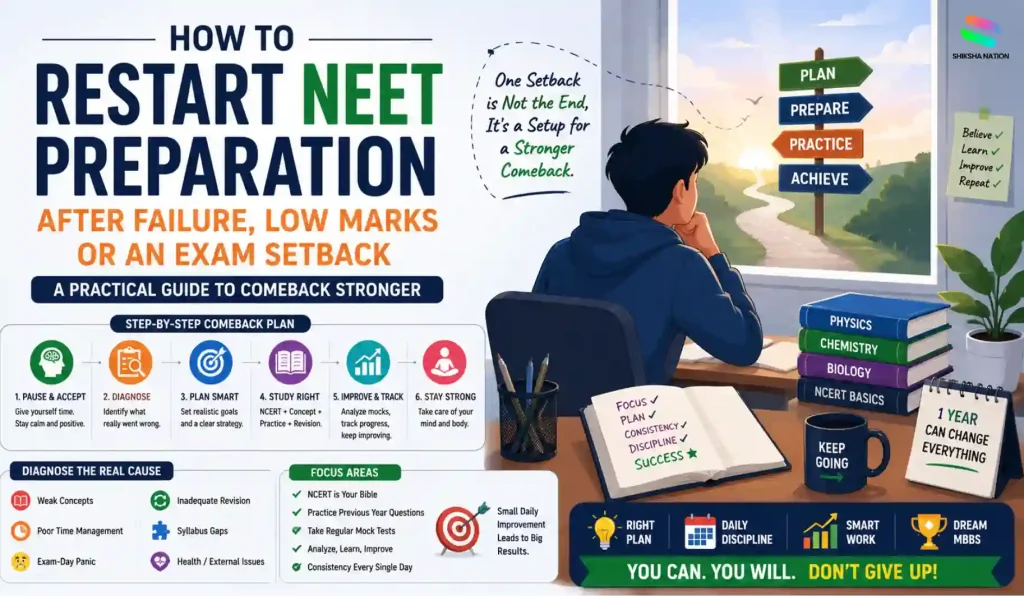
First: Let the Result Land Before You React
This is the part most guides skip, and it matters more than any study schedule.
Opening your NEET result and seeing a number far below what you expected is genuinely painful. You may feel a sharp spike of panic, or a heavy numbness, or a mix of both. Neither of those is a problem. The problem comes when you try to immediately convert that feeling into a decision or a plan, because decisions made in the first 48 hours after a setback tend to be reactive rather than reasoned.
So here is what the first few days should look like: close the browser tab, stay off NEET forums and Telegram groups, let yourself sit with disappointment without dressing it up as motivation. Talk to a parent or a friend you trust. Eat properly. Sleep.
You have time. NEET is conducted once a year (or as scheduled by NTA). A low score this cycle means your next opportunity is approximately a year away. That year is exactly enough time to do this right, and doing it right starts with a clear head, not a panicked one.
Also Read: Eligibility Criteria of year 2026 / NEET Preparation Plan for 2 years / NEET Qualifying and Admission Cut off / About Scorecard, Cut off, AIR, Result Link, Latest Updates / Syllabus of 2026 NEET
Diagnosing What Actually Went Wrong
Most students who don’t clear NEET on a first attempt attribute it to “not studying enough.” That explanation is almost always too simple to be useful.
Before you build any plan for a second attempt, you need to identify the actual cause of the setback. The fix depends entirely on the cause. Studying more hours for a problem rooted in exam-day anxiety will not help. Changing coaching for a problem rooted in weak concept foundations will not help either.
Work through this diagnostic honestly.
5 questions to ask yourself:
- In which subject or subjects did I lose the most marks?
- Was I running out of time in the exam, or did I have time but make errors?
- Were the questions I got wrong things I had studied and forgotten, or concepts I never fully understood?
- How did I feel walking into the exam hall? Was panic a factor on the day itself?
- Were there external circumstances (illness, a family situation, an internet disruption during an online mock phase) that meaningfully affected my preparation or performance?
Your honest answers to these questions point directly to the type of problem you’re dealing with.
The Diagnostic Table: Causes, Signs, and Fixes
| Cause | Signs in Your Result | What To Do |
| Weak concept foundations | Consistently low scores across months of mocks, not just final exam; blanked on questions from core chapters | Go back to NCERT basics before attempting advanced problems. Chapter-by-chapter revision before any new mock testing. |
| Poor time management in the exam | Knew the answers after the exam but did not attempt them; left questions blank due to time | Practice timed sectional tests weekly. Build a fixed time budget per subject (e.g. 65-70 min Physics, 45-50 min Chemistry, 40-45 min Biology) and practice keeping to it. |
| Exam-day panic or mental freeze | Performed better in mocks than in the actual exam; felt your mind go blank in the hall | Simulate real exam conditions more often. Dress for mock tests, sit for the full 3 hours without breaks, practice controlled breathing before starting. |
| Inadequate or patchy revision | Did well in mocks early but scores dropped close to the exam; forgot things you had definitely studied | Build a rolling revision system where every chapter is revisited at least once a month. Revision needs to be scheduled, not fit in when there is leftover time. |
| Syllabus coverage gaps | Specific chapters or subjects consistently missing from your attempt or full of wrong attempts | Map uncovered chapters explicitly. Create a completion tracker and fill gaps before any advanced revision. |
| External disruption or health setback | Objective situation: illness on exam day, family emergency, sustained period of poor sleep or health during preparation | Acknowledge this as a separate variable from academic readiness. Your base preparation may be solid. Build a cleaner support structure (health, sleep, reduced external stressors) for the next attempt. |
Be honest with yourself here. Most students have a primary cause and a secondary one. Identify both.
Deciding Whether to Take a Dropper Year or Pursue an Alternate Path
This is the question that feels highest-stakes, and it deserves a calm, honest answer rather than a decision driven by sunk-cost thinking or family pressure.
A dropper year (a full year dedicated to NEET preparation after Class 12, without joining a degree course) is a common and normalized path in Indian medical entrance preparation. Many working doctors cleared NEET on a second or even third attempt, and a gap year specifically focused on rebuilding preparation is one of the most reliable routes to doing so. You are not unusual or behind for considering it.
That said, a dropper year works well under specific conditions. It is not automatically the right choice for everyone.
5 signs a dropper year is likely the right move:
- Your score was significantly below the qualifying cutoff, not a borderline miss.
- Your diagnostic points to correctable academic gaps (not a one-off bad day).
- You have genuine motivation to enter medicine (not just family expectation or inertia).
- You have the emotional resilience to handle another year of high-pressure preparation.
- You and your family can manage the practical and financial aspects of an additional year without serious strain.
Signs it may be worth reconsidering:
- Your score was just below cutoff and a different exam strategy (not more content) would likely fix it.
- You discovered during preparation that medicine is not something you actually want.
- The emotional cost of another high-pressure year would seriously damage your health or relationships.
If you’re on the fence, it helps to separate what you want from what the people around you want. A conversation with a counsellor, a trusted teacher, or even a practicing doctor you know can give you perspective that family members in the middle of their own anxiety cannot.
How to Rebuild a Study Plan After a Setback (This Is Different from a First-Attempt Plan)
Here is something most repeater guides miss: you are not starting from zero.
You have already gone through the NEET syllabus once. You know what NCERT chapters feel like. You have sat inside a NEET exam hall. You know the 180-question format, the +4/-1 marking scheme, and the 3-hour pressure. That is real preparation capital, and your second-attempt plan should build on it rather than pretend it doesn’t exist.
A first-attempt plan usually spends the first several months building conceptual foundations from scratch. Your second-attempt plan can compress that phase because the foundations already exist. The rebuild is targeted, not wholesale.
The structure of a repeater’s study plan looks like this:
- Diagnosis phase (first 4-6 weeks): Do not touch new content. Go through your previous exam paper, your mock test history, and your diagnostic answers. Map every weak chapter and every conceptual gap. This phase produces a prioritized list, not a general revision plan.
- Foundation repair (next 6-8 weeks): Address the specific gaps your diagnosis uncovered. This means going back to NCERT for those chapters, redoing the basics, and rebuilding the concept from the ground up. Not the whole syllabus. The gaps.
- Full syllabus rebuild (months 3-8): Systematic subject-wise revision of the entire syllabus, with Biology leading in time allocation (it carries 50% of the marks, so roughly 50% of your weekly hours should reflect that). One chapter at a time, with active recall rather than passive reading.
- Mock-heavy consolidation (months 9-11): Full-length mock tests under real exam conditions at least once a week, moving to two or three per week in the final 6-8 weeks. Every mock is followed by an error analysis session, not just a score check.
- Final revision sprint (last 3-4 weeks): No new content. Only NCERT revision, high-priority chapter summaries, and short targeted tests on your historically weak areas.
Month-by-Month Repeater Year Timeline
| Phase | Months | Focus |
| Diagnosis and reset | Month 1 | Review previous exam paper, map all weak chapters, set up a study calendar, rebuild routine and sleep schedule |
| Foundation repair | Months 2-3 | NCERT-first revision of identified weak chapters, no mock tests yet, concept re-learning over problem drilling |
| Full syllabus rebuild | Months 4-8 | Systematic chapter-wise revision across all 3 subjects, sectional tests introduced in month 5, rolling revision begins |
| Mock-heavy consolidation | Months 9-10 | Weekly full-length mocks under real conditions, detailed error analysis after every mock, targeted revision of error patterns |
| Final sprint | Month 11 | NCERT-only revision, high-frequency chapter summaries, 2-3 mocks per week, no new topics |
| Exam week | Month 12 | Light revision, sleep at consistent times, trust preparation already done |
This timeline assumes a 12-month repeater cycle. If your exam window is shorter (NTA scheduling varies), compress the foundation repair phase and protect the mock-heavy consolidation phase. That last phase is non-negotiable.
Rebuilding Confidence and Mental Resilience
A setback in a high-stakes exam does something specific to confidence: it creates doubt about your score and, more quietly, about your ability to succeed at all. That doubt, if left unaddressed, degrades preparation quality even when you’re putting in the hours.
Here is what actually helps, stated in concrete terms rather than slogans.
- Track small wins every single day. Keep a simple log: chapters completed, questions attempted, mock improvement vs. last attempt. A student who scored 380 on a baseline mock and then 420 two months later has evidence that the preparation is working, regardless of how far 420 is from 600. The trajectory is the evidence. Follow it.
- Don’t measure your confidence against toppers. You are not Aryan Gupta starting fresh in Class 11. You are a specific student with specific gaps and a specific year of preparation already behind you. Comparing your daily output to someone else’s best day is a guaranteed confidence drain.
- Use your mock results as diagnostic tools, not report cards. A low mock score is not a sign that you will fail again. It is a list of things to fix. When you treat every mock as feedback rather than judgment, the emotional weight of each score drops significantly.
- Build non-NEET recovery into your week. One day, or at minimum a half-day, every week where you do something completely unrelated to studying. This is not lost preparation time. Sustained performance over a year requires recovery. Students who try to study every single day without a break do not outperform students who rest once a week. They usually underperform them in the final months because accumulated fatigue compounds.
How to Choose or Change Coaching Support for a Second Attempt
If your first-attempt coaching was not serving you well, the repeater year is the right time to make a change. But change for its own sake is not an improvement.
Before switching, be specific about what was not working. Was the teaching quality weak for a specific subject? Were the mock tests low quality or not aligned with actual NEET patterns? Did you simply not use the coaching well (skipping classes, not doing assignments)?
If the gap was in your own execution, switching coaching institutes will not fix it. If the gap was in teaching quality or test quality, it makes sense to explore alternatives.
What to look for in repeater batch coaching:
- Does the institute run a dedicated repeater or dropper batch with a separate curriculum (not just a repeat of the first-year pace)?
- What is the mock test frequency and quality? Does the format match actual NEET closely?
- Is there academic support beyond lectures: doubt clearing sessions, personal error tracking?
- Can you access the teaching at a pace that suits you, such as recorded lectures for topics where you’re already strong?
If you are considering self-study or a hybrid approach (self-study plus online coaching for specific subjects), that can work well for a repeater. The key condition is that you have already demonstrated the discipline to execute a self-directed plan. If you struggled with self-direction in the first attempt, a structured classroom environment is likely to serve you better.
Common Mistakes Repeaters Make
These come up repeatedly, and most of them are understandable given the pressure of a second attempt.
- Restarting the syllabus as if it’s the first attempt. You’ve already done this once. Over-revisiting material you already know well means under-visiting the gaps that cost you marks. Let your diagnostic drive the allocation.
- Using mock test scores as emotional validation rather than diagnostic input. A good mock score this early in the year feels reassuring. A bad one feels devastating. Neither is meaningful without error analysis. What matters is what the score tells you to fix next.
- Trying out too many new resources. The instinct after a setback is to find the “missing” resource. The YouTube channel you didn’t know about, the book a topper mentioned, the notes from a different coaching. This instinct is almost always wrong. New resources rarely solve the problem. Depth with the resources you already have almost always does.
- Letting the social discomfort drive decisions. A dropper year can feel socially awkward when peers are in college. The discomfort is real, and it is also temporary and irrelevant to your actual outcome. Medical college is a five-and-a-half-year commitment. Spending one additional year to enter the right program is a rational choice.
- Skipping error analysis after mocks. The mock test itself is not where you improve. The hour after the mock, when you go through every wrong answer and understand why you chose it, is where improvement happens.
- Treating the repeater year as punishment. This mindset makes every study session feel like penance rather than preparation. You are not doing this because you failed. You are doing this because you have a specific goal and a specific year to achieve it. That is a different psychological position, and it produces different energy.
A Note on How Family Can Help During This Phase
If you are a parent reading this, the single most useful thing you can do right now is resist the urge to fill silence with commentary on the result.
Your child already knows the score. They do not need it repeated, contextualized, or compared to a neighbor’s result. What they need in the first few weeks is a home environment that feels safe enough for them to think clearly, not one where the result hangs over every meal.
Practically, the supportive role after a NEET setback looks like this: keep meals regular, keep the study space quiet, ask “what do you need from me this week?” instead of “what is your plan?”, and separate your anxiety about the outcome from your conversations with them. The guide on parents’ role and emotional support during NEET preparation covers this in more detail for families at the start of a first attempt, and most of those principles apply here too.
The one addition specific to a repeater situation: try to avoid making the dropper year feel like a family obligation that is costing everyone something. A student who feels like a burden during their repeater year carries that weight into every study session. It is a genuine performance drag.