
Learning English tenses becomes easier when students understand the logic behind a sentence instead of only memorising formulas. Many learners get confused when they see Hindi sentences ending with “से रहा है”, “से रही है” या “से रहे हैं” because they are unsure which tense should be used.
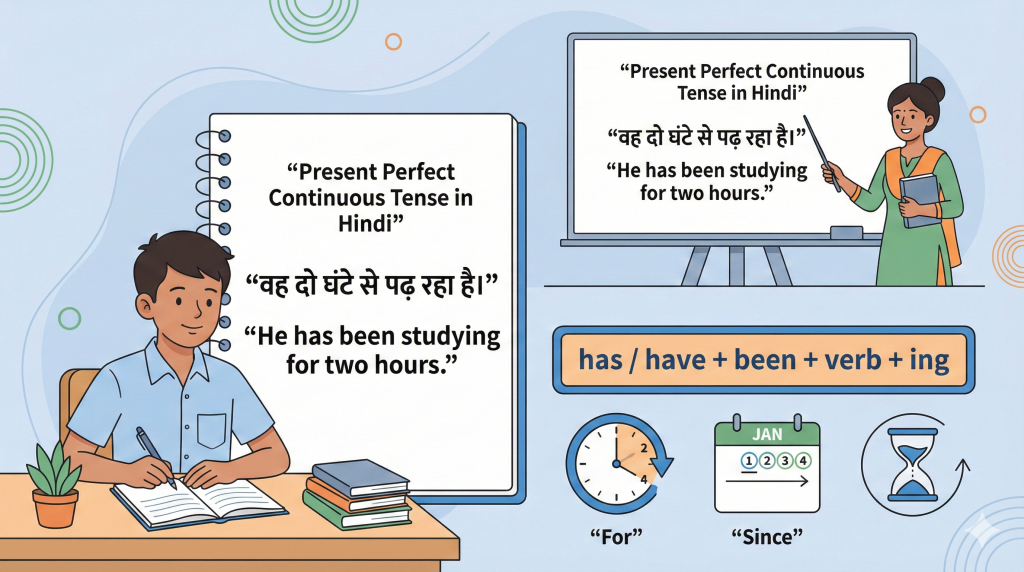
Present perfect continuous tense in hindi explains an action that started in the past and is still continuing in the present. This tense is commonly used in school grammar exercises, Hindi-to-English translation questions, and daily conversations.
For example:
वह दो घंटे से पढ़ रहा है।
He has been studying for two hours.
Here, studying started two hours ago and the action is continuing now.
In this guide, students will learn the meaning, identification rules, formula, examples, common mistakes, and practice exercises with simple explanations.
What is Present Perfect Continuous Tense
Present Perfect Continuous Tense is used for an action that began in the past and continues in the present.
Formula:
Subject + has/have + been + Verb(ing) + since/for + time
Example:
Hindi:
मैं सुबह से पढ़ रहा हूँ।
English:
I have been studying since morning.
Quick Identification:
- Ending: से रहा है / से रही है / से रहे हैं
- Helping Verb: has been / have been
- Main Verb: Verb + ing
- Time Words: since, for
Present Perfect Continuous Tense का Hindi Meaning
Present perfect continuous tense meaning in hindi यह है कि कोई काम पहले शुरू हुआ था, कुछ समय से चल रहा है और अभी भी खत्म नहीं हुआ है।
इस tense में action की continuity सबसे important होती है।
Example:
वह पाँच साल से दिल्ली में रह रहा है।
He has been living in Delhi for five years.
इस sentence में:
- रहने का काम पहले शुरू हुआ
- पाँच साल तक चला
- अभी भी जारी है
यही इस tense की basic पहचान है।
Teacher Note:
अगर sentence में केवल काम पूरा होने की बात हो, तो यह tense नहीं लगेगा। हमेशा देखें कि action अभी continue हो रहा है या नहीं।

Present Perfect Continuous Tense की पहचान
Present perfect continuous tense ki pehchan समझने के लिए केवल sentence ending याद करना काफी नहीं है। Students को sentence का meaning भी समझना चाहिए।
आमतौर पर Hindi sentences में ये endings मिलती हैं:
- से रहा है
- से रही है
- से रहे हैं
- से रहा हूँ
Examples:
वह सुबह से खेल रहा है।
He has been playing since morning.
वे दो घंटे से इंतजार कर रहे हैं।
They have been waiting for two hours.
लेकिन ध्यान रखें:
“रहा है” हमेशा Present Perfect Continuous नहीं होता।
Example:
वह पढ़ रहा है।
He is studying.
यह Present Continuous है क्योंकि इसमें समय नहीं दिया गया है।
Present Perfect Continuous Tense Rules in Hindi
Sentence बनाने के लिए तीन चीजें याद रखें:
- सही helping verb चुनें
- Verb में ing लगाएं
- Since या For का सही उपयोग करें
Sentence Formula
Subject + has/have + been + Verb + ing + since/for + time
Example:
वह सुबह से काम कर रहा है।
He has been working since morning.
Has Been और Have Been का प्रयोग
Subject के अनुसार helping verb बदलती है।
| Subject | Helping Verb | Example |
|---|---|---|
| He | has been | He has been reading |
| She | has been | She has been studying |
| It | has been | It has been raining |
| I | have been | I have been working |
| We | have been | We have been learning |
| You | have been | You have been writing |
| They | have been | They have been playing |
Memory Trick:
He, She, It और एक व्यक्ति के साथ has been याद रखें। बाकी subjects के साथ अधिकतर have been आता है।
Since और For का सही Use
इस tense में since और for बहुत important हैं क्योंकि ये बताते हैं कि काम कितने समय से चल रहा है।
| Since | For |
|---|---|
| Fixed starting time | Time duration |
| कब से | कितने समय से |
| since morning | for two hours |
| since 2020 | for five years |
| since Monday | for three days |
Examples:
She has been studying since morning.
He has been working for three hours.
Common Student Mistake
Wrong:
I have been waiting since two hours.
Correct:
I have been waiting for two hours.
क्योंकि “two hours” duration है, fixed starting point नहीं।
Present Perfect Continuous Tense Examples in Hindi and English
यहाँ दिए गए examples school exams और daily English practice के लिए बनाए गए हैं।
Affirmative Sentences
Structure:
Subject + has/have been + Verb ing + time
Examples:
- वह दो घंटे से पढ़ रहा है।
He has been studying for two hours. - मैं सुबह से तुम्हारा इंतजार कर रहा हूँ।
I have been waiting for you since morning. - बच्चे दोपहर से खेल रहे हैं।
Children have been playing since afternoon. - वह कई दिनों से मेहनत कर रही है।
She has been working hard for many days. - हम पिछले महीने से तैयारी कर रहे हैं।
We have been preparing since last month. - किसान सुबह से खेत में काम कर रहा है।
The farmer has been working in the field since morning. - वे पाँच साल से यहाँ रह रहे हैं।
They have been living here for five years. - मैं एक घंटे से सवाल हल कर रहा हूँ।
I have been solving questions for one hour.
Negative Sentences
Structure:
Subject + has/have + not + been + Verb ing + time
Examples:
- वह दो दिनों से स्कूल नहीं जा रहा है।
He has not been going to school for two days. - मैं सुबह से मोबाइल इस्तेमाल नहीं कर रहा हूँ।
I have not been using my phone since morning. - वे कई दिनों से अभ्यास नहीं कर रहे हैं।
They have not been practising for many days. - वह एक हफ्ते से पढ़ाई नहीं कर रही है।
She has not been studying for a week. - बच्चे सुबह से शोर नहीं कर रहे हैं।
Children have not been making noise since morning.
Interrogative Sentences
Structure:
Has/Have + Subject + been + Verb ing + time?
Examples:
- क्या वह सुबह से पढ़ रहा है?
Has he been studying since morning?
- क्या तुम दो घंटे से इंतजार कर रहे हो?
Have you been waiting for two hours?
- क्या बच्चे सुबह से खेल रहे हैं?
Have children been playing since morning?
- क्या वे लंबे समय से तैयारी कर रहे हैं?
Have they been preparing for a long time?
WH Question Examples
WH questions exams और conversations दोनों में important होते हैं।
Structure:
WH Word + has/have + subject + been + verb ing?
Examples:
How long have you been studying?
तुम कितने समय से पढ़ रहे हो?
Where has she been working?
वह कहाँ काम कर रही है?
Why have they been waiting?
वे इंतजार क्यों कर रहे हैं?
Present Perfect vs Present Perfect Continuous Tense Difference
Students अक्सर इन दोनों tenses में गलती करते हैं।
| Present Perfect | Present Perfect Continuous |
|---|---|
| Completed action दिखाता है | Continuing action दिखाता है |
| Result important होता है | Duration important होती है |
| Has/Have + V3 | Has/Have been + Verb ing |
Examples:
Present Perfect:
I have completed my homework.
(काम पूरा हो चुका है)
Present Perfect Continuous:
I have been completing my homework for two hours.
(काम अभी जारी है)
Present Perfect Continuous Passive Voice
इस tense का passive voice बहुत कम use होता है और modern English में generally avoid किया जाता है।
Structure:
Object + has/have been being + V3
Example:
Active:
He has been writing a letter.
Passive:
A letter has been being written by him.
Exam Note:
School exams में इस tense का active form ज्यादा पूछा जाता है। Passive structure केवल advanced grammar understanding के लिए याद रखें।
Revision Table
| Point | Rule |
|---|---|
| Tense Name | Present Perfect Continuous |
| Use | Past से शुरू होकर present तक चलने वाला काम |
| Helping Verb | has been / have been |
| Main Verb | Verb + ing |
| Time Words | since, for |
| Example | He has been studying |
Present Perfect Continuous Tense Practice Worksheet
Fill in the blanks
Use has been / have been.
- He ______ studying for two hours.
- They ______ playing since morning.
- She ______ preparing for exams.
- We ______ waiting since 8 AM.
- I ______ learning English for one year.
Answers:
- has been studying
- have been playing
- has been preparing
- have been waiting
- have been learning
Hindi to English Practice
Translate:
- वह सुबह से पढ़ रहा है।
- मैं दो घंटे से काम कर रहा हूँ।
- बच्चे शाम से खेल रहे हैं।
- वह कई दिनों से अभ्यास कर रही है।
Answers:
- He has been studying since morning.
- I have been working for two hours.
- Children have been playing since evening.
- She has been practising for many days.