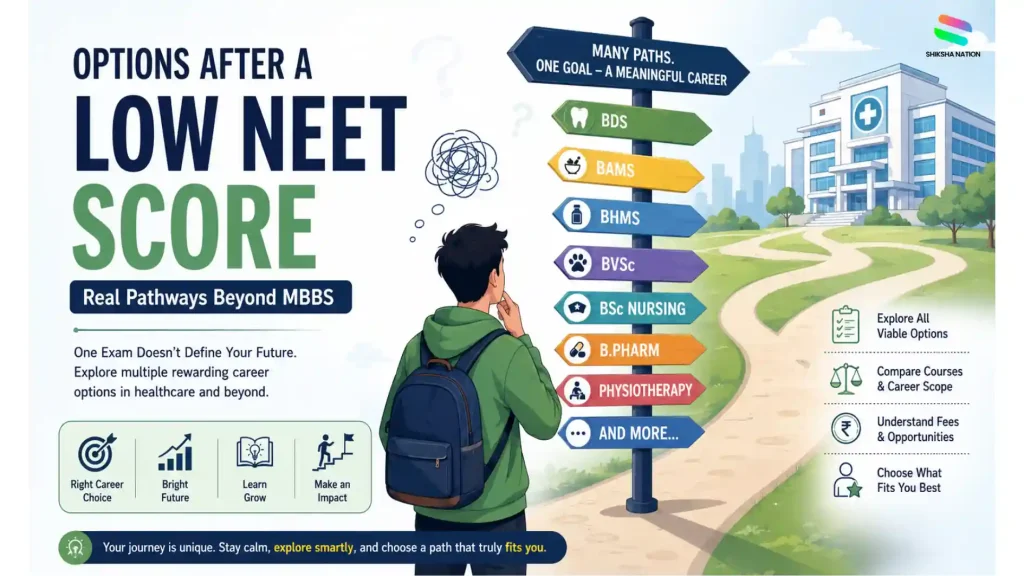
What Your After Low NEET Score
Here’s a clear overview, then a deeper look at the ones worth serious consideration.
Major Options After Low NEET Score Comparision
| Course |
Duration |
NEET Required? |
Govt. College Fees (Indicative) |
Private College Fees (Indicative) |
Career/Earning Outlook |
| BDS |
5 years (incl. internship) |
Yes |
₹20,000-1.5 lakh/year |
₹3-8 lakh/year |
Private practice; job market competitive in metro areas |
| BAMS |
5.5 years (incl. internship) |
Yes |
₹10,000-1 lakh/year |
₹1.5-5 lakh/year |
Growing; practice rights vary significantly by state |
| BHMS |
5.5 years (incl. internship) |
Yes |
₹10,000-75,000/year |
₹1-4 lakh/year |
Niche but stable; private practice dominant |
| BVSc |
5.5 years (incl. internship) |
Yes (most states) |
₹20,000-1.5 lakh/year |
₹2-6 lakh/year |
Govt. jobs competitive; private/corporate sector growing |
| BSc Nursing |
4 years |
Yes (for many central/state seats) |
₹10,000-50,000/year |
₹1-3 lakh/year |
Strong demand; international opportunities (Gulf, UK, Canada) |
| B.Pharm |
4 years |
No (most states) |
₹20,000-60,000/year |
₹50,000-2 lakh/year |
Retail, hospital, or industry tracks; mid-career scope is strong |
| BPT (Physiotherapy) |
4.5 years (incl. internship) |
No (most states) |
₹15,000-50,000/year |
₹50,000-2 lakh/year |
Urban demand rising; clinic/sports/rehab paths |
| DMLT / MLT |
2-3 years (diploma/degree) |
No |
₹5,000-30,000/year |
₹30,000-1 lakh/year |
Lab diagnostics; steady employment |
| BSc Radiology / Imaging |
3 years |
No |
₹10,000-40,000/year |
₹50,000-1.5 lakh/year |
Hospital-driven demand; limited but reliable niche |
| BOT (Occupational Therapy) |
4.5 years |
No |
₹15,000-40,000/year |
₹50,000-1.5 lakh/year |
Growing awareness; urban rehab and disability sector |
Fee ranges are indicative only and vary considerably by state, institution type, and management quota vs. merit seat. Verify current fees directly with the institution and relevant state counselling authority before deciding.
Also Read: NTA NEET UG Result 2026, OMR Sheet, Answer Key Status and everything needs to know / NEET Result 2026 Cut off, Score Card, AIR, Result Link and Latest Updates / NEET Syllabus 2026
Questions to Ask Yourself Before Choosing an Alternative to MBBS
- What do I actually want to do in a healthcare setting diagnose, treat, assist, research, or advise?
- How long am I willing to study, and how much debt am I (and my family) genuinely comfortable with?
- Where do I want to live and work after graduating metro, smaller city, rural area, or abroad?
- Am I choosing this course because I want it, or because it’s the closest thing to MBBS I could find?
- Have I looked at what practitioners in this field actually do on a normal Tuesday, not just the career-guide version?
- Does the earning potential of this course make financial sense against the private college fees I’d pay?
- Am I willing to reconsider MBBS via a drop year, and what’s my honest read on whether that would change my score significantly?
BDS – Bachelor of Dental Surgery
BDS is often the first alternative people consider, and that’s not irrational. It’s a five-year degree, including a mandatory one-year internship, fully recognised under law, and dentists have independent prescribing and practice rights. You’re a licensed clinician.
The honest caveat: dental job markets in India are saturated in certain urban pockets. New graduates in Delhi, Mumbai, or Bengaluru often spend years building a patient base before private practice becomes financially stable. Dentists who set up in tier-2 and tier-3 towns, or areas with low dental penetration, often do considerably better within a few years. The international route is real too, but it requires country-specific licensing exams (MDS plus NBDE for the US, GDC registration for the UK, and similar).
A private BDS charging ₹6–8 lakh a year is a 30-lakh-plus investment. That’s not unreasonable if you’re committed to building a practice, but it deserves honest thought.
BAMS – Bachelor of Ayurvedic Medicine and Surgery
BAMS is a 5.5-year course, including internship, regulated by the Central Council of Indian Medicine. It’s a proper clinical degree with pharmacology, anatomy, pathology, and patient management, not a certification in herbal wellness.
The important thing to understand before choosing BAMS: practice rights vary by state. A 2020 notification allowing BAMS graduates to perform certain surgical procedures under specific conditions created significant controversy and remains contested in parts of the country. What a BAMS graduate can legally prescribe, treat, or operate on differs between states and is subject to ongoing regulatory revision. If your reason for considering BAMS hinges on a specific scope of practice, verify the current rules in your state against the latest AYUSH and state medical council notifications rather than relying on something you heard two years ago.
Where BAMS has genuine traction: government AYUSH dispensaries and hospitals (job notifications appear regularly in states like Rajasthan, Maharashtra, and UP), private Ayurvedic clinics, and integration into wellness and preventive care. PG options exist through AIAPGET.
BHMS – Bachelor of Homeopathic Medicine and Surgery
BHMS is also 5.5 years, regulated by the Central Council of Homeopathy. The career reality is narrower than BAMS. Private homeopathic practice has a genuine patient base in India, particularly in Maharashtra, West Bengal, and Kerala, but government job opportunities through BHMS are more limited than through BAMS in most states.
The same scope-of-practice caution applies here: what a BHMS practitioner can do, especially around prescribing rights and whether modern medicine can be co-prescribed, varies by state.
BHMS suits someone with genuine interest in homeopathy as a system of medicine who’s realistic about building a private practice. It’s harder to recommend if you’re mainly drawn to it because it was the closest available option that mismatch tends to show up in career outcomes later.
BVSc – Bachelor of Veterinary Science and Animal Husbandry
BVSc runs 5.5 years and requires NEET in most states for government college admission. It’s an underrated option that doesn’t get enough credit in standard career guidance.
Veterinary science in India sits at a genuinely interesting point: the livestock and poultry industry is large, the pet care market is expanding fast in urban India, and food safety and animal public health need trained vets at the government level. State veterinary officer positions come up regularly and are reasonably competitive.
The honest limitation: government job competition is real, and small-animal private practice requires building a client base in cities where that market is still growing. But for someone genuinely interested in animals, biology, and a healthcare role without the specific pressures of human medicine, BVSc can be a very satisfying career.
BSc Nursing
Four years, clinically intensive, and the employment numbers are genuinely strong, not in a marketing-brochure way but in a real-demand way. Gulf countries, the UK, Canada, Australia, and Germany are all actively recruiting Indian nurses, and the pathway to overseas registration, while it involves licensing exams and credential verification, is well-established enough that many nursing graduates plan for it from year one.
Within India, both public hospitals and growing private hospital chains hire nurses at scale. ICU-specialised nurses, OT nurses, and nurses with NICU experience command real salary premiums.
The work is physically and emotionally demanding. Night shifts are standard, and hospital hierarchy can be rigid. These aren’t reasons to skip nursing, but they’re part of the realistic picture worth knowing before you’re in year two.
NEET is used for BSc Nursing admissions at many central and state institutions; private college admissions vary. Check the specific counselling process for the state you’re applying to.
B.Pharm – Bachelor of Pharmacy
Four years, and in most states it doesn’t require NEET, which makes it accessible to students who want to stay in healthcare but whose NEET score doesn’t open other doors.
The career tracks genuinely differ depending on what you do with the degree. Retail pharmacy is the most visible path, but not the only one. Pharmaceutical manufacturing and quality control hire pharmacists into production, QA, and regulatory affairs. Hospital pharmacy is a growing discipline. Clinical research organisations hire B.Pharm graduates for trial coordination and data roles. Government Drug Inspector posts are another direction.
M.Pharm or Pharm.D (six years, more clinically oriented) significantly expand scope. B.Pharm gets you started; what you do with the mid-career years matters a lot.
BPT – Bachelor of Physiotherapy
Four and a half years, including internship. Most states don’t require NEET for physiotherapy admissions, again making it accessible regardless of your NEET rank.
Physiotherapy in India is at an interesting inflection point. Urban awareness of sports medicine, rehabilitation, and post-surgical care has grown meaningfully over the last decade. Corporate wellness programmes hire physiotherapists. Sports teams, from IPL franchises to state-level associations, have expanding physio rosters. Neurological rehabilitation for stroke and trauma patients is a specialisation with strong demand as India’s older population grows.
Private practice is viable in cities; government hospital physiotherapy positions exist but are limited. The international route is cleaner than many assume: registered physiotherapists can pursue licensing pathways to the UK (HCPC), Canada, Australia, and parts of the Gulf.
Non-NEET Pathways: Staying in Science and Healthcare
If you want to stay connected to biology, medicine, or healthcare science without the NEET route, these are worth knowing about.
BSc Biology, Biotechnology, Microbiology, Biochemistry: Three-year degrees opening into research, diagnostics, public health, the pharmaceutical industry, and PG pathways like MSc and PhD. The job-at-graduation picture is less structured than clinical courses, but for students genuinely drawn to research or lab science, the ceiling is high.
Allied Health Sciences degrees: BSc programmes in medical laboratory technology, radiology, operation theatre technology, and dialysis technology are offered by AIIMS, CMC Vellore, and various state health universities. These are often undersubscribed and underrated.
BSc Biotechnology or Life Sciences into research: CSIR, ICMR, and DBT run fellowship programmes for postgraduates. For someone genuinely drawn to scientific inquiry over clinical practice, a research track is a real option, not a fallback.
Beyond healthcare entirely this post won’t tell you “you can do anything,” you already know that and it’s not particularly useful right now. But if engineering, economics, law, or design genuinely interest you more than any healthcare path, choosing a healthcare path just because it feels medically adjacent to MBBS isn’t a sound reason.
Evaluating Alternatives on Their Own Terms
This is the part most career guidance articles skip, but it matters.
If you choose BDS or BVSc or nursing while thinking “well, it’s not MBBS, but…” you’re setting yourself up for five-plus years of mild resentment and, often, underinvestment in actually getting good at what you’re doing. That’s bad for you and bad for the people you’ll eventually treat.
The more useful framing: what does a good outcome in this field actually look like, and does that outcome appeal to you? A physiotherapist running a well-regarded sports rehab clinic in a growing city. A nurse who’s completed a critical care certification and is working in the UK on a structured migration pathway. A veterinarian who’s built a small-animal practice in a city where that market barely existed ten years ago. These are specific, real outcomes they don’t require settling, they require choosing deliberately and then actually committing.
Some of these fields, particularly nursing with international scope and pharmacy on the clinical or regulatory track, have mid-career earning and satisfaction profiles that hold up reasonably well against general MBBS practice. That’s not overclaiming it’s just true, and it’s worth sitting with before you decide between a drop year and an alternative course.
Low NEET Score related FAQs