Which college your NEET rank can realistically get depends on four things: your category rank (not just your overall rank), whether you’re competing in AIQ or your home state’s counselling, the quota or seat type you’re eligible for, and what previous years’ opening and closing ranks show for that specific lane. There’s no single number that maps cleanly to a single college but there’s a method that gets you close.

Why “My Rank = This College” Thinking Doesn’t Work
It’s tempting to search for a clean answer: “I have rank X, so I get College Y.” That’s not how seat allotment works, and believing it can lead to real mistakes in your choice filling the step covered in the MCC vs state counselling post, where most students either play it smart or leave seats on the table.
Two concepts matter here.
- Opening rank is the best (lowest-numbered) rank that received an allotment for a particular seat in a particular round.
- Closing rank is the worst (highest-numbered) rank that received an allotment. If closing rank for a seat last year was, say, some number N in the general AIQ category, the student ranked N was the last one to get in anyone ranked beyond N in that category missed it.
Here’s why year-to-year comparison needs care. Seat matrices change: new colleges open, existing colleges gain or lose seats, reservation categories shift. NEET difficulty changes year to year, which moves rank distributions even when scores look similar. The number of candidates in each category changes too. A closing rank from one year doesn’t guarantee the same cutoff next year it might move meaningfully in either direction. That’s why you need three to five years of data, not just the most recent cycle.
One year of data is a guess. Three to five years of data is a pattern.
Also Read: Check Score by NEET Result 2026, result download link, AIR, Cutoff and Latest Updates / Eligibility Criteria of NEET 2026 / NTA NEET UG 2026, download OMR Sheet, and other things
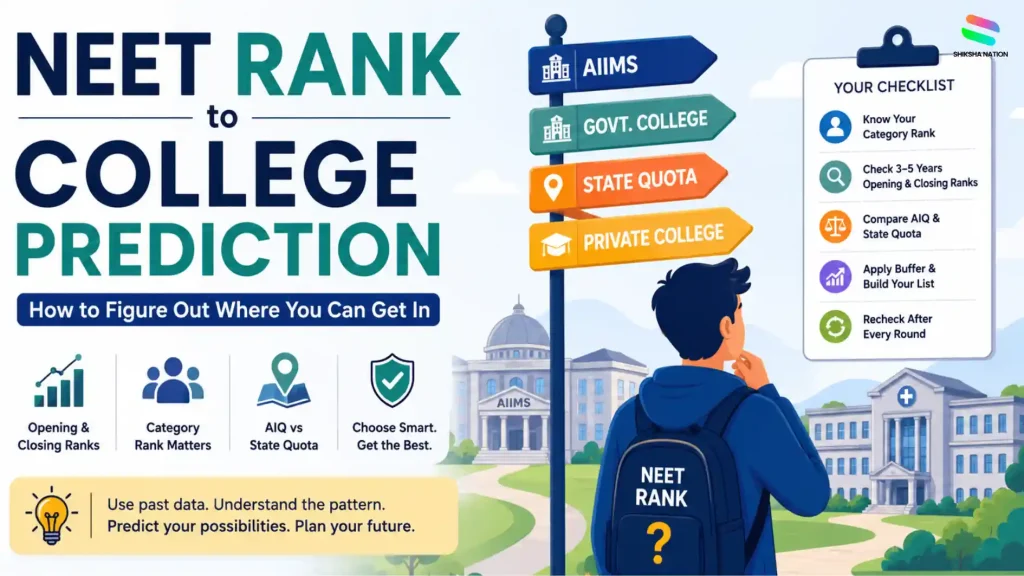
Steps to Realistically Predict Your College Using Rank Data
- Identify your category rank, not just your overall rank: Your allotment competes against your category peers, not the entire NEET field. If you belong to OBC, SC, ST, or EWS, your category rank is what actually matters for most reserved seats this is the natural next step from the category rank concept covered in the state quota eligibility post.
- Decide which counselling lanes apply to you: Are you eligible for AIQ seats through MCC? Your home state’s state quota? Both? Private colleges under management quota? Each lane carries different competition levels and different historical data.
- Go to the official source for cutoff data: For AIQ seats, that’s mcc.nic.in, which publishes previous years’ opening and closing ranks by college, course, category, and round. For state quota seats, use the specific state’s DME or DGME counselling website. Bookmark these don’t rely on screenshots circulating in Telegram groups.
- Pull three to five years of data for colleges in your realistic range: Look at the closing rank for your category across those years. Note the highest (most competitive) and lowest (least competitive) closing rank in that period your realistic zone sits somewhere in that range.
- Apply a buffer: Don’t assume you’ll get in just because your rank exactly matches last year’s closing rank that’s the absolute last seat, and year-to-year variation is real. Look for colleges where your rank sits comfortably within the historical range, not right at its edge.
- Build a list across tiers: Colleges where your rank is well within historical closing ranks (likely), colleges near the edge (possible), and colleges somewhat outside but reachable in favourable years (stretch). Your choice-filling order across these tiers is what the counselling post covers in detail.
- Recheck after each round: Seats vacate and reopen between rounds in MCC counselling. A college that looked out of reach in Round 1 might be accessible in Round 2 or the Stray Vacancy round. Prediction is a starting point, not a final answer.
AIIMS Campuses: Not One Target, Several
Students often treat “AIIMS” as a single category. It isn’t. AIIMS Delhi and the newer AIIMS institutes set up under the Pradhan Mantri Swasthya Suraksha Yojana (PMSSY) programme sit at very different competition levels.
AIIMS Delhi is, by any measure, among the most competitive medical seats in the country. The newer AIIMS campuses spread across states like Bhopal, Jodhpur, Patna, Raipur, Rishikesh, and others are considerably more accessible by comparison, though still competitive relative to most government medical colleges.
The practical implication: if AIIMS Delhi looks genuinely out of reach based on historical data for your category rank, some newer AIIMS campuses may still be realistic targets. The reverse is also true don’t assume all AIIMS campuses are equally accessible just because one or two are.
AIIMS allotments run through MCC counselling, so cutoff data for every AIIMS campus, including previous years’ opening and closing ranks by category, is available on mcc.nic.in. Compare your category rank against each individual campus’s historical data, not “AIIMS” as a block.
How Your Category Rank Changes the Picture
Your overall NEET rank places you relative to every candidate who appeared. Your category rank places you relative only to candidates in your reservation category competing for reserved seats.
If you’re competing in the general category, your overall rank and general category rank are effectively the same. If you belong to OBC, SC, ST, or EWS, your category rank is typically significantly better than your overall rank and it’s your category rank that determines your competitiveness for reserved seats.
The practical point: a student with a mid-range general category rank might have a category rank that opens up colleges that would otherwise be out of reach. Most government medical colleges and AIIMS campuses carry reserved seats in each category, each with its own historical closing ranks.
When pulling data from mcc.nic.in or a state counselling website, always filter by your specific category. Comparing your rank against the general category closing rank while you’re actually competing for OBC reserved seats will give you the wrong prediction entirely.
The Home-State Advantage Is Real Here’s Why
Your NEET rank goes further inside your home state’s counselling than it does in AIQ. That’s not a quirk it’s by design, and the mechanism is straightforward.
85% of seats in government medical colleges are state quota seats, filled through each state’s own counselling, open only to candidates with domicile or state eligibility for that state. The competition pool is smaller and localised only eligible candidates from that state compete for those seats.
AIQ takes the remaining 15% of government college seats and fills them nationally through MCC. A government college seat in Tamil Nadu that goes through AIQ is being competed for by candidates from Maharashtra, Delhi, UP, and everywhere else. The competition is national.
The result: the closing rank for a state quota seat at a given college is almost always higher-numbered (less competitive) than the closing rank for the AIQ seat at that same college. Your rank simply goes further in state quota because fewer candidates compete for those seats.
Many states also carry state-specific reservations defence personnel’s children, NRI category, physically disabled, sports quota, and others that don’t apply in AIQ at all, further segmenting competition within state counselling. This is exactly why knowing your state of eligibility, covered in the earlier eligibility post, matters before you even start building a college list.
The Different Lanes Your Rank Competes In
| Seat Type | Who Can Access | Typical Competition Level | Key Data Source |
|---|---|---|---|
| AIQ General (Unreserved) | All NEET-qualified candidates | Very High | mcc.nic.in |
| AIQ Reserved Category | Candidates with valid OBC/SC/ST/EWS certificate | High | mcc.nic.in |
| State Quota General | State-eligible candidates (general) | Moderate (state-specific) | State DME/DGME website |
| State Quota Reserved | State-eligible candidates with reservation | Moderate to Accessible | State DME/DGME website |
| AIIMS All Categories | All NEET-qualified; category reservations apply | Very High (Delhi) to High (newer campuses) | mcc.nic.in |
| Management Quota (Private) | All NEET-qualified; rank matters less | Accessible by rank; fee is the primary filter | College prospectus / state private authority |
| NRI Quota (Private) | NRI-sponsored candidates | Accessible by rank; high fee | College prospectus |
Management and NRI quota seats deserve a separate note: the rank requirement is often substantially lower than for government or open-quota private seats. The real limiting factor is fee, not rank and the earlier post in this series on private medical college fees and ROI is worth cross-referencing if management quota is realistically on your list.
Online Rank Predictors: What to Trust and What to Ignore
There are dozens of “NEET rank predictor” apps and websites out there. Some give you a confidence score, a college list, even a probability percentage. Treat these with real skepticism.
Most pull from incomplete datasets, outdated cutoff information, or simply repackage last year’s closing rank data with a veneer of algorithm. The better ones are basically doing what this post describes cross-referencing your rank against previous years’ data without full transparency about which years, which categories, or whether the seat matrix has been updated since.
The deeper problem is false confidence. A student told by an app they have a “78% chance” at a particular college may stop building out a backup list, which is exactly the wrong move in a multi-round counselling process with shifting seat availability.
Use official data instead. For AIQ and AIIMS seats, that’s mcc.nic.in. For state quota seats, your state’s DME or DGME website, which publishes round-wise allotment lists and previous years’ cutoffs after each counselling cycle. Some states also publish official brochures with historical rank matrices these are more reliable than any third-party app.
The method in this post pulling three to five years of official closing rank data, segmented by category, across both AIQ and state quota lanes will serve you better than any predictor tool.