
Students often ask what is the opposite of modern, especially while studying English grammar or preparing for school exams. This is a common vocabulary question in Classes 4-10 and usually appears in word-meaning, fill-in-the-blanks, or short-answer sections.
The modern opposite word is not always the same in every situation. Its meaning depends on how the word modern is used in a sentence. In most academic contexts, the opposite of modern refers to something that belongs to an earlier time or follows old ways.
Understanding the opposite of modern correctly helps students write better answers and avoid confusion in exams. Parents also look for clear explanations so they can guide their children at home.
In this topic, we will explain the correct opposite words of modern, their meanings, and how to use them properly in English grammar, with a clear focus on exam usage.
What Is the Opposite of Modern?
The word modern is used to describe something that is new, recent, or related to the present time. In English grammar, it often refers to ideas, objects, or ways of living that belong to today’s world.
So, the opposite of modern depends on what aspect we are talking about. Because modern can be used in different situations, more than one opposite word exists. This is why students often feel confused while answering grammar questions.
Why Does Modern Have More Than One Opposite?
The opposite word of modern changes with context. For time, it usually means something from the past. For habits or lifestyle, it may refer to older traditions or practices.
In exams, when students are asked what is the antonym of modern, teachers expect the most suitable opposite based on the sentence given. Understanding the meaning first helps in choosing the correct answer.
Modern Opposite Words in English
In English grammar, there is not just one fixed modern opposite. The correct opposite depends on how the word modern is used in a sentence. This is why students learn multiple modern opposite words instead of memorising only one.
Teachers expect students to choose the right word based on meaning and context. Knowing different antonyms of modern helps in writing accurate answers in exams and improves overall vocabulary.
Common Antonyms of Modern
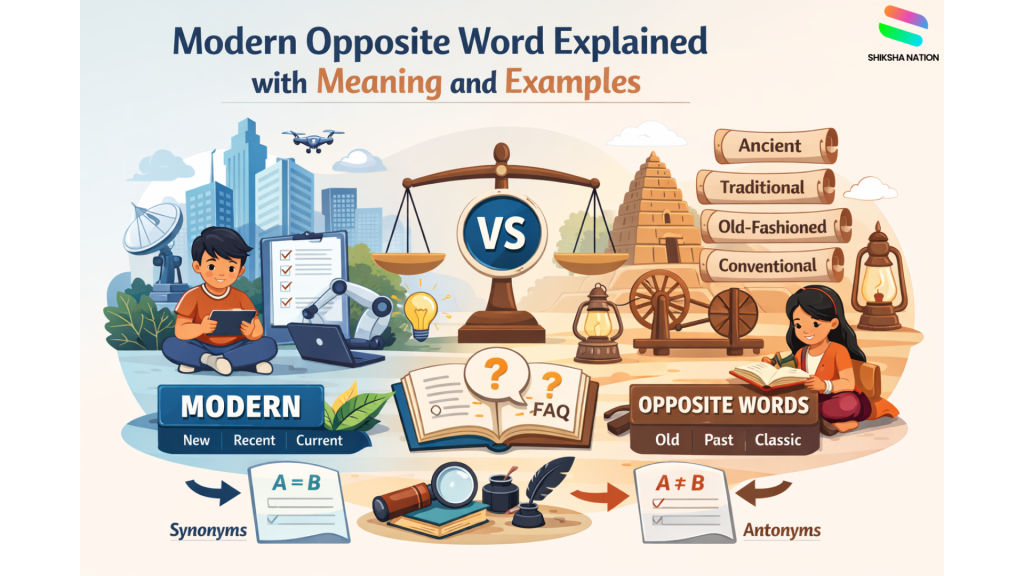
Ancient
This word is used when modern refers to time or history. It describes things that belong to a very old period, such as ancient civilisations or ancient tools.
Traditional
This is used when modern relates to customs, culture, or lifestyle. Traditional refers to practices followed for many years.
Old-fashioned
This word is suitable when talking about clothes, ideas, or habits that are no longer popular today.
Conventional
This is used when modern means new or innovative thinking. Conventional refers to usual or commonly accepted ways.
These words are the most common modern antonyms in English. Understanding their usage helps students clearly identify the correct antonyms modern in grammar-based questions.
Meaning of Modern and Its Opposites (Grammar Context)
In English grammar, the word modern is mainly used as an adjective. It describes a noun by telling us that something belongs to the present time or uses new ideas. For example, we say modern technology or modern methods.
To understand the modern opposite word meaning, students must first look at the noun being described. The opposite word changes based on what modern is qualifying in the sentence. This approach is important in school-level grammar.
How Modern and Its Opposites Are Used in Grammar
In modern opposite word in English, opposites are also adjectives. They describe the same noun but with a different time, style, or way of thinking. Grammar questions often test this understanding.
In modern opposite word in English grammar, exams usually check whether students can choose the correct adjective based on context, not just memory. Parents can help children by encouraging them to read the full sentence before selecting an opposite word.
Modern vs Ancient – Explained with Examples
In many grammar questions, ancient is taught as the modern opposite word ancient. This is correct when modern is used to talk about time, history, or development. Understanding this difference helps students avoid mistakes in exams.
Parents often notice that children memorise words but struggle to apply them in sentences. Looking at examples makes the meaning clear and easier to remember.
Comparison: Modern vs Ancient
| Modern | Ancient |
| Related to present time | Related to very old time |
| Uses new ideas and methods | Uses early or old methods |
| Example: modern technology | Example: ancient tools |
| Example: modern cities | Example: ancient civilizations |
Examples in Sentences
- We use modern machines to complete work faster today.
- Ancient people used simple tools made from stone and wood.
- Schools follow modern teaching methods to help students learn better.
- Many ancient buildings still exist and show old architectural styles.
In grammar, when modern clearly refers to the present age, ancient becomes the correct opposite modern choice. Reading the sentence carefully helps students select the right answer confidently.
Modern Synonym and Antonyms (For Exams)
In school exams, students are often asked to write modern synonym and antonyms. Knowing the difference between them helps in vocabulary questions, match-the-following, and sentence correction.
A modern synonym is a word that has a similar meaning to modern. These words are used when something is new, recent, or updated.
Synonyms of Modern
Some common modern synonyms used in exams are:
- Contemporary
- Recent
- New-age
- Current
- Updated
These synonyms of modern can be used in sentences where the meaning remains almost the same.
Antonyms of Modern
Antonyms are words with opposite meanings. Common opposites include:
- Ancient
- Traditional
- Old-fashioned
- Conventional
Students should remember that the synonym for modern or its opposite depends on the sentence. Parents can help by asking children to replace the word in a sentence and check if the meaning still makes sense. This practice improves exam accuracy.
Modern Ka Opposite Word (For Hindi Medium Students)
Hindi medium students often ask modern ka opposite word while studying English grammar. To understand this clearly, it is important to connect the English word with its meaning in Hindi, not just memorise the answer.
The word modern usually means आधुनिक. So, modern ka opposite will depend on the situation used in the sentence. In most exam-based questions, the expected opposite is प्राचीन or परंपरागत.
Exam-Safe Understanding for Students
When modern talks about time or history, its opposite means something from the past. When it talks about customs or lifestyle, the opposite refers to old traditions.
Teachers prefer clear and neutral answers. So while writing modern ka antonyms in exams, students should choose words that are academically correct and free from social judgement. Parents can help by practising simple sentence examples at home.
Modernity Opposite Word – What Does It Mean?
The word modernity is an abstract noun. It does not name a physical object but an idea or quality. Modernity refers to the state of being modern, including new thinking, lifestyle, and social development.
The modernity opposite word refers to ideas or systems that are linked to older times. In grammar and exam context, this opposite is often understood as tradition or traditionalism, depending on how the sentence is framed.
Students should remember that abstract nouns do not always have one fixed opposite. The correct opposite comes from the meaning of the sentence. Parents can guide children by explaining ideas in simple terms instead of focusing only on memorised words.
FAQs on Modern Opposite Word
Q. What is the opposite of modern in one word?
The most common one-word opposite of modern is ancient. It is used when modern refers to the present time or recent development. In school exams, this is usually the expected answer unless the sentence gives a different context.
Q. Is ancient always the opposite of modern?
No, ancient is not always correct. It works only when modern is related to time, history, or age. If the sentence talks about lifestyle, habits, or culture, another word may fit better. Students should read the sentence carefully before answering.
Q. Can traditional be used as the opposite of modern?
Yes, traditional can be used as the opposite of modern in many cases. It is suitable when modern refers to customs, values, or ways of living. Parents often see children confuse these words, so understanding usage is more important than memorising.
Q. What is the antonym of modern for exams?
For exams, the answer to what is the antonym of modern depends on the sentence. Common accepted answers include ancient, traditional, or old-fashioned. Teachers look for meaning-based answers, not just fixed word pairs. Choosing the correct opposite of modern shows clear grammar understanding.