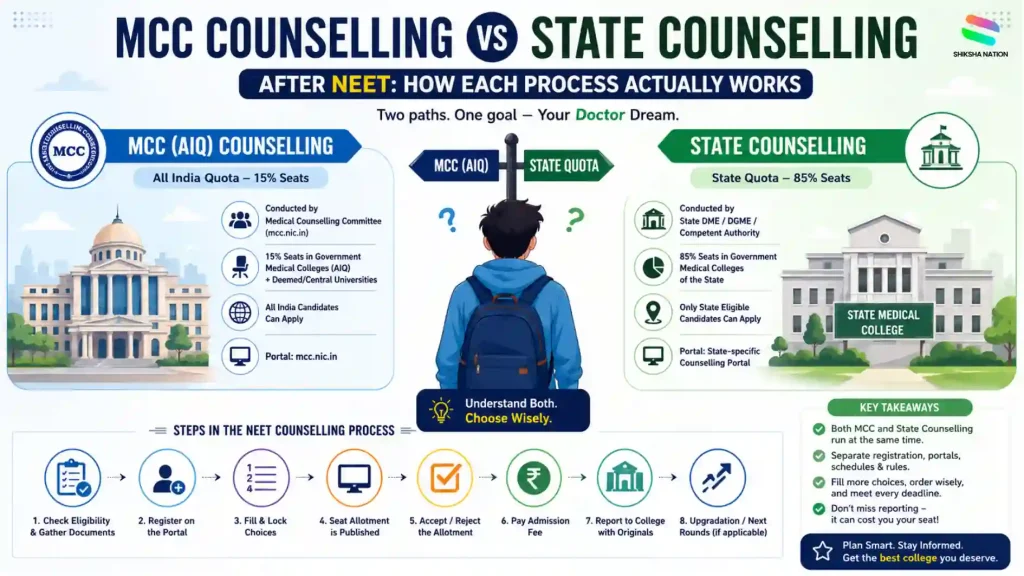
MCC counselling (run by the Medical Counselling Committee) fills the 15% All India Quota seats across government medical colleges through a centralised online process at mcc.nic.in. State counselling fills the remaining 85% state quota seats and is run separately by each state’s DME or DGME. The core difference isn’t just seat share both run simultaneously on their own timelines, with separate registrations, portals, and rules.
If you’ve already read our earlier post on NEET state quota eligibility, covering domicile requirements, state of eligibility, and category reservations, this picks up where that one left off. That post is about who can apply where. This one is about how the actual process runs, round by round, once you’re eligible.
The Two Counselling Tracks: A Quick Orientation
Every NEET-UG seat in a government medical college falls into one of two buckets.
The first 15% of seats in each government medical college (except in Jammu and Kashmir, which has its own arrangement) go under the All India Quota. MCC conducts this counselling centrally. Any eligible NEET candidate from any state can compete for these seats, subject to category rules and college-specific eligibility.
The remaining 85% are state quota seats. Each state runs its own counselling to fill these, with its own registration portal, schedule, and rules. A candidate competing for Maharashtra’s state quota seats goes through the process run by Maharashtra’s competent authority, not through MCC.
Both processes run in parallel each year. You don’t have to choose one over the other at the start you can register for both simultaneously. Managing both well just requires understanding how each one operates.
MCC AIQ vs State Counselling: Side-by-Side Comparison
| Feature |
MCC (AIQ) Counselling |
State Counselling |
| Conducting authority |
Medical Counselling Committee (mcc.nic.in) |
State DME / DGME / competent authority |
| Seat share |
15% of government medical college seats (AIQ) + deemed/central university seats |
85% of government medical college seats in that state |
| Typical rounds |
Round 1, Round 2, Mop-Up, sometimes a Stray Vacancy round (verify current year) |
Varies by state typically 2+ rounds; some run additional or spot-admission rounds (check official notification) |
| Registration portal |
mcc.nic.in |
State-specific portal (e.g., DMER Maharashtra, TNMGRMU Tamil Nadu) |
| Choice filling |
Online, candidates rank colleges/courses in order of preference |
Online via state portal; mechanics vary slightly but follow the same preference-order logic |
| Seat allotment basis |
Merit rank, category, choices filled, seat availability |
Merit rank, state eligibility, category, choices filled |
| Reporting requirement |
Must report to allotted college within the specified window with originals |
Same physical reporting with original documents within the state’s window |
| Security deposit / fee |
Refundable deposit required at registration; amount varies, confirm on mcc.nic.in |
States set their own registration and deposit amounts varies significantly |
| No-show consequence |
Deposit forfeited; seat cancelled; may affect eligibility for later rounds |
Similar seat cancelled, deposit forfeited; some states bar the candidate from the next round entirely |
Do Check: NEET Eligibility Criteria / NEET Result 2026 Scorecard, AIR, Cutoff and Link to download Result / NTA NEET UG 2026 Result, download OMR Sheet, status of Answer Key and to know other things
Steps in the NEET Counselling Process: From Registration to Admission
This applies broadly to both AIQ (MCC) and most state counselling processes. Exact deadlines differ each year treat this as a framework, not a calendar.
- Check eligibility and gather documents. Confirm you meet the eligibility criteria for the seats you’re targeting. Keep originals ready: NEET admit card, scorecard, Class 10 and 12 certificates, domicile/residence proof, category certificate (if applicable), and recent passport photos.
- Register on the relevant portal. For AIQ, register at mcc.nic.in. For state quota, register on your state’s counselling portal. Both open separately, usually after results are declared, and both require a registration/security deposit fee.
- Fill and lock your choices. List colleges and courses in your preferred order, then lock before the deadline. This step is critical more on the strategy below.
- Seat allotment is published. Based on your rank, category, choices, and seat availability, a seat is offered to you as a “provisional allotment.”
- Accept or reject the allotted seat. Accept the seat (and report to the college), reject it, or in some systems accept while staying in the pool for upgradation each choice has different implications.
- Pay the admission fee (if accepting). Usually done online or at the college shortly after acceptance.
- Report to the college with original documents. Physical reporting within the window is mandatory. Document verification happens here. Skipping this cancels the seat, regardless of your online acceptance.
- Wait for upgradation or subsequent rounds (if applicable). If you’re not satisfied with your allotment, or didn’t get one, the process continues into Round 2, Mop-Up, or equivalent state rounds.
Choice Filling Strategy: How to Actually Think About It
Choice filling sounds mechanical it isn’t. The order in which you rank colleges and courses directly determines what you get, and most candidates either overthink it or underthink it in ways that cost them.
List every college you’d genuinely attend. Build a full list without censoring yourself first. Most systems let you add dozens of choices. The question isn’t “which five do I most want” it’s “which colleges would I actually attend if allotted?” Add all of them.
Order choices strictly by your actual preference. Most-wanted college at the top, second-most-wanted below that, and so on. The algorithm allots the highest-ranked seat from your list that’s available at your rank and category. You will never receive a lower-ranked choice when a higher-ranked one was available to you.
Understand float vs freeze (or the equivalent). After Round 1 allotment, you typically get options like:
- Freeze: you’re happy with what you got, want no further upgradation, and will report as-is.
- Float: you keep the allotted seat as a backup but stay in the pool for upgradation to a higher-ranked choice next round. If upgraded, your earlier seat returns to the pool; if not, you keep it.
- Upgrade (in some systems): similar to float, but may not guarantee retention of the current seat if upgradation isn’t granted.
Terminology varies slightly by counselling body check the current year’s brochure from mcc.nic.in or your state portal to understand exactly what each option means before clicking it.
Don’t game the system with “reach” choices at the top. Putting colleges you have almost no chance at above realistic ones rarely helps and just muddies your own sense of what’s achievable. Fill in order of genuine preference aspirational but realistic.
Lock on time. Missing the choice-filling deadline means you’re out of that round. There’s no extension, no grace window. Set multiple reminders.
Seat Allotment and Reporting: What These Terms Actually Mean
- Provisional allotment means the system has offered you a seat based on your choices and rank. It’s not confirmed admission yet you still need to act within the given window.
- Accepting the allotment is the first step once provisional results are out. You log in, see what you’ve been offered, and indicate whether you want to proceed. This acceptance window is usually short, sometimes just two or three days.
- Reporting to the college means physically going to the allotted college within the specified window with your original documents. The admission committee verifies everything in person this is what converts a provisional allotment into an actual admission. Skip it, and the seat is cancelled, no matter that you accepted online.
- Document verification typically covers your NEET scorecard and admit card, birth certificate or Class 10 board certificate, Class 12 marksheet and pass certificate, category certificate (prescribed format, for reserved candidates), and proof of state eligibility where required.
- Upgradation means receiving a seat ranked higher in your choice list in a later round than the one you currently hold. Your earlier seat releases back into the pool. It only happens if you chose the float/upgrade option never automatically if you froze.
What Happens If You Miss a Deadline or Don’t Report
This is where candidates lose seats they legitimately earned, and it happens more often than it should.
- Missing the choice-filling or locking deadline means you won’t be considered for allotment in that round. You may still be eligible for later rounds, but that round’s opportunity is gone.
- Not reporting to the college after accepting an allotment cancels the seat immediately. It returns to the pool for the next round, and your security deposit is typically forfeited the exact amount is stated in the counselling brochure, but it’s real money gone.
- Missing the reporting window after Round 1 in MCC generally still lets you participate in Round 2, though your deposit may be partially or fully forfeited. Rules on this change annually check the current MCC brochure.
- In state counselling, consequences can be stricter. Some states bar candidates from later rounds entirely if they don’t report after accepting a prior allotment. This isn’t universal, but it’s common enough that you should check before assuming you can just skip a round.
- Not paying the admission fee on time after accepting online can also trigger cancellation in some systems. The sequence matters accept, pay, report and missing any step within its window means the seat is gone.
The system isn’t designed to punish students; it’s designed to keep seats from being held indefinitely. But the outcome for a student who misses a step is the same regardless of the reason. Deadlines are hard.
State Counselling Rules Change Every Year Check Official Sources
This post covers the structural logic of how counselling works, not verified numbers, dates, or state-specific round counts those change every year, and publishing them here would mean publishing outdated information within months.
Before each counselling season:
- Download the official information brochure from mcc.nic.in for AIQ counselling
- Find your state’s official counselling notification from its DME, DGME, or competent authority website
- Note exact registration dates, fee amounts, choice-filling windows, and round schedules from those documents
- Don’t rely on last year’s schedule, coaching institute summaries, or social media posts as your primary source these are often outdated or wrong
If you’re in a state like Maharashtra, Tamil Nadu, Karnataka, Rajasthan, or UP, the competent authority websites are well-established with detailed notifications. Smaller states can be harder to navigate start with the state health department website.
MCC vs State Counselling After NEET related FAQs