Mahatma Gandhi Essay in English for Students
Mahatma Gandhi is remembered as one of the greatest leaders in India’s history for leading the freedom struggle through truth
Mahatma Gandhi is remembered as one of the greatest leaders in India’s history for leading the freedom struggle through truth and non-violence. His life continues to inspire students to value honesty, courage, discipline, and compassion. Whether you need a Mahatma Gandhi essay in English for a school exam, homework, assignment, speech, or essay competition, finding the right word limit can make preparation much easier.
On this page, you will find an essay on Mahatma Gandhi in English in different formats, including 10 lines and essays of 100, 150, 200, 300, 500, and 1000 words. Each essay is written in simple, clear language so that students of different classes can understand the topic easily and write with confidence.
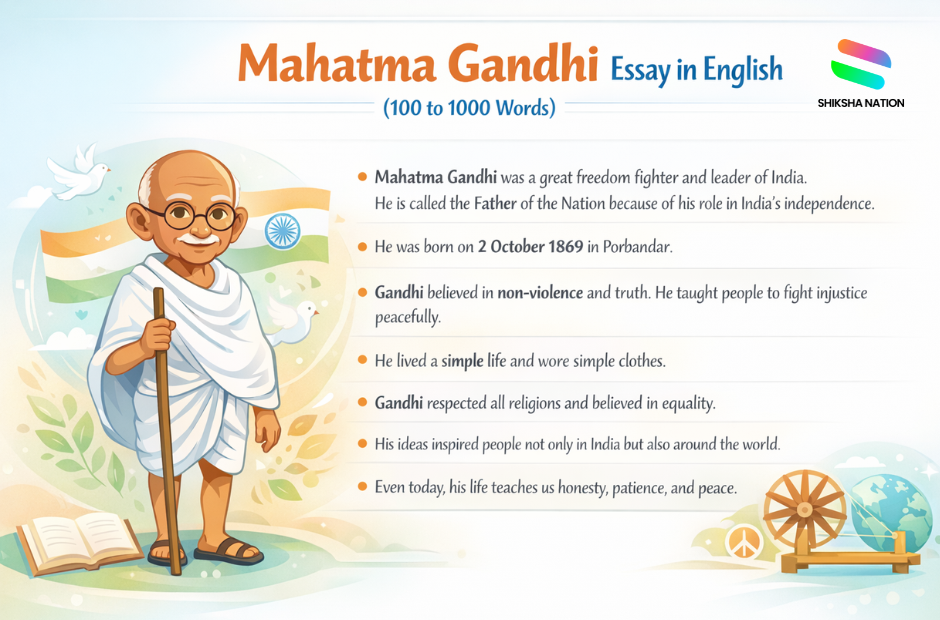
Mahatma Gandhi Essay in 10 Lines
1. Mahatma Gandhi was one of the greatest leaders of India’s freedom movement.
2. His full name was Mohandas Karamchand Gandhi.
3. He was born on 2 October 1869 in Porbandar, Gujarat.
4. Mahatma Gandhi is popularly known as the Father of the Nation.
5. He believed in the principles of truth (Satya) and non-violence (Ahimsa).
6. He encouraged people to fight for freedom through peaceful methods.
7. Gandhi promoted khadi, self-reliance, and the use of Indian-made products.
8. He also worked to remove social discrimination and promote equality.
9. His ideas inspired many leaders and peace movements across the world.
10. We should learn from Mahatma Gandhi’s life and follow the values of honesty, kindness, and respect.
Mahatma Gandhi Essay in English in 100 Words
Mahatma Gandhi was one of the most respected leaders in India’s freedom struggle. Born on 2 October 1869 in Porbandar, Gujarat, he is widely known as the Father of the Nation. Gandhi believed that truth and non-violence were the strongest ways to fight injustice. Through his peaceful leadership, he inspired millions of Indians to work together for independence. His simple lifestyle, honesty, and self-discipline made him a role model for people of all ages. Even today, his life and ideals encourage people to live with integrity, respect others, and work for the betterment of society.
Mahatma Gandhi Essay in English in 150 Words
Mahatma Gandhi was one of the most influential leaders in Indian history. His full name was Mohandas Karamchand Gandhi, and he was born on 2 October 1869 in Porbandar, Gujarat. He dedicated his life to helping India achieve independence through peaceful means and became a symbol of truth, courage, and justice.
Gandhi believed that lasting change could be achieved through truth (Satya) and non-violence (Ahimsa). He introduced the idea of Satyagraha, encouraging people to stand against injustice without using violence. His leadership united people from different backgrounds and inspired them to participate in the freedom movement with confidence and determination.
Apart from his role in the independence struggle, Gandhi promoted simplicity, self-reliance, and mutual respect. He believed that every individual could contribute to building a stronger and more united nation. His life continues to inspire students to develop good values and become responsible citizens who work for the welfare of society.
Mahatma Gandhi Essay in English in 200 Words
Mahatma Gandhi, whose full name was Mohandas Karamchand Gandhi, was a great freedom fighter, social reformer, and one of the most respected leaders in India’s history. He was born on 2 October 1869 in Porbandar, Gujarat. From a young age, Gandhi valued honesty, discipline, and simplicity, qualities that later shaped his leadership.
After completing his schooling, Gandhi travelled to England to study law. Later, he worked as a lawyer in South Africa, where he experienced racial discrimination. These incidents deeply influenced him and strengthened his belief that injustice should be challenged through peaceful and lawful means instead of violence.
When Gandhi returned to India, he became actively involved in the freedom movement. He encouraged people to unite against British rule by following the principles of truth (Satya) and non-violence (Ahimsa). His idea of Satyagraha inspired thousands of Indians to participate in peaceful protests and demand their rights with courage and determination.
Besides leading the independence movement, Gandhi promoted khadi, self-reliance, cleanliness, and equality. He believed that a strong nation could only be built when people respected one another and worked together. His life remains a powerful example of leadership, perseverance, and service to society, inspiring generations across India and the world.
Mahatma Gandhi Essay in English in 300 Words
Mahatma Gandhi, popularly known as the Father of the Nation, played a historic role in India’s struggle for independence. His full name was Mohandas Karamchand Gandhi, and he was born on 2 October 1869 in Porbandar, Gujarat. Through his unwavering commitment to truth and non-violence, Gandhi proved that peaceful resistance could become a powerful tool for bringing social and political change.
After studying law in England, Gandhi began his legal career in South Africa. During his stay there, he witnessed racial discrimination, which inspired him to stand against injustice through peaceful protest. This experience led to the development of Satyagraha, a movement based on truth, courage, and non-violence.
On returning to India, Gandhi became closely involved in the freedom movement. He travelled across the country to understand the challenges faced by ordinary people and encouraged them to unite against British rule. Under his leadership, several historic movements, including the Non-Cooperation Movement, Civil Disobedience Movement, and the famous Dandi March (Salt March), strengthened the fight for independence. His efforts united people from different regions, religions, and communities with a shared vision of a free India.
Gandhi also believed that true freedom meant social progress. He promoted khadi, supported self-reliance, worked to remove untouchability, and encouraged communal harmony. His simple lifestyle reflected the values he asked others to follow, making him a leader admired for both his words and actions.
Although India gained independence in 1947, Mahatma Gandhi’s legacy extends far beyond the freedom struggle. His principles have influenced civil rights movements around the world and continue to inspire people to resolve conflicts through peace, honesty, and mutual respect. His life remains an enduring example of selfless leadership and service to humanity.
Mahatma Gandhi Essay in English in 500 Words
Mahatma Gandhi was one of the most influential leaders in world history and a guiding force behind India’s freedom struggle. His full name was Mohandas Karamchand Gandhi, and he was born on 2 October 1869 in Porbandar, Gujarat. Popularly known as the Father of the Nation, Gandhi transformed the Indian independence movement by proving that courage, determination, and moral values could achieve lasting change without violence. His philosophy of truth and non-violence continues to inspire people across the world.
Gandhi spent his early years in Porbandar and later pursued higher education in England, where he studied law. After completing his studies, he moved to South Africa to work as a lawyer. During his stay, he faced racial discrimination that deeply affected him. Instead of responding with anger, Gandhi chose the path of peaceful resistance. These experiences laid the foundation of Satyagraha, a philosophy that encouraged people to oppose injustice through truth, patience, and non-violent action.
When Gandhi returned to India in 1915, he travelled extensively to understand the problems faced by farmers, workers, and ordinary citizens. He believed that true leadership begins by listening to people and understanding their struggles. His close connection with the public earned their trust and transformed the freedom movement into a nationwide campaign.
Under Gandhi’s leadership, India witnessed several historic movements that challenged British rule. The Champaran Satyagraha marked one of his first successful campaigns in India, where he supported farmers against unfair practices. This was followed by the Non-Cooperation Movement, which encouraged Indians to boycott British institutions and products. In 1930, Gandhi led the famous Dandi March, also known as the Salt March, to protest the British salt tax. Later, the Civil Disobedience Movement and the Quit India Movement united millions of Indians in the demand for complete independence. These peaceful movements played a significant role in India’s journey towards freedom.
Apart from political leadership, Gandhi worked for social reform. He promoted khadi and Swadeshi to encourage self-reliance and strengthen local industries. He strongly opposed untouchability and believed that every individual deserved equal dignity and respect. Gandhi also encouraged communal harmony, cleanliness, and rural development, believing that a strong nation could only be built through social unity and responsible citizenship.
Gandhi’s ideas influenced leaders far beyond India. Personalities such as Martin Luther King Jr. in the United States and Nelson Mandela in South Africa drew inspiration from his principles while leading movements for justice and equality. His approach demonstrated that peaceful protest could become a powerful force for protecting human rights.
Although Mahatma Gandhi was assassinated on 30 January 1948, his ideals continue to remain relevant. In a world facing conflict, inequality, and social challenges, his message of truth, non-violence, compassion, and service continues to guide individuals and communities. Mahatma Gandhi’s life teaches us that meaningful change begins with personal integrity and a commitment to the welfare of others. His extraordinary journey remains an inspiration for students and future generations around the world.
Mahatma Gandhi Essay in English in 1000 Words
Mahatma Gandhi was one of the greatest leaders in Indian history and a symbol of peace, truth, and justice. His full name was Mohandas Karamchand Gandhi, and he was born on 2 October 1869 in Porbandar, Gujarat. Popularly known as the Father of the Nation, Gandhi played a leading role in India’s struggle for independence from British rule. Unlike many freedom fighters of his time, he believed that lasting change could be achieved through truth, non-violence, and moral courage instead of force. His ideas transformed India’s freedom movement and continue to inspire people across the world.
Gandhi was born into a simple and respected family. His father, Karamchand Gandhi, served as the Diwan (Chief Minister) of Porbandar, while his mother, Putlibai Gandhi, was deeply religious and compassionate. From an early age, Gandhi learned the importance of honesty, self-discipline, and respect for others. These values remained with him throughout his life and became the foundation of his character. Although he described himself as an ordinary student, he was sincere, hardworking, and always willing to learn from his experiences.
After completing his schooling, Gandhi travelled to England in 1888 to study law. Living in a different country exposed him to new ideas, cultures, and ways of thinking. He worked hard to complete his legal education while staying committed to the principles and traditions he had learned during childhood. After becoming a lawyer, he returned to India but struggled to establish a successful legal practice. Soon, he accepted an opportunity to work in South Africa, a decision that changed the course of his life.
During his time in South Africa, Gandhi experienced racial discrimination firsthand. One of the most well-known incidents occurred when he was forced to leave a train despite holding a valid first-class ticket because of his race. Instead of responding with violence or hatred, Gandhi chose to fight injustice through peaceful resistance. He believed that people could challenge unfair laws with courage, patience, and truth while maintaining respect for others. This belief gradually developed into the philosophy of Satyagraha, which means holding firmly to truth through non-violent action.
Gandhi spent over twenty years in South Africa, working for the rights of the Indian community. He organised peaceful protests, encouraged unity, and demonstrated that determined yet non-violent action could bring meaningful social change. These experiences strengthened his leadership skills and prepared him for the much larger responsibility that awaited him in India.
In 1915, Gandhi returned to India and began travelling across the country to understand the daily struggles of farmers, workers, and ordinary citizens. Rather than leading from a distance, he believed that a true leader should first listen to the people. He visited villages, interacted with local communities, and gained a deep understanding of poverty, injustice, and the challenges faced under British rule. This close connection with the people helped him earn their trust and transformed him into a national leader.
One of Gandhi’s first major successes in India came through the Champaran Satyagraha in Bihar. Farmers in Champaran were being forced to grow indigo under unfair conditions imposed by British planters. Gandhi carefully studied their problems, met the affected farmers, and organised a peaceful movement demanding justice. His determination led to significant improvements in the farmers’ conditions and showed the country that peaceful protest could successfully challenge injustice. The Champaran movement also established Gandhi as a powerful and trusted leader of the Indian freedom struggle.
Following the success of Champaran, Gandhi continued to support ordinary people through peaceful campaigns. He encouraged Indians to become self-reliant, remain united, and participate actively in the fight for freedom. His leadership inspired people from different regions, religions, and communities to work together with a common purpose.
The growing public support for Gandhi led to the launch of the Non-Cooperation Movement in 1920. He urged Indians to withdraw their cooperation from the British government by boycotting foreign goods, government schools, courts, and official institutions. Gandhi believed that British rule could not continue without the support of the Indian people. The movement witnessed large-scale participation from students, teachers, lawyers, farmers, and workers, making it one of the first nationwide campaigns against colonial rule. Although the movement was later suspended after the Chauri Chaura incident, it awakened a strong sense of national unity and encouraged millions of Indians to participate in the freedom struggle through peaceful means.
The spirit of peaceful resistance continued to grow under Gandhi’s leadership. In 1930, he launched the historic Dandi March, also known as the Salt March, to protest the British salt tax. Gandhi walked nearly 390 kilometres from Sabarmati Ashram to the coastal village of Dandi with a group of followers. At the end of the march, he made salt from seawater as a symbolic act of defiance against an unjust law. This simple yet powerful protest attracted worldwide attention and inspired thousands of Indians to participate in the freedom movement.
The Dandi March became the starting point of the Civil Disobedience Movement, during which people openly and peacefully broke unfair British laws. Across the country, Indians boycotted foreign goods, refused to pay certain taxes, and participated in peaceful demonstrations. Although many protesters, including Gandhi, were arrested, the movement strengthened the demand for self-rule and showed that unity and determination could challenge even the most powerful government.
As the struggle for independence continued, Gandhi launched the Quit India Movement in 1942. At a time when the Second World War was affecting many nations, he gave the inspiring call of “Do or Die,” urging Indians to remain united in their demand for complete independence. Thousands of people joined the movement despite facing arrests and hardships. Although the movement was suppressed by the British government, it increased public support for independence and became one of the final milestones on India’s journey towards freedom.
Along with political leadership, Gandhi devoted himself to bringing positive social change. He believed that true independence would have little meaning if society continued to suffer from discrimination and inequality. He strongly opposed untouchability and worked for the upliftment of marginalised communities, whom he referred to as Harijans, meaning “children of God.” Gandhi encouraged equal respect for all individuals, regardless of caste, religion, or background, and promoted communal harmony during challenging times.
Gandhi also believed in the importance of self-reliance. He encouraged people to wear khadi and support the Swadeshi Movement, which promoted the use of Indian-made goods instead of imported products. For Gandhi, spinning cotton on the charkha was more than a daily activity; it symbolised dignity of labour, economic independence, and national unity. He also emphasised cleanliness, rural development, education, and simple living, believing that lasting progress begins at the community level.
One of Gandhi’s greatest strengths was his leadership style. He never relied on fear or authority to influence people. Instead, he led by personal example. His honesty, humility, discipline, and willingness to sacrifice for others earned him the trust of millions. Gandhi remained calm even during difficult situations and believed that patience and dialogue were more effective than violence. His ability to unite people from different regions, languages, and religions made him one of the most respected leaders of the twentieth century.
Gandhi’s philosophy influenced many leaders beyond India. Martin Luther King Jr. adopted the principles of non-violent protest during the American Civil Rights Movement, while Nelson Mandela drew inspiration from Gandhi’s ideas in the fight against apartheid in South Africa. His message of peace and justice continues to guide movements for human rights and social equality across the world, proving that his influence extends far beyond India’s freedom struggle.
India achieved independence on 15 August 1947, marking the fulfilment of a dream for which Gandhi had worked tirelessly. However, he was deeply saddened by the violence and communal tensions that accompanied the partition of the country. He spent his final months promoting peace and harmony among communities. On 30 January 1948, Mahatma Gandhi was assassinated in New Delhi. Although his life came to a tragic end, his principles continue to inspire generations across the globe.
Mahatma Gandhi’s life is much more than the story of a freedom fighter. It is the story of a leader who believed that truth, compassion, courage, and self-discipline could transform society. His contributions to India’s independence, his commitment to social reform, and his message of non-violence remain relevant even in today’s world. For students, Gandhi’s journey teaches that real leadership comes from integrity, empathy, and the willingness to stand for what is right. His legacy reminds us that meaningful change begins with our own thoughts, actions, and responsibility towards others.
Key Facts About Mahatma Gandhi for Students
- Full Name: Mohandas Karamchand Gandhi
- Popularly Known As: Mahatma Gandhi and the Father of the Nation
- Date of Birth: 2 October 1869
- Birthplace: Porbandar, Gujarat, India
- Parents: Karamchand Gandhi and Putlibai Gandhi
- Profession: Lawyer, Freedom Fighter, Social Reformer, and Political Leader
- Education: Studied Law in England
- Key Principles: Truth (Satya), Non-violence (Ahimsa), and Satyagraha
- Major Freedom Movements: Champaran Satyagraha, Non-Cooperation Movement, Dandi March (Salt March), Civil Disobedience Movement, and Quit India Movement
- Social Reforms: Promoted khadi, Swadeshi, communal harmony, cleanliness, rural development, and worked against untouchability.
- Date of Death: 30 January 1948
- Memorial: Raj Ghat, New Delhi
- Global Influence: Inspired world leaders such as Martin Luther King Jr. and Nelson Mandela through his philosophy of peaceful resistance.
- Legacy: Mahatma Gandhi’s ideals of truth, peace, equality, and non-violence continue to inspire people and remain relevant in building a just and compassionate society.
Frequently Asked Questions
Who was Mahatma Gandhi?+
Mahatma Gandhi, whose full name was Mohandas Karamchand Gandhi, was a renowned freedom fighter, social reformer, and political leader. He played a key role in India's independence movement by promoting the principles of truth and non-violence.
Why is Mahatma Gandhi called the Father of the Nation?+
Mahatma Gandhi is called the Father of the Nation because he united millions of Indians and led the freedom struggle through peaceful movements based on truth, non-violence, and moral courage.
When and where was Mahatma Gandhi born?+
Mahatma Gandhi was born on 2 October 1869 in Porbandar, Gujarat, India.
What are the main principles of Mahatma Gandhi?+
The main principles of Mahatma Gandhi were Truth (Satya), Non-violence (Ahimsa), Satyagraha, self-reliance, simplicity, and equality. He believed that lasting change could be achieved through peaceful means.
Which major movements were led by Mahatma Gandhi?+
Mahatma Gandhi led several important movements during India's freedom struggle, including the Champaran Satyagraha, Non-Cooperation Movement, Dandi March (Salt March), Civil Disobedience Movement, and the Quit India Movement.
Why is Mahatma Gandhi important for students?+
Mahatma Gandhi's life teaches students valuable lessons about honesty, discipline, compassion, leadership, and perseverance. His example encourages young learners to solve problems peacefully and contribute positively to society.
What can we learn from Mahatma Gandhi's life?+
Mahatma Gandhi's life teaches us that truth, non-violence, hard work, humility, and respect for others are essential values. His journey shows that determination and moral courage can bring positive change in society.
Why is Mahatma Gandhi remembered even today?+
Mahatma Gandhi is remembered for his extraordinary contribution to India's independence and his timeless message of peace, equality, and justice. His ideas continue to inspire people, leaders, and social movements across the world.