
Cranial Nerves Names: The human nervous system controls almost every activity of the body, including movement, sensation, vision, hearing, breathing, and swallowing. Among the important parts of this system are the cranial nerves. These nerves directly arise from the brain and connect different organs and muscles of the head, neck, and some internal body parts.
There are 12 pairs of cranial nerves in the human body. Each nerve has a specific name, number, and function. Some cranial nerves control sensory activities such as smell, vision, and hearing, while others help in movement and muscle control. A few cranial nerves perform both sensory and motor functions.
Learning the cranial nerves names is very important for students studying biology, anatomy, nursing, MBBS, NEET, and other medical subjects. Understanding these nerves also helps doctors identify neurological disorders and nerve damage. Here, you will learn the complete list of 12 cranial nerves names in order, their functions, classifications, mnemonic tricks, and clinical importance.
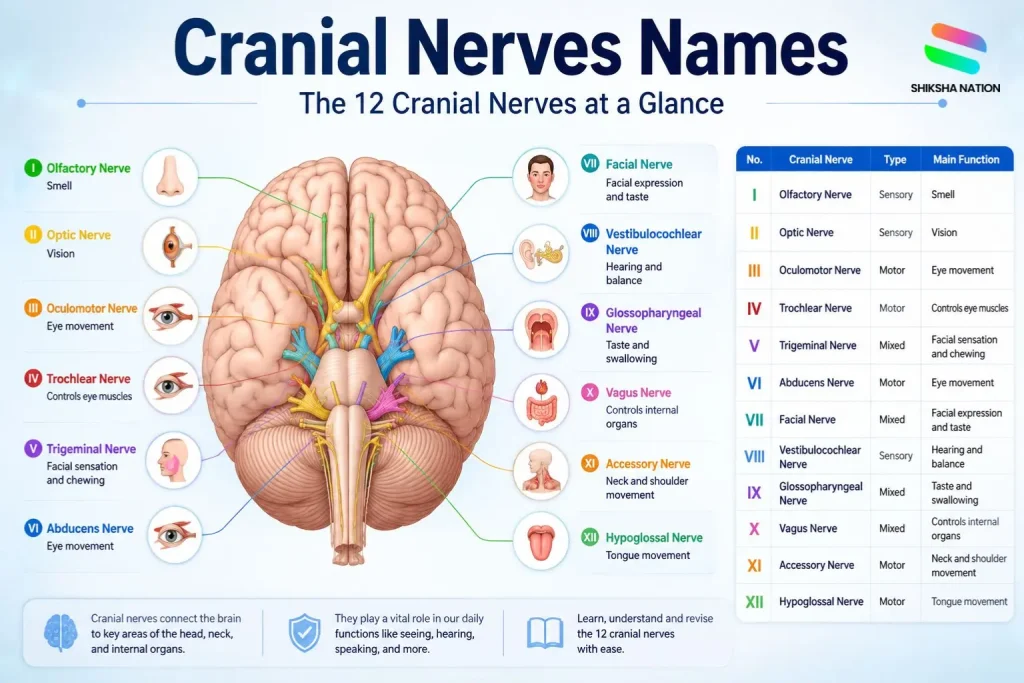
What are Cranial Nerves?
Cranial nerves are a group of nerves that arise directly from the brain and brainstem. These nerves mainly control the activities of the head and neck region. Unlike spinal nerves, which come from the spinal cord, cranial nerves originate from different parts of the brain.
Humans have 12 pairs of cranial nerves. Each pair is identified by a Roman numeral from I to XII. Every cranial nerve has a special role in the nervous system.
Some important functions of cranial nerves include:
- Smelling
- Seeing
- Hearing
- Tasting
- Swallowing
- Eye movement
- Facial expression
- Tongue movement
- Balance control
Cranial nerves are divided into three categories:
- Sensory nerves
- Motor nerves
- Mixed nerves
These nerves are an important part of cranial nerves anatomy and play a major role in communication between the brain and body organs.
List of 12 Cranial Nerves Names in Order
The following table shows the names of 12 cranial nerves in sequence along with their types and functions.
| Number | Cranial Nerve Name | Type | Main Function |
|---|---|---|---|
| I | Olfactory Nerve | Sensory | Smell |
| II | Optic Nerve | Sensory | Vision |
| III | Oculomotor Nerve | Motor | Eye movement |
| IV | Trochlear Nerve | Motor | Controls eye muscles |
| V | Trigeminal Nerve | Mixed | Facial sensation and chewing |
| VI | Abducens Nerve | Motor | Eye movement |
| VII | Facial Nerve | Mixed | Facial expression and taste |
| VIII | Vestibulocochlear Nerve | Sensory | Hearing and balance |
| IX | Glossopharyngeal Nerve | Mixed | Taste and swallowing |
| X | Vagus Nerve | Mixed | Controls internal organs |
| XI | Accessory Nerve | Motor | Neck and shoulder movement |
| XII | Hypoglossal Nerve | Motor | Tongue movement |
This cranial nerve name list is commonly asked in medical entrance exams and anatomy classes.
Cranial Nerves Names and Functions Explained
I. Olfactory Nerve
The olfactory nerve is the first cranial nerve. It is a sensory nerve responsible for the sense of smell. It carries smell information from the nose to the brain.
Main Function
- Detects odors and smells
Clinical Importance
Damage to this nerve can lead to loss of smell, called anosmia.
II. Optic Nerve
The optic nerve is related to vision. It carries visual signals from the eyes to the brain.
Main Function
- Helps in seeing objects and colors
Clinical Importance
Damage may cause vision loss or blindness.
III. Oculomotor Nerve
The oculomotor nerve controls most eye muscles. It helps move the eyeball and control pupil size.
Main Function
- Eye movement
- Pupil control
Clinical Importance
Damage can cause double vision and drooping eyelids.
IV. Trochlear Nerve
The trochlear nerve controls one eye muscle called the superior oblique muscle.
Main Function
- Helps rotate and move the eye downward
Clinical Importance
Damage can make downward eye movement difficult.
V. Trigeminal Nerve
The trigeminal nerve is the largest cranial nerve. It is a mixed nerve with both sensory and motor functions.
Main Function
- Facial sensation
- Chewing movements
Clinical Importance
Trigeminal neuralgia causes severe facial pain.
VI. Abducens Nerve
The abducens nerve controls the lateral rectus muscle of the eye.
Main Function
- Moves the eye sideways
Clinical Importance
Damage can cause inward turning of the eye.
VII. Facial Nerve
The facial nerve controls facial expressions and taste sensations from part of the tongue.
Main Function
- Smiling and facial movement
- Taste sensation
Clinical Importance
Damage can lead to Bell’s palsy.
VIII. Vestibulocochlear Nerve
This sensory nerve is related to hearing and body balance.
Main Function
- Hearing
- Maintaining balance
Clinical Importance
Damage may cause dizziness and hearing loss.
IX. Glossopharyngeal Nerve
The glossopharyngeal nerve helps in swallowing and tasting food.
Main Function
- Taste sensation
- Swallowing
Clinical Importance
Damage can affect speech and swallowing.
X. Vagus Nerve
The vagus nerve is the longest cranial nerve. It connects the brain with the heart, lungs, and digestive organs.
Main Function
- Controls heart rate
- Digestion
- Breathing
Clinical Importance
The vagus nerve is very important in autonomic nervous system control.
XI. Accessory Nerve
This motor nerve controls neck and shoulder muscles.
Main Function
- Shoulder movement
- Head rotation
Clinical Importance
Damage may weaken shoulder muscles.
XII. Hypoglossal Nerve
The hypoglossal nerve controls tongue muscles.
Main Function
- Tongue movement
- Speech support
Clinical Importance
Damage can affect speaking and swallowing.
Classification of Cranial Nerves
Cranial nerves are classified according to their functions.
Sensory Cranial Nerves
These nerves carry sensory information to the brain.
| Cranial Nerves | Function |
|---|---|
| Olfactory (I) | Smell |
| Optic (II) | Vision |
| Vestibulocochlear (VIII) | Hearing and balance |
Motor Cranial Nerves
These nerves control muscle movement.
| Cranial Nerves | Function |
|---|---|
| Oculomotor (III) | Eye movement |
| Trochlear (IV) | Eye muscle control |
| Abducens (VI) | Eye movement |
| Accessory (XI) | Neck movement |
| Hypoglossal (XII) | Tongue movement |
Mixed Cranial Nerves
These nerves perform both sensory and motor functions.
| Cranial Nerves | Function |
|---|---|
| Trigeminal (V) | Facial sensation and chewing |
| Facial (VII) | Taste and facial expression |
| Glossopharyngeal (IX) | Taste and swallowing |
| Vagus (X) | Organ control |
Understanding this cranial nerves classification helps students remember their functions easily.
Easy Mnemonic to Remember Cranial Nerves Names
Students often use mnemonics to memorize the cranial nerves names in sequence.
A popular mnemonic is:
“On Old Olympus Towering Tops, A Finn And German Viewed Some Hops.”
| Mnemonic Word | Cranial Nerve |
|---|---|
| On | Olfactory |
| Old | Optic |
| Olympus | Oculomotor |
| Towering | Trochlear |
| Tops | Trigeminal |
| A | Abducens |
| Finn | Facial |
| And | Auditory (Vestibulocochlear) |
| German | Glossopharyngeal |
| Viewed | Vagus |
| Some | Spinal Accessory |
| Hops | Hypoglossal |
This mnemonic is very useful for quick revision before exams.
Cranial Nerves Names in Sequence
The names of 12 cranial nerves in order are:
- Olfactory
- Optic
- Oculomotor
- Trochlear
- Trigeminal
- Abducens
- Facial
- Vestibulocochlear
- Glossopharyngeal
- Vagus
- Accessory
- Hypoglossal
Remembering the correct sequence is important for anatomy practical exams and neurological assessments.
Clinical Importance of Cranial Nerves
Cranial nerves are very important in medicine because doctors use them to check brain function and diagnose neurological diseases.
Common Disorders Related to Cranial Nerves
- Facial Paralysis: Damage to the facial nerve may lead to facial paralysis or Bell’s palsy.
- Vision Problems: Optic nerve damage can cause blurred vision or blindness.
- Hearing Loss: Vestibulocochlear nerve disorders may reduce hearing ability.
- Difficulty Swallowing: Glossopharyngeal and vagus nerve damage can affect swallowing.
- Loss of Smell: Olfactory nerve injury may reduce or completely remove the sense of smell.
- Speech Problems: Hypoglossal nerve disorders can affect tongue movement and speech clarity.
Doctors perform cranial nerve examinations during neurological tests to identify brain disorders, infections, tumors, or nerve injuries.
Importance of Cranial Nerves in the Nervous System
Cranial nerves are essential for normal body functioning. They help the brain communicate with sensory organs, muscles, and internal organs.
Some important roles include:
- Detecting environmental changes
- Helping in communication
- Controlling voluntary movements
- Maintaining body balance
- Supporting digestion and breathing
- Coordinating facial expressions
Without proper cranial nerve function, daily activities such as eating, speaking, seeing, and hearing become difficult.
Tips to Memorize Cranial Nerves Easily
Learning all cranial nerves may seem difficult at first, but simple methods can help students remember them quickly.
- Use Mnemonics: Mnemonics make memorization easier and faster.
- Practice Diagrams: Draw cranial nerve diagrams regularly to improve memory.
- Learn Functions Together: Study the nerve names with their functions instead of separately.
- Use Flashcards: Flashcards help in quick revision before exams.
- Revise Daily: Short daily revision improves long-term memory retention.
Difference Between Cranial Nerves and Spinal Nerves
| Feature | Cranial Nerves | Spinal Nerves |
|---|---|---|
| Origin | Brain | Spinal cord |
| Number | 12 pairs | 31 pairs |
| Main Area | Head and neck | Whole body |
| Functions | Sensory and motor | Sensory and motor |
This comparison helps students understand the anatomy of the nervous system more clearly.