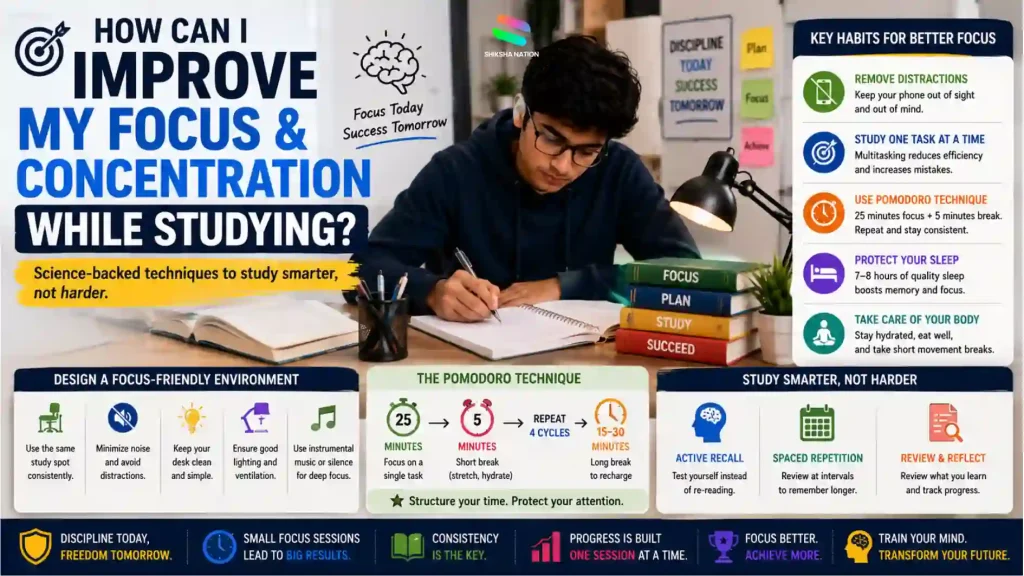
To improve your focus and concentration while studying, design a low-distraction environment, remove your phone from the room, work in timed blocks using the Pomodoro technique (25 minutes on, 5 minutes off), study one task at a time, and protect your sleep. These changes, taken together, make a real and measurable difference.

Why Focus is Hard (And Why That is Not Your Fault)
Attention is a limited resource. The brain is not wired to lock onto a single demanding task for hours without mental fatigue setting in. Every time your attention slips, a small recovery cost kicks in before you are fully back on task. This is not a personality flaw or a laziness problem. It is simply how human attention works.
This matters because most students respond to lost focus by trying harder, when the better move is to restructure how they study so the brain does not have to fight against its own limits.
The good news is that environment, technique, and a few key habits do most of the heavy lifting. You do not need iron willpower. You need a better setup.
Design Your Study Environment for Concentration
Where you study matters more than most people assume. A dedicated study space, one that your brain has learned to associate specifically with focused work, builds a mental cue over time. The brain starts to shift into study mode when you sit down in that spot because it has practiced doing exactly that there.
A few things that make a genuine difference:
- Use the same spot consistently for studying, and only for studying. Avoid using it for eating, scrolling, or watching videos.
- Keep the surface clear. Visual clutter competes for attention in a low-grade, persistent way.
- Control the noise level. Total silence is not always ideal, but unpredictable noise (loud TV in another room, random conversation nearby) is consistently disruptive.
- Get the lighting right. Dim or harsh lighting causes eye strain and fatigue earlier than you would otherwise experience.
None of these require a fancy setup. A cleared desk in a quiet corner, used consistently, does the job.
Background Noise and Music: What Actually Helps
Instrumental or ambient background sound works for some students, particularly when the alternative is an environment that is noisily distracting. However, music with lyrics tends to compete for the same language-processing attention you use when reading and writing. If you are doing verbal or text-heavy studying (reading a chapter, writing an essay, working through word problems), lyrics are more likely to slow you down than help you concentrate. For most text-based study, instrumental music or silence is the safer choice.
Handle Your Phone and Social Media Specifically
The phone deserves its own section because the most common advice (“just put it on silent”) does not go far enough. The phone does not need to be ringing or buzzing to reduce your focus. Its physical presence in your field of vision draws a low-level portion of your cognitive resources toward it, even without active notifications.
The most effective step is to remove it from the room while you study. This is not about self-discipline. It is about eliminating the object that requires discipline to ignore. Put it in another room, or in your bag outside the door, for the duration of your study block.
If you need your device for study materials, use app blockers or built-in focus modes to restrict social media access during your session. Setting specific offline windows and sticking to them is far easier than trying to moderate your usage in the moment, because the moment you pick the phone up “just to check one thing,” the session is already interrupted.
The Pomodoro Technique: How It Works and Why It Helps
The Pomodoro Technique was developed by Francesco Cirillo. The method is straightforward: work on a single task for 25 minutes, take a 5-minute break, and repeat. After four of these cycles, take a longer break of 15 to 30 minutes.
The reasoning behind it connects directly to how attention works. Research associated with Alejandro Lleras at the University of Illinois supports the idea that the brain struggles to maintain uninterrupted focus over long stretches, and that brief, deliberate breaks help reset attention. Structuring study into defined intervals makes it easier to stay concentrated within each block, because each block has a clear, manageable end point.
A few things that make the technique work better in practice:
- Pick a single, specific task before you start the timer.
- Avoid switching tasks during the 25-minute block.
- Use your break for something physically different from studying: stretch, walk around, drink water. Switching to social media is not a real break.
Here is a sample Pomodoro-based structure for a 2-hour study session:
| Time Block | Activity | Purpose |
| 0:00 – 0:25 | Study Session 1 (single task) | Deep focus, first interval |
| 0:25 – 0:30 | Short break (stretch, water) | Attention reset |
| 0:30 – 0:55 | Study Session 2 (same or next task) | Sustained focus, second interval |
| 0:55 – 1:00 | Short break (walk, rest eyes) | Attention reset |
| 1:00 – 1:25 | Study Session 3 | Deep focus, third interval |
| 1:25 – 1:30 | Short break | Attention reset |
| 1:30 – 1:55 | Study Session 4 | Deep focus, fourth interval |
| 1:55 – 2:25 | Long break (15 to 30 minutes) | Full cognitive recovery |
The structure creates natural urgency within each block (you have 25 minutes, so you actually start) and prevents the slow, unnoticed drift into distracted browsing that happens with open-ended, unstructured sessions.
Single-Tasking vs. Multitasking: The Real Cost of Switching
What students call multitasking while studying, such as checking messages between paragraphs, listening to lyrical music while reading, or toggling between subjects every few minutes, is not actually parallel processing. It is rapid task-switching.
Every time you pull attention from one task and redirect it somewhere else, there is a cognitive cost before you are fully re-engaged with the original task. These costs are individually small but they accumulate across a session. A study block full of task-switching produces significantly weaker retention and requires more total time to cover the same material than a session of equal length with single-task focus.
The fix is simple: decide on one task before each Pomodoro block and stick with it. Close other tabs. Work through one subject at a time rather than bouncing between them.
Set Session Goals That Actually Support Concentration
“Study chemistry for two hours” is not a useful goal. It has no finish line, which means the brain has no clear target to aim at. Sessions like this are much easier to drift through.
“Complete 10 practice problems on Ionic Equilibrium” is a specific goal. It gives your attention somewhere concrete to land. When you sit down knowing exactly what you are going to accomplish, the session starts faster and focus comes more naturally.
Before each study session, write down one specific, narrow goal. Not a topic, not a subject, but a defined task with a clear endpoint. This one habit alone improves how focused each session feels, because your attention has somewhere to go from the moment you sit down.
Active Recall and Spaced Repetition: Study Methods That Train Focus
Active recall means closing the book and testing yourself on what you have just studied: reciting it aloud, writing it from memory, or working through practice questions without checking your notes. This is harder than rereading or highlighting, and that is the point. The mental effort required to retrieve information builds stronger, more durable retention. It also requires genuine sustained attention, which itself trains focus over time.
Students who rely mainly on passive review (rereading chapters, highlighting text) tend to feel like they are studying but do not retain much, partly because passive methods do not demand real concentration.
Spaced repetition pairs naturally with active recall. Rather than covering a topic in one long session, you review it at increasing intervals across multiple days. This reduces the mental fatigue of marathon study blocks. Each shorter session stays fresher, attention stays higher, and retention improves compared to cramming.
Sleep, Movement, and Nutrition: The Underrated Focus Factors
Students often treat sleep as the first thing to cut when deadlines pile up. This is a costly trade. Sleep (7 to 9 hours for most students, though individual need varies) is directly linked to attention, working memory, and the ability to concentrate the next day. Sleep deprivation does not just make you feel tired. It measurably reduces the ability to focus, even when you push through with willpower.
Short movement breaks matter too. Even brief walks between sessions are associated with improved alertness and concentration afterward, compared to staying sedentary for very long unbroken stretches.
On nutrition: skipping meals or eating in ways that produce heavy sugar crashes causes real dips in energy and attention during study time. Regular, balanced meals and staying hydrated support more stable cognitive function throughout a long session.
Focus Killers vs. Focus Builders
| Common Habit | Why It Hurts Focus | What to Do Instead |
| Phone on desk (even on silent) | Visual proximity draws cognitive resources away from the task even without notifications | Remove the phone from the room entirely |
| Multitasking between subjects | Rapid task-switching creates a cognitive cost each time attention shifts | Study one task per Pomodoro block |
| Open-ended sessions (“study until I’m done”) | No clear endpoint makes it easier to drift and delay starting | Set a specific, concrete goal before each session |
| Passive rereading and highlighting | Feels productive but builds weak retention and requires little sustained attention | Use active recall: close the book and test yourself from memory |
| Lyrical music during reading or writing tasks | Lyrics compete with the same language-processing attention used in text-based study | Switch to instrumental or ambient sound, or study in silence |
| Cramming in one long sitting | Mental fatigue accumulates and retention drops sharply in later hours | Use spaced repetition: spread review across multiple shorter sessions |
| Sacrificing sleep for extra study hours | Sleep deprivation measurably reduces attention and working memory the next day | Protect 7 to 9 hours; late-night cramming costs more than it gains |