
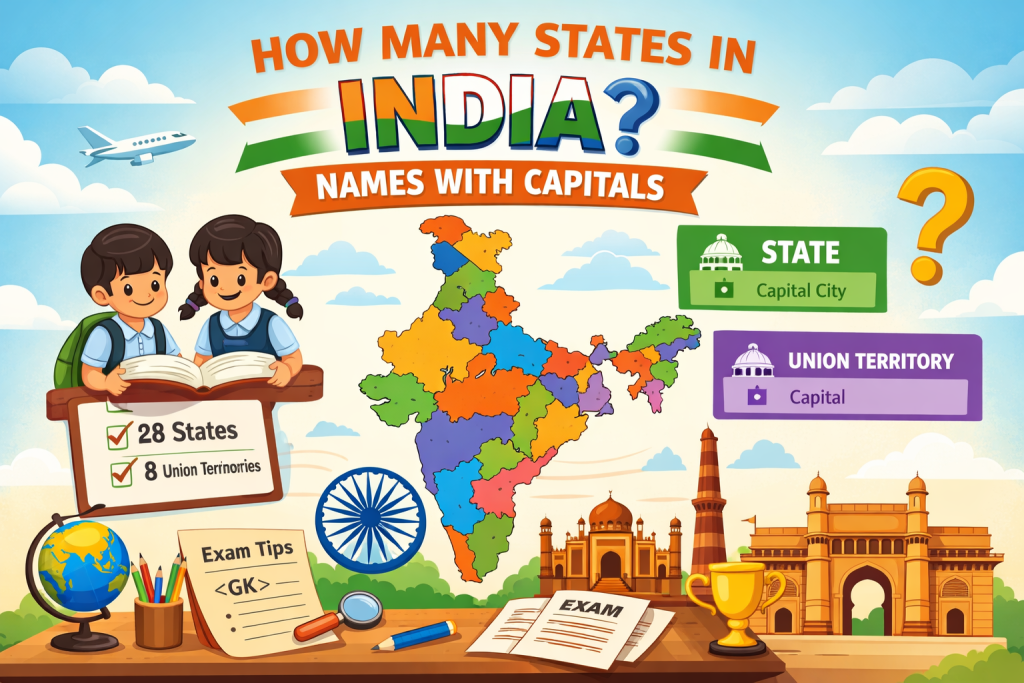
India has 28 states and 8 Union Territories, according to the latest official administrative structure. This is the correct and updated answer for school exams, competitive exams, general knowledge (GK), and everyday learning. If you have seen older books or websites mentioning 29 states, don’t worry. That information is outdated because of changes made in 2019.
Many students search for how many states are there in India, how many states in India, or states and capitals of India before exams. Parents also look for updated information to help their children prepare confidently. This page brings together the latest list of 28 states and their capitals, along with simple explanations that are easy to understand and remember.
Facts:
| Topic | Latest Information |
|---|---|
| Total States in India | 28 |
| Total Union Territories | 8 |
| Capital of India | New Delhi |
| Last Major Administrative Change | 2019 |
| Suitable For | School Exams, GK, Olympiads, Competitive Exams |
Also Read: GK Questions for School Assembly
Complete List of 28 States and Their Capitals
The table below contains the official list of 28 states of India with their capitals. The states are arranged in alphabetical order, making it easier for students to revise before exams.
| State | Capital |
|---|---|
| Andhra Pradesh | Amaravati |
| Arunachal Pradesh | Itanagar |
| Assam | Dispur |
| Bihar | Patna |
| Chhattisgarh | Raipur |
| Goa | Panaji |
| Gujarat | Gandhinagar |
| Haryana | Chandigarh |
| Himachal Pradesh | Shimla |
| Jharkhand | Ranchi |
| Karnataka | Bengaluru |
| Kerala | Thiruvananthapuram |
| Madhya Pradesh | Bhopal |
| Maharashtra | Mumbai |
| Manipur | Imphal |
| Meghalaya | Shillong |
| Mizoram | Aizawl |
| Nagaland | Kohima |
| Odisha | Bhubaneswar |
| Punjab | Chandigarh |
| Rajasthan | Jaipur |
| Sikkim | Gangtok |
| Tamil Nadu | Chennai |
| Telangana | Hyderabad |
| Tripura | Agartala |
| Uttar Pradesh | Lucknow |
| Uttarakhand | Dehradun |
| West Bengal | Kolkata |

How Many Union Territories Are There in India?
Apart from the 28 states, India also has 8 Union Territories (UTs). These are administrative regions that are governed differently from states. Some Union Territories have their own Legislative Assembly, while others are directly administered by the Central Government.
Students often confuse states and Union Territories, especially in GK quizzes and school exams. Remember that Union Territories are counted separately and should not be included while answering the question “How many states are there in India?”
Facts About Union Territories:
| Topic | Information |
|---|---|
| Total Union Territories | 8 |
| Included in State Count? | No |
| Total Administrative Divisions | 36 (28 States + 8 Union Territories) |
| Suitable For | School Exams, GK, Olympiads, Competitive Exams |
Do Check: GK Questions with Answers for Class 6
List of 8 Union Territories and Their Capitals
The table below shows the latest list of Union Territories and their capitals.
| Union Territory | Capital |
|---|---|
| Andaman and Nicobar Islands | Port Blair |
| Chandigarh | Chandigarh |
| Dadra and Nagar Haveli and Daman and Diu | Daman |
| Delhi (National Capital Territory) | New Delhi |
| Jammu and Kashmir | Srinagar (Summer), Jammu (Winter) |
| Ladakh | Leh |
| Lakshadweep | Kavaratti |
| Puducherry | Puducherry |
Note: Jammu and Kashmir is a Union Territory, not a state. It has Srinagar as the summer capital and Jammu as the winter capital.
Why Does India Have 28 States Instead of 29?
Many students wonder why some books mention 29 states, while others say 28 states. The reason is that India’s administrative structure changed in 2019.
Before 2019, Jammu and Kashmir was a state, making the total number of states 29. On 31 October 2019, the Jammu and Kashmir Reorganisation Act, 2019 came into effect. Under this change:
- The state of Jammu and Kashmir was reorganised.
- It was divided into two Union Territories:
- Jammu and Kashmir
- Ladakh
- As a result, the total number of states changed from 29 to 28.
Since then, India has officially had 28 states and 8 Union Territories.
What Changed in 2019?
The table below explains the change in a simple way.
| Before 31 October 2019 | After 31 October 2019 |
|---|---|
| 29 States | 28 States |
| 7 Union Territories | 8 Union Territories |
| Jammu and Kashmir was a State | Jammu and Kashmir became a Union Territory |
| Ladakh was part of Jammu and Kashmir | Ladakh became a separate Union Territory |
This is the latest administrative structure followed by schools, government records, and competitive examinations.
Difference between States vs Union Territories
Although both states and Union Territories (UTs) are part of India, they are governed differently. Understanding this difference is important for school exams, GK questions, and competitive exams.
| Feature | State | Union Territory |
|---|---|---|
| Total Number | 28 | 8 |
| Government | Has its own elected government | Administered by the Central Government (some UTs have a Legislative Assembly) |
| Head of Government | Chief Minister | Lieutenant Governor or Administrator (depending on the UT) |
| Law-Making Powers | State Legislature makes laws on many state subjects | Powers vary depending on the Union Territory |
| Examples | Uttar Pradesh, Gujarat, Kerala | Delhi, Ladakh, Chandigarh |
- States have more authority to manage their own administration through an elected government.
- Union Territories are administered under the supervision of the Central Government, although some UTs have elected governments with limited powers.