

Introduction
How many states are there in India today?
India currently has 28 states, and this is the official and correct answer for school exams, competitive exams, and GK tests. Many students search how many states in india name them with capital to get a clear and updated answer without confusion.
Why students and parents often get confused
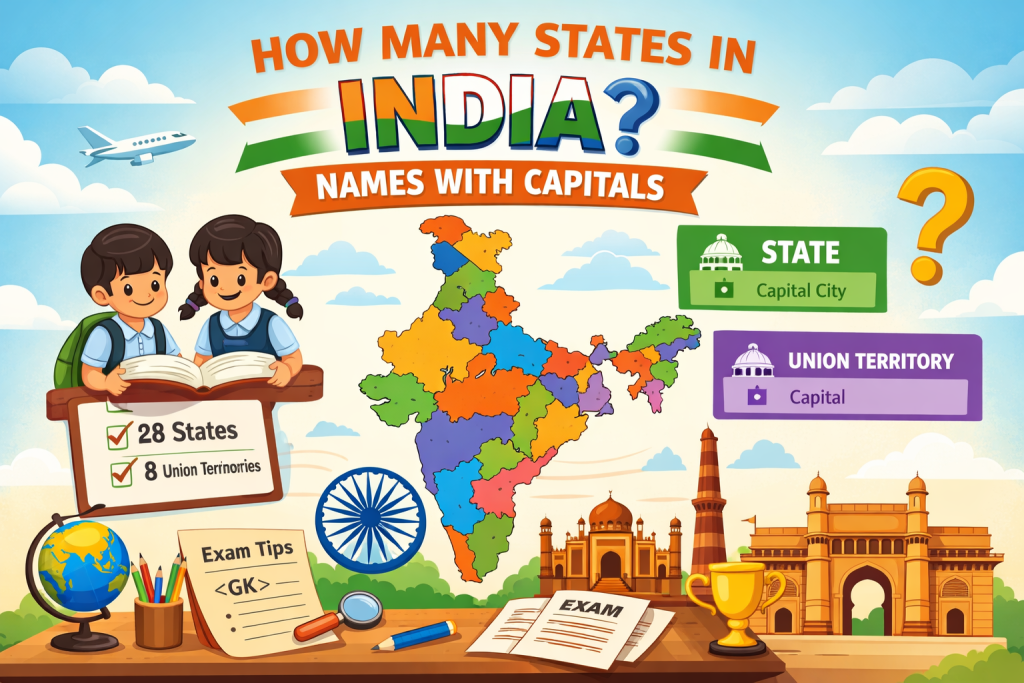
Confusion usually happens because older textbooks, notes, or websites still mention 29 states. This creates doubt for students and worry for parents during exam preparation. Changes made after 2019 are not updated everywhere, which leads to mixed information.
What this article will help you understand
This article gives a clear, exam-ready explanation of the current number of states, their capitals, and how they are different from Union Territories. It also explains states and capitals of india in a simple way so students can learn correctly and parents can guide them with confidence.

How Many States Are There in India in 2025?
Current official number of states
As of 2025, India has 28 states, and this number is final and officially accepted. Students looking for how many states in India and their names with capital can confidently use this count for school exams, GK tests, and competitive exams.
Why the number changed earlier
The count became 28 after the 2019 reorganisation, when some regions were restructured for better administration. Since then, there has been no further change in the state list or the state and capital of India structure.
Is this valid for exams and textbooks?
Yes, this information is fully valid for current exam syllabi. Parents can trust this number while helping children revise, as most exam questions are based on the latest official data, not outdated sources.
Complete List of 28 States of India with Capitals (Official)
Below is the exam-ready list of 28 states of India with capital, prepared as per the current official administrative structure. This information is valid for school exams, GK tests, Olympiads, and foundation-level competitive exams.
The states are arranged in alphabetical order to make learning and revision easier for students. Parents can also use this list to help children memorise correct spellings and avoid confusion from outdated sources.
Students should learn the state and capital names exactly as given below, as accuracy is important in objective and short-answer questions.
| State Name | Capital |
| Andhra Pradesh | Amaravati |
| Arunachal Pradesh | Itanagar |
| Assam | Dispur |
| Bihar | Patna |
| Chhattisgarh | Raipur |
| Goa | Panaji |
| Gujarat | Gandhinagar |
| Haryana | Chandigarh |
| Himachal Pradesh | Shimla |
| Jharkhand | Ranchi |
| Karnataka | Bengaluru |
| Kerala | Thiruvananthapuram |
| Madhya Pradesh | Bhopal |
| Maharashtra | Mumbai |
| Manipur | Imphal |
| Meghalaya | Shillong |
| Mizoram | Aizawl |
| Nagaland | Kohima |
| Odisha | Bhubaneswar |
| Punjab | Chandigarh |
| Rajasthan | Jaipur |
| Sikkim | Gangtok |
| Tamil Nadu | Chennai |
| Telangana | Hyderabad |
| Tripura | Agartala |
| Uttar Pradesh | Lucknow |
| Uttarakhand | Dehradun |
| West Bengal | Kolkata |
States with More Than One Capital in India
Why some states use more than one capital
In states and capitals of India, a few states use different capitals for different seasons. This is mainly done because of weather conditions and administrative convenience. Students should understand this concept clearly to avoid confusion in exams.
Himachal Pradesh – summer and winter capitals
Himachal Pradesh follows a seasonal capital system. Shimla is used as the summer capital, while Dharamshala works as the winter capital. In exams, students may be asked to name one or both capitals depending on the question.
Maharashtra – clearing a common confusion
Maharashtra does not have two official capitals. Mumbai is the only capital of the state. Some government sessions are held in Nagpur during specific periods, but this does not make it a second capital. Parents should help students remember this distinction to avoid factual mistakes.
Why Do Some Books Still Mention 29 States?
Reason behind outdated information
Some books and websites still mention 29 states because they were published before the latest administrative changes in India. Many study materials are not updated regularly, which leads to old information being reused year after year.
How this affects students and parents
This outdated data creates confusion for students during exam preparation and worry for parents helping with revision. A child may learn one number from school notes and see a different answer online, which reduces confidence.
What students should follow for exams
For exams, students should always rely on the current official count of 28 states. Parents are advised to check updated sources and guide children to follow the latest information used in school syllabi and competitive exams.
Union Territories and Their Capitals (For Exam Clarity)
Clear difference for exam preparation
Many students get confused between states and union territories and capitals, which often leads to mistakes in exams. Union Territories are counted separately from states and follow a different administrative structure.
Learning this list clearly helps students answer GK, school exam, and competitive exam questions with confidence. Parents should ensure children memorise Union Territories separately to avoid mixing them with states.
Below is the official and exam-ready list of Union Territories and their capitals, based on the current structure of India.
| Union Territory | Capital |
| Andaman and Nicobar Islands | Port Blair |
| Chandigarh | Chandigarh |
| Dadra and Nagar Haveli and Daman and Diu | Daman |
| Delhi (NCT) | New Delhi |
| Jammu and Kashmir | Srinagar (Summer), Jammu (Winter) |
| Ladakh | Leh |
| Lakshadweep | Kavaratti |
| Puducherry | Puducherry |
Difference Between States and Union Territories in India
What is a state in India?
A state has its own elected government that looks after education, health, roads, and local rules. The Chief Minister and state ministers take most day-to-day decisions. This gives states more freedom to manage their internal matters.
What is a Union Territory?
A Union Territory is mainly governed by the Central Government. Some Union Territories have a local assembly, but their powers are limited compared to states. Important decisions are taken at the national level.
Why this difference matters for students
For Class 6-8 students, understanding this difference helps avoid mistakes in exams. Parents can explain that states and Union Territories are counted separately, which is important for GK questions, MCQs, and short answers.
Why Knowing States and Capitals Is Important for Students
Common topic in school and competitive exams
States and capitals are a basic topic asked in school exams, GK tests, and Olympiads. Questions are often direct, so students need clear and accurate knowledge to score easy marks.
Useful for future exam preparation
This topic also helps in CUET foundation exams and SSC-level preparation, where general awareness plays an important role. Learning it early builds a strong base for higher classes.
Builds confidence and accuracy
When students know their states and capitals well, they feel more confident during exams and quizzes. Parents can support children through regular revision, which helps reduce last-minute stress and mistakes.
FAQs on States and Capitals of India
Q. How many states are there in India in 2025?
India currently has 28 states, and this number is officially accepted for school exams and competitive exams. Students should follow this count while answering GK and civics questions.
Q. Are there 28 or 29 states in India?
The correct answer is 28 states. Some books and websites still mention 29 because they use outdated information. Parents should guide students to rely on updated sources for exam preparation.
Q. Which states in India have two capitals?
Only Himachal Pradesh has two capitals. Shimla is used in summer, and Dharamshala is used in winter. This detail is sometimes asked in GK and higher-level exams.
Q. How many Union Territories are there in India?
India has 8 Union Territories, and they are counted separately from states. Each Union Territory is governed differently, which is important to remember for exams.
Q. Is this information valid for school and competitive exams?
Yes, this information follows the current official structure. Students can safely use it for school exams, Olympiads, CUET foundation tests, and other competitive exams without confusion.