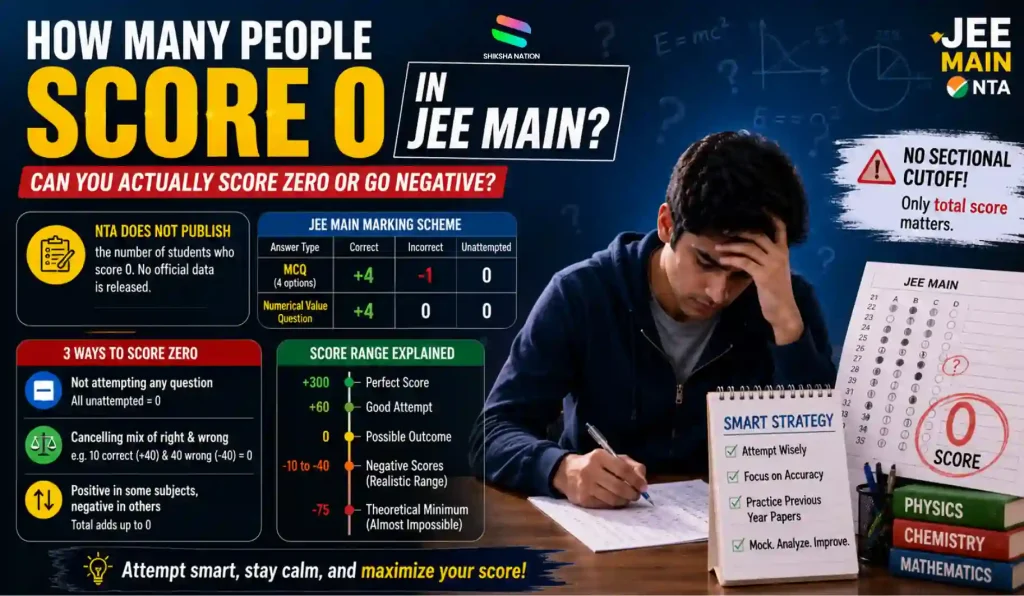
Scoring 0 in JEE Main is mathematically real. A candidate who skips every single question will finish at exactly 0, and it’s also possible to land there through a specific mix of correct and incorrect answers that cancel each other out. That said, the National Testing Agency does not publish a breakdown of how many students scored any particular mark, so there is no official figure for “students who scored zero” in any given session.

Does NTA Actually Publish Data on Zero Scorers?
This is the honest answer you won’t get from most coaching blogs: no, NTA does not release that number.
The agency publishes results as percentile scores, NTA scores, and All India Ranks. It does not release a subject-wise or session-wise tally of how many students landed at specific score points, including zero. If someone tells you “X thousand students scored 0 in JEE Main 2026,” they are guessing, not citing official data.
What does exist is anecdotal. Forums like Quora and Careers360 have threads where students self-report scoring zero or going into negative territory. These are unverified individual accounts, not NTA statistics. But they’re consistent enough across years to confirm that zero and negative scores do happen in real exam conditions, not just on paper.
Do Check: JEE Mains 2026 Cut off, Rank Percentile and best Colleges for CSE / JEE Main 2026 21 Jan Paper Analysis
How JEE Main Marking Actually Works
Understanding the marking scheme is the foundation for understanding how zero scores are possible.
JEE Main has 75 questions total: 25 from Physics, 25 from Chemistry, and 25 from Mathematics. The full paper is worth 300 marks.
| Answer Type | Marks Awarded | Marks Deducted | Notes |
| MCQ (correct answer) | +4 | 0 | Four marks added per correct MCQ |
| MCQ (incorrect answer) | 0 | -1 | One mark deducted per wrong MCQ |
| MCQ (unattempted) | 0 | 0 | No penalty and no reward for skipping |
| Numerical value question (correct) | +4 | 0 | Full marks if the typed answer matches |
| Numerical value question (incorrect) | 0 | 0 | No negative marking for wrong numerical answers |
| Numerical value question (unattempted) | 0 | 0 | Treated the same as a wrong numerical answer |
The numerical value questions deserve special attention. Each paper includes some non-MCQ questions where you type a number rather than select an option from a list. These typically carry no negative marking. A wrong guess on a numerical question costs you nothing, which is a very different risk profile from an MCQ where every wrong answer subtracts a mark.
The Three Ways a Candidate Can Score Exactly 0
There isn’t just one path to a zero score. There are at least three distinct scenarios, and understanding each one matters.
- Not attempting anything at all: If a candidate submits the paper without marking a single answer, every question counts as unattempted. Unattempted questions carry no penalty and no reward across both MCQs and numerical questions. The total works out to exactly 0.
- A cancelling mix of correct and incorrect MCQ answers: This is the less obvious scenario. A candidate could answer some MCQs correctly, earning +4 each, and get enough others wrong, losing -1 each, so that the two effects cancel out to zero. For instance, one correct answer (+4) offset by four incorrect answers (-4 total) nets to zero across those five questions. Apply that pattern across the full paper and a total of zero is reachable without having skipped everything.
- Positive in some subjects, negative in others: A candidate might do well in Mathematics but score heavily negative in Chemistry. If those results add up to zero or near it at the total level, that’s a third route to the same outcome.
Realistic Score Scenarios: From Zero to Negative
Here’s how different attempt patterns translate into score outcomes in practice.
| Scenario | Correct Answers | Incorrect MCQ Answers | Resulting Score | Notes |
| No attempt at all | 0 | 0 | 0 | All 75 questions unattempted |
| All MCQs wrong (theoretical) | 0 | 75 | -75 | Absolute floor, practically impossible |
| Cancelling mix | 10 | 40 | 0 | 10x(+4) = +40, 40x(-1) = -40, net = 0 |
| Partial attempt, poor accuracy | 5 | 30 | -10 | 5x(+4) = +20, 30x(-1) = -30, net = -10 |
| Numericals only, no MCQs | 15 | 0 | +60 | No negative marking risk at all |
| Moderate attempt, decent accuracy | 20 | 20 | +60 | 20x(+4) = +80, 20x(-1) = -20, net = +60 |
What Is the Theoretical Minimum Score in JEE Main?
The theoretical floor is -75. That would require a candidate to attempt all 75 questions as MCQs and get every single one wrong.
In practice, this is nearly impossible. Random guessing on a four-option MCQ gives a 25% hit rate on any given question, so even a purely random approach would produce some correct answers and push the score above -75. The floor exists mathematically but is not a realistic outcome.
Anecdotal student reports on forums mention negative scores in the -30 to -40 range. These are unverified self-reports from individual students, not anything NTA has published. Even so, they illustrate that going significantly negative is not purely theoretical. It happens when candidates attempt large numbers of MCQs under poor conditions or with low subject familiarity.
No Sectional Cutoff: What That Means for You
JEE Main does not require a minimum score in any individual subject. There is only one threshold that matters: the total combined score.
A candidate can score 0 in Chemistry, or even go negative in it, and still qualify at the overall level if Physics and Mathematics bring the combined total high enough. The exam does not penalize you for a weak subject in isolation. Only the aggregate matters for percentile calculation and for determining whether you meet the qualifying cutoff for JEE Advanced or JoSAA counselling.
This has a practical implication for exam strategy. If you’re very weak in one subject, the question isn’t “will I be disqualified for a bad Chemistry score?” It’s “what is the smartest way to minimize damage in Chemistry without dragging down my total?”
What Happens to Your Rank and Qualification at Zero or Negative?
A score of 0 places you in the lowest percentile band across the session. Since percentile is calculated relative to all candidates who appeared, a zero score means you performed at or below virtually every other test-taker. Your NTA percentile would likely round to 0.00 or an extremely small number.
For JEE Advanced qualification, the cutoff typically sits at a percentile that corresponds to scores well above zero. A zero or negative score will not get you close to that threshold. For NIT, IIIT, and GFTI admissions through JoSAA, the same applies. You’d receive a rank and a percentile, but not a rank that leads to a meaningful counselling outcome.
There is no disqualification for scoring zero or going negative. You’re ranked, you receive a percentile, and you’re at the very bottom of the distribution for that session.
How to Avoid Going Negative: Practical Strategy for the Exam
Protecting your score from slipping below zero is mostly about disciplined question selection.
- Leave MCQs blank if you genuinely don’t know: Skipping an MCQ costs 0. Guessing wrong costs -1. If you can’t confidently eliminate at least two of the four options, skipping is the better play statistically.
- Attempt every numerical question you can: No negative marking means no downside. Even an uncertain guess on a numerical question is worth making because a correct answer earns +4 and a wrong one costs nothing.
- Use elimination to change the guessing math: If you can eliminate two of four options on an MCQ, guessing between the remaining two gives you a 50% hit rate. At that point the expected value is positive (+1.5 per guess on average), which makes guessing worthwhile.
- Avoid panic-attempting in the final minutes: Clicking random MCQ answers in the last 60 seconds is one of the most reliable ways to bleed marks. A blank answer is always worth 0. A random wrong MCQ guess is worth -1.
- Keep a rough sense of your attempt quality as you go: If you’ve attempted 25 MCQs and you know you’re shaky on about half of them, that’s a mental flag to slow down on new MCQ attempts rather than adding more risky guesses.