
This GK Quiz on Strait of Hormuz quiz includes important questions and answers about its location, geographical features, global importance, and its role in oil transport and international trade. It is useful for school exams, competitive exams, and general knowledge improvement.
GK Quiz on Strait of Hormuz: The Strait of Hormuz is a narrow and very important waterway in the Middle East. It connects the Persian Gulf to the Gulf of Oman and further to the Arabian Sea. This strait lies between Iran in the north and the Musandam Peninsula (Oman) in the south, while a small part is controlled by the United Arab Emirates (UAE). The total length of the strait is around 167 km, and its width ranges from about 39 km to 97 km.
It is one of the busiest and most important shipping routes in the world. A large portion of the world’s oil supply passes through this strait every day, making it a key point for global oil transport, energy security, and international trade. As of 2026, the Strait of Hormuz remains very important due to rising energy demand, geopolitical tensions, and its strategic location in global trade routes.
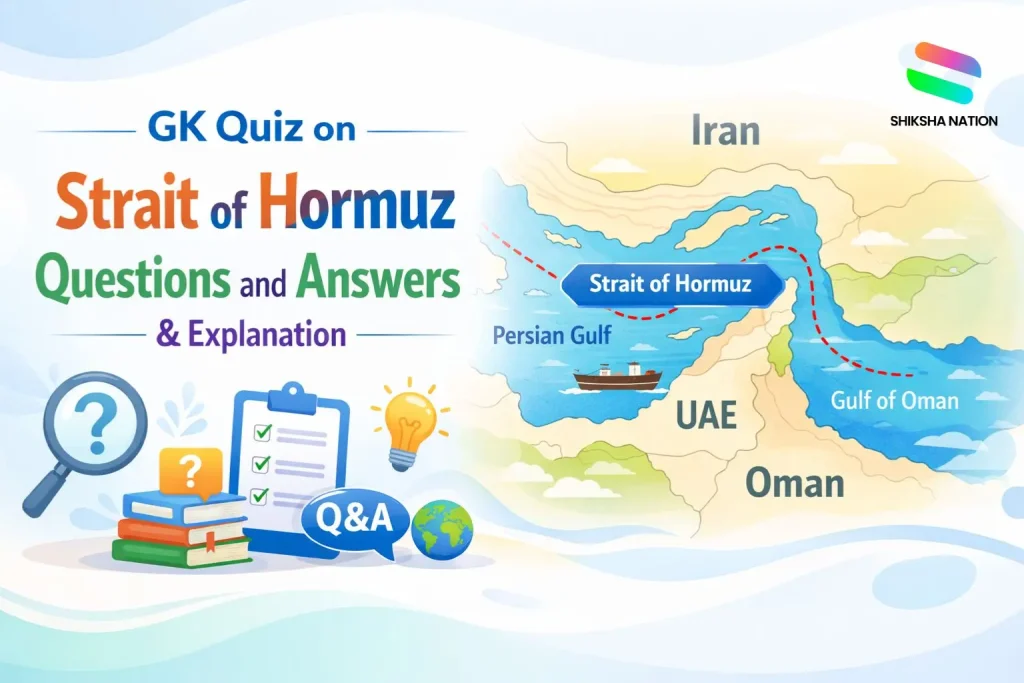
GK Quiz on Strait of Hormuz Questions and Answers
Practice this GK quiz on Strait of Hormuz with answers to improve your knowledge. These GK questions cover important topics like location, countries around it, economic importance, and its role in global shipping and oil supply. This quiz is helpful for students preparing for exams like SSC, UPSC, and other competitive tests.
1. What is the Strait of Hormuz?
A. A mountain range
B. A narrow sea passage connecting two water bodies
C. A desert region
D. A river
Answer: B
Explanation:
The Strait of Hormuz is a narrow waterway that connects the Persian Gulf with the Gulf of Oman and the Arabian Sea. It is an important sea route for ships and oil transport.
2. Who owns the Strait of Hormuz?
A. Only Iran
B. Only Oman
C. Both Iran and Oman share control
D. United Nations
Answer: C
Explanation:
The strait lies between Iran (north) and Oman (south). It is not owned by a single country. It is considered an international waterway, so ships from all countries can pass through it.
3. Can Iran close the Strait of Hormuz?
A. Yes, anytime without reason
B. No, it has no control at all
C. It can try, but it is difficult due to international laws and global pressure
D. Only the USA can close it
Answer: C
Explanation:
Iran has a strong position near the strait and can disrupt or block traffic, but fully closing it is difficult because it is an international route and many countries depend on it.
4. How wide are the Straits of Hormuz (general width)?
A. 10 km
B. 20 km
C. 39 km to 97 km
D. 200 km
Answer: C
Explanation:
The width of the Strait of Hormuz ranges from about 39 km to 97 km, depending on the location.
5. How wide is the Strait of Hormuz at its narrowest point?
A. 5 km
B. 39 km (approx.)
C. 100 km
D. 500 km
Answer: B
Explanation:
At its narrowest point, the strait is about 33–39 km wide, making it a tight and sensitive route for ships.
6. Why is the Strait of Hormuz important?
A. It is used for tourism only
B. It connects two continents
C. It is a key route for global oil and trade
D. It is used only for fishing
Answer: C
Explanation:
The strait is one of the most important trade routes in the world, especially for transporting oil and gas, making it vital for the global economy.
7. How much oil passes through the Strait of Hormuz?
A. 1 million barrels per day
B. 5 million barrels per day
C. Around 20 million barrels per day
D. 100 million barrels per day
Answer: C
Explanation:
About 20 million barrels of oil pass daily, which is nearly 20% of the world’s oil supply.
8. What is the Strait of Hormuz used for?
A. Farming
B. Transporting oil, gas, and goods by ships
C. Mining
D. Space research
Answer: B
Explanation:
It is mainly used for shipping oil, natural gas, and goods between countries, especially from the Middle East to Asia and other parts of the world.
9. Where is the Strait of Hormuz located?
A. Between India and Sri Lanka
B. Between Iran and Oman
C. Between USA and Canada
D. Between Africa and Europe
Answer: B
Explanation:
The strait lies between Iran (north) and Oman (south) and connects the Persian Gulf to the Gulf of Oman.
10. Which water bodies are connected by the Strait of Hormuz?
A. Red Sea and Arabian Sea
B. Persian Gulf and Gulf of Oman
C. Mediterranean Sea and Black Sea
D. Bay of Bengal and Arabian Sea
Answer: B
Explanation:
It connects the Persian Gulf with the Gulf of Oman, and then to the Arabian Sea.
11. Why is the Strait of Hormuz called a “chokepoint”?
A. It has mountains
B. It is very deep
C. It is narrow but very important for trade
D. It is blocked by ice
Answer: C
Explanation:
A chokepoint means a narrow route where a lot of traffic passes, making it very important and sensitive.
12. Which region depends most on oil passing through the Strait of Hormuz?
A. Europe
B. Africa
C. Asia
D. Australia
Answer: C
Explanation:
Most oil goes to Asian countries like India, China, and Japan.
13. What percentage of global oil passes through the Strait of Hormuz?
A. 5%
B. 10%
C. About 20%
D. 50%
Answer: C
Explanation:
Around 20% of the world’s oil supply moves through this strait daily.
14. Which country is NOT directly connected to the Strait of Hormuz?
A. Iran
B. Oman
C. UAE
D. India
Answer: D
Explanation:
India depends on it but is not located next to the strait.
15. What type of goods mainly pass through the Strait of Hormuz?
A. Cars
B. Oil and natural gas
C. Clothes
D. Food grains
Answer: B
Explanation:
It is mainly used to transport oil and gas, which are very important for energy.
16. What happens if the Strait of Hormuz is blocked?
A. No effect
B. Oil prices may increase globally
C. Rainfall increases
D. Flights stop
Answer: B
Explanation:
Blocking it reduces oil supply, so prices go up worldwide.
17. Which international law allows ships to pass through the strait?
A. WTO rules
B. UNCLOS (Law of the Sea)
C. IMF rules
D. NATO rules
Answer: B
Explanation:
International law allows free passage of ships through such important waterways.
18. How many barrels of oil pass daily through the Strait of Hormuz?
A. 1 million
B. 5 million
C. Around 20 million
D. 50 million
Answer: C
Explanation:
About 20 million barrels per day pass through it.
19. Which countries export oil through the Strait of Hormuz?
A. USA and UK
B. Saudi Arabia, UAE, Iraq, Kuwait, Iran
C. Japan and China
D. Germany and France
Answer: B
Explanation:
Major oil-producing countries in the Middle East use this route.
20. What is the approximate narrowest width of the Strait of Hormuz?
A. 10 km
B. 20 km
C. Around 33 km
D. 100 km
Answer: C
Explanation:
At its narrowest, it is about 33 km wide.
21. Why is the Strait of Hormuz important for India?
A. Tourism
B. Oil imports
C. Farming
D. Space research
Answer: B
Explanation:
India gets a large part of its oil supply through this route.
22. Which type of ships mostly pass through this strait?
A. Fishing boats
B. Oil tankers
C. Passenger trains
D. Submarines only
Answer: B
Explanation:
Mostly oil tankers and cargo ships travel through it.
23. What is LNG transported through the Strait of Hormuz?
A. Liquid Nitrogen Gas
B. Liquefied Natural Gas
C. Liquid Nuclear Gas
D. Light Natural Gas
Answer: B
Explanation:
LNG means Liquefied Natural Gas, also transported through this route.
24. Which organization often monitors security in this region?
A. WHO
B. United Nations
C. US Navy / International forces
D. UNESCO
Answer: C
Explanation:
International naval forces help keep the route safe for ships.
25. Why has the Strait of Hormuz been in news recently?
A. Tourism growth
B. Oil discovery
C. Rising tensions and conflict in the Middle East
D. New bridges
Answer: C
Explanation:
In 2026, conflicts and tensions have affected oil transport and shipping.