
Generation names have become a common part of everyday conversations. Terms such as Baby Boomers, Generation X, Millennials, Gen Z, and Generation Alpha are often used to describe different age groups. However, many people still wonder what these generation names actually mean, how they are created, and why people born in different years are placed into different categories.
Understanding Generation Names is important because each generation grows up in a unique social, cultural, and technological environment. These experiences influence the way people learn, work, communicate, and view the world. From the rise of television and the internet to the growth of smartphones and artificial intelligence, every generation has witnessed different changes that have shaped its identity.
In this comprehensive guide, you will learn about generation names 2026, the complete generation timeline, generation names in India, and generation names and years in India. You will also discover the characteristics of Millennials, Gen Z, Generation Alpha, and Generation Beta, along with an explanation of generation names who decides.
What are Generation Names and Why Do They Matter?
Generation names are labels given to groups of people born within a similar time period, usually fifteen to twenty years. The idea is simple: people born around the same time often go through the same major events, the same technology shifts, and the same cultural moments. That shared experience shapes how they think, work, spend money, and raise their own children.
Generation names matter because they help researchers, marketers, employers, and even families understand broad patterns of behaviour. A company trying to sell a product to 25-year-olds needs to know that this group grew up with smartphones from childhood, while a company targeting 60-year-olds is dealing with people who remember a world without the internet.
That said, these labels are not perfect. Pew Research Center, which is treated as the closest thing to an authority on this topic, has openly said that generational boundaries are not a hard science. People born near the edge of two generations often feel like they belong to both, or neither.
Generation Names 2026 age & Birth Year
If you are wondering what generation you belong to right now, in 2026, here is a simple breakdown by current age:
| Generation | Age in 2026 | Birth Years |
|---|---|---|
| Baby Boomers | 62–80 | 1946–1964 |
| Generation X | 46–61 | 1965–1980 |
| Millennials | 30–45 | 1981–1996 |
| Generation Z | 14–29 | 1997–2012 |
| Generation Alpha | 0–13 | 2013–2025 |
| Generation Beta | Newborn | 2025 onward |
This table is useful if you simply want to check where you fall without reading through every detail above.
Generation Names and Meaning
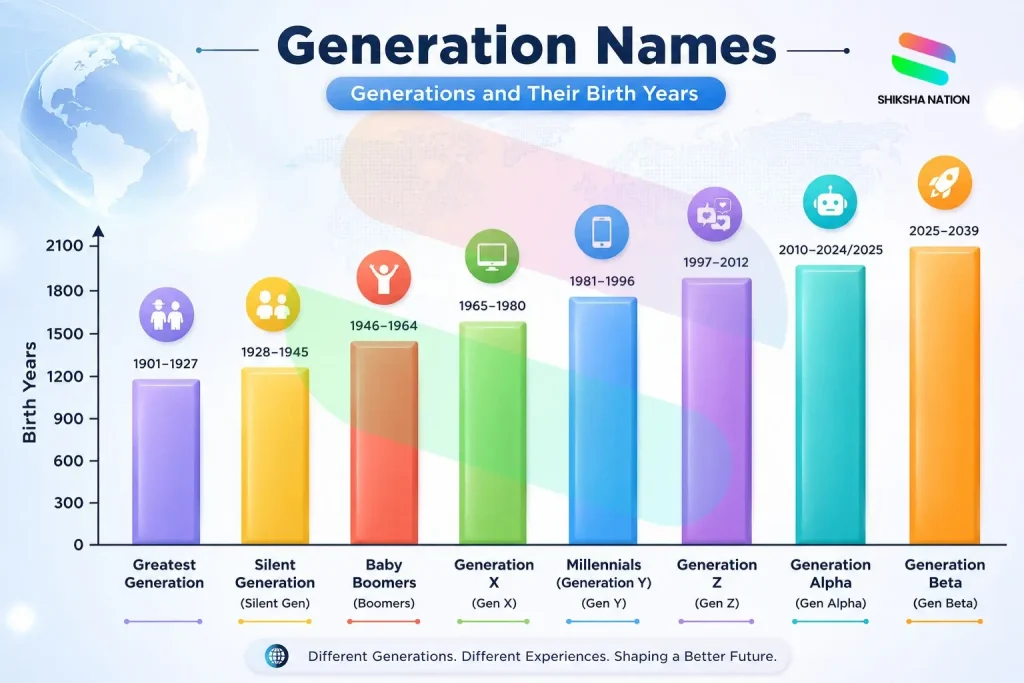
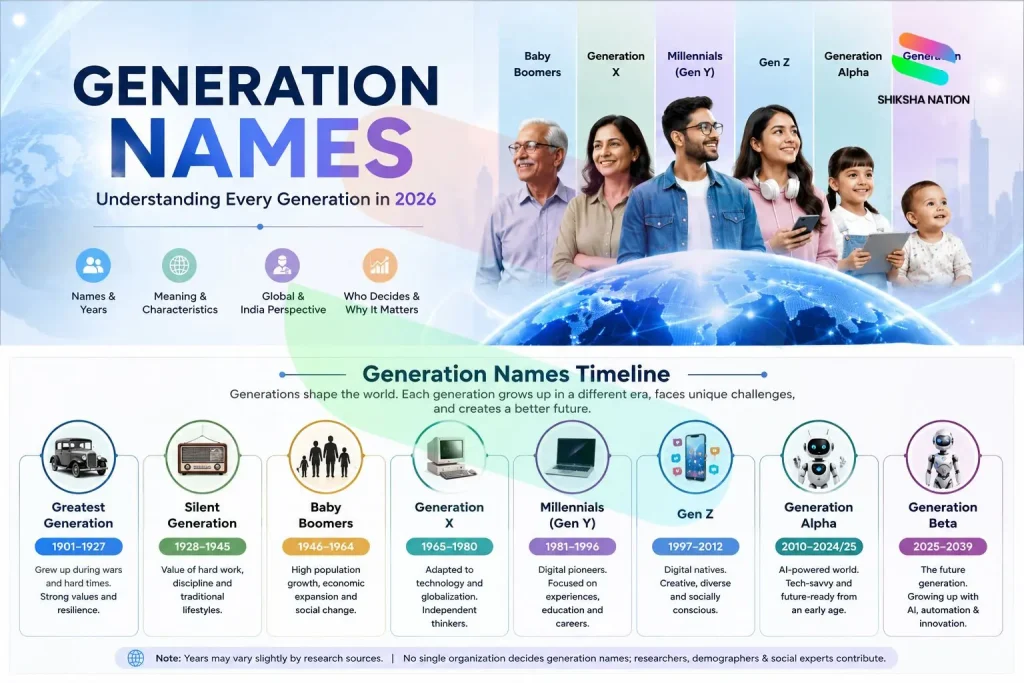
Here is a simple table covering every major generation, the years they cover, and what each group is commonly known for.
| Generation Name | Birth Years | Known For |
|---|---|---|
| Silent Generation | 1928–1945 | Cautious, pragmatic, shaped by war and economic hardship |
| Baby Boomers | 1946–1964 | Born during the post-war birth spike, career-focused |
| Generation X | 1965–1980 | Independent, first generation with widespread computer use |
| Millennials (Gen Y) | 1981–1996 | Tech-adaptive, shaped by the 2008 financial crisis |
| Generation Z | 1997–2012 | Digital natives, grew up with social media and smartphones |
| Generation Alpha | 2010/2013–2024 | Born into AI, tablets, and remote learning from birth |
| Generation Beta | 2025–2039 | Still forming, expected to grow up fully immersed in AI |
A quick note on overlapping years: you may notice some sources list Generation Alpha starting in 2010 and others say 2013. This is not a mistake on anyone’s part. It happens because, as we will explain in the next section, there is no single official rulebook for generation names.
Silent Generation (1928–1945)
This was the smallest living generation for a long time. The name came from a 1951 Time magazine essay describing how children of that era were raised to be seen and not heard. They lived through the Great Depression and World War II, which made many of them careful with money throughout their lives.
Baby Boomers (1946–1964)
The name comes directly from the sharp rise in births after World War II ended, often called the baby boom. This is the only generation that has an official definition, recognised by the U.S. Census Bureau, because the birth spike was a measurable demographic event rather than a cultural guess.
Generation X (1965–1980)
Sandwiched between Boomers and Millennials, Gen X is sometimes called the forgotten generation because it gets far less media attention. They were the first to grow up with personal computers becoming common in homes and offices, but they also remember a childhood without the internet.
Millennial Generation Names (1981–1996)
Millennials, also known as Generation Y, came of age around the start of the new millennium, which is where the name comes from. This generation is known for adapting quickly to new technology while also facing tough economic conditions early in their careers, particularly the 2008 financial crisis. Some people at the very edge of this group, born between 1994 and 2000, are sometimes called Zillennials, since they share traits of both Millennials and Gen Z.
Generation Names Gen Z (1997–2012)
Gen Z, sometimes called Zoomers, is considered the first generation to grow up almost entirely with the internet, smartphones, and social media already in place. They did not have to adapt to this technology; they were born into it. This group is often described as more socially aware and more comfortable discussing mental health and identity openly compared to earlier generations.
Generation Names Alpha (2010–2024)
Generation Alpha is named after the first letter of the Greek alphabet, since the Latin alphabet ran out of letters after Gen Z. Most members of this generation have Millennial parents, which is why they are sometimes nicknamed mini Millennials. They are the first generation to experience tablets, streaming platforms, and even early AI tools from early childhood. This generation is also unusually large, with estimates suggesting nearly two billion members worldwide once all births are counted.
Generation Beta (2025 onward)
This is the newest and youngest generation, and it is still being born as you read this. The name was coined by demographer Mark McCrindle, who also created the term Generation Alpha. Generation Beta is expected to grow up fully surrounded by artificial intelligence, more so than any generation before it.
Generation Names – Who Decides Them?
This is the question that surprises people the most. There is no government body, no global committee, and no single scientist who officially decides generation names. The only exception is the term Baby Boomers, which the U.S. Census Bureau recognises because it is tied to an actual measurable spike in birth rates.
For every other generation, the names come from a mix of:
- Demographers and researchers like Mark McCrindle, who personally coined both Generation Alpha and Generation Beta
- Research organisations such as Pew Research Center, which has become the most widely cited reference point for generational cutoffs
- Journalists and media outlets, who often popularise a name even before researchers fully agree on it
- Public culture itself, since terms like Zoomers or Boomer became common through everyday conversation rather than official declaration
Because there is no single authority, different sources sometimes disagree by a year or two on where one generation ends and another begins. Generational researcher Jason Dorsey has pointed out that these labels are still useful even without strict scientific boundaries, because they give people a shared starting point for understanding broader cultural shifts.
So if you have ever wondered why one website says Gen Z ends in 2012 and another says 2013, now you know the honest answer: it depends on who is writing it, not on any fixed rule.
Generation Names in India
Generation names were originally built around Western experiences, mainly American and European events like World War II, the baby boom, and the dot-com era. India did not go through identical events at the same time, so applying these labels directly needs a bit of context.
Generation Names and Years in India
In practice, most Indian researchers and media still use the same global age brackets, Gen Z from 1997 to 2012, Millennials from 1981 to 1996, and so on. However, the lived experience inside those years often looks different.
For example, India’s economic liberalisation in 1991 changed daily life dramatically for people born in that decade, similar to how the internet boom changed life for American Millennials. Many Indian Millennials grew up watching their country shift from limited consumer choices to a fast-growing, globally connected economy within their own childhood.
Generation Alpha in India deserves special mention here. India and Nigeria together hold the largest populations of Generation Alpha children in the world. This means India’s youngest generation is not just following global trends, it is actually shaping them, since such a large share of the world’s Alpha generation lives within the country.
A few points worth noting about generation names in India:
- Mobile internet reached Indian households later than in the West, so Indian Millennials experienced the digital shift slightly later than their American counterparts
- Indian Gen Z grew up alongside the explosive growth of affordable smartphones and cheap data, which happened earlier and faster in India than in many Western countries
- Joint family structures and regional cultural differences mean generational traits in India can vary more by region than by birth year alone
- English-language Western terms like Boomer or Gen Z are now common in Indian cities, but rural India often does not use these labels at all in daily conversation
Millennial Generation Names – Nicknames and Sub-Groups
Millennials carry more nicknames than most other generations. Besides the official term Generation Y, you might come across:
- Echo Boomers – since many Millennials are children of Baby Boomers, creating an “echo” of the original baby boom
- Zillennials – the small group born between 1994 and 2000, who feel caught between Millennial and Gen Z identities
- Gen Y.1 and Gen Y.2 – a marketing split separating younger Millennials still building careers from older Millennials already raising families
Generation Names Gen Z – Traits and Alternate Names
Gen Z is also called Zoomers, iGen, or simply digital natives. What separates this generation from Millennials is timing. Millennials adapted to the internet as it grew around them, but Gen Z never knew a world without it. This single difference shapes how each generation approaches work, communication, and even mental health conversations.