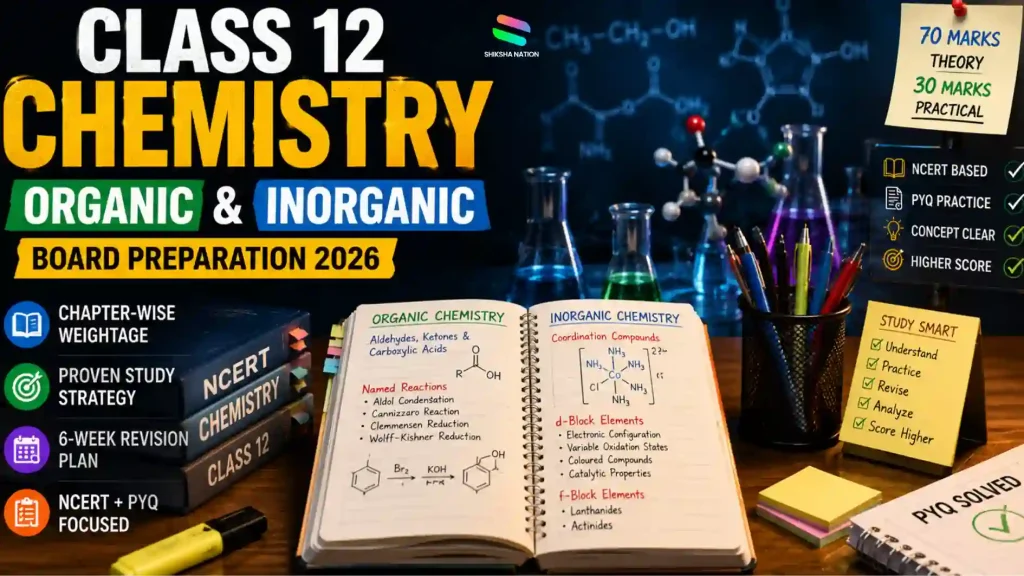
To prepare organic and inorganic chemistry for CBSE Class 12 boards, start with NCERT and understand the chapter-wise weightage before you open your notes. Organic chemistry demands mastery of reaction mechanisms and named reactions. Inorganic chemistry is more about definitions, trends, and coordination theory. Allocate study time proportional to marks and solve previous year papers consistently.

Understand the Exam Before You Open Your Textbook
The Class 12 Chemistry board exam carries 100 marks in total. The theory paper is 70 marks and the practical exam is 30 marks. The theory paper runs for 3 hours and has 33 questions across 5 sections.
Here is the section breakdown:
- Section A: 16 MCQs (1 mark each)
- Section B: 5 short answer questions (2 marks each, 10 marks total)
- Section C: 7 short answer questions (3 marks each, 21 marks total)
- Section D: 2 case-based questions (4 marks each)
- Section E: 3 long answer questions (5 marks each)
Roughly 50% of the paper is competency-based (MCQs, case-based, source-based), 30% is constructed response (short and long answers), and 20% is select-response MCQs.
This matters for how you study. You cannot only memorise content. A student who understands why a reaction happens will outscore one who has only memorised the product.
Do Check: Chemical Formula List for Class 10 / Class 12 Chemistry Chapterwise Formulas
Chapter-Wise Weightage: Know Where Your Marks Come From
This is the most useful table you can have before you begin studying. The marks are verified for the 2026 CBSE Chemistry syllabus.
| Section | Chapter | Marks |
| Organic Chemistry | Aldehydes, Ketones and Carboxylic Acids | 8 |
| Amines | 6 | |
| Alcohols, Phenols and Ethers | 6 | |
| Haloalkanes and Haloarenes | 6 | |
| Biomolecules | 7 | |
| Organic Total | 33 | |
| Inorganic Chemistry | Coordination Compounds | 7 |
| d-Block and f-Block Elements | 7 | |
| Inorganic Total | 14 | |
| Physical Chemistry | Electrochemistry | 9 |
| Chemical Kinetics | 7 | |
| Solutions | 7 | |
| Physical Total | 23 | |
| Theory Paper Total | 70 |
Organic chemistry accounts for 33 of the 70 theory marks. That makes it the largest single block in the paper. If you want a high score, you cannot treat organic as an afterthought.
How to Prepare Organic Chemistry for CBSE Class 12 Boards
Organic chemistry trips up many students because they treat it like a memorisation task. That approach breaks down fast. Organic has its own internal logic, and once you understand that logic, the reactions make sense on their own.
Aldehydes, Ketones and Carboxylic Acids (8 marks)
This is the highest-weightage chapter in organic and one of the most important in the entire syllabus. Expect questions on nucleophilic addition reactions, named reactions (Aldol condensation, Cannizzaro reaction, Clemmensen reduction), and conversion problems.
Here is how to approach it:
- Start with the NCERT text and read every mechanism step by step.
- Write out each named reaction on paper at least twice, with reagents, conditions, and the product clearly shown.
- Practice conversion problems: “Convert ethanal to butanol” style questions appear regularly in Section E.
- Distinguish clearly between aldehydes and ketones in their reactivity with oxidising agents. This distinction shows up repeatedly in MCQs.
- For carboxylic acids, understand the acidic strength comparisons and the effect of substituents on acidity.
Amines (6 marks)
Amines feel complicated because basicity comparisons, Gabriel synthesis, Hoffmann bromamide reaction, and diazonium salt chemistry all come together in a compact chapter. Do not try to memorise the basicity order without understanding it.
The key principle: basicity depends on the availability of the lone pair on nitrogen. Work through the reasoning for aliphatic versus aromatic amines, and the order will stick. Then focus on diazonium salts, which generate a whole family of conversion questions.
Alcohols, Phenols and Ethers (6 marks)
Focus on the Lucas test and what it tells you about primary, secondary, and tertiary alcohols. Study Williamson synthesis for ether preparation carefully. Understand why phenol is more acidic than alcohol but less acidic than carboxylic acid. Know the oxidation products of primary versus secondary alcohols. NCERT exercises for this chapter are well designed, so work through all of them.
Haloalkanes and Haloarenes (6 marks)
SN1 and SN2 mechanisms are the backbone of this chapter. Know when each applies, what factors influence the rate (substrate structure, nucleophile strength, solvent polarity), and what stereochemical outcome each produces.
Optical activity appears consistently in MCQs. Understand chirality, enantiomers, and when a reaction produces a racemic mixture versus a single enantiomer. Haloarenes behave very differently from haloalkanes, so understand why nucleophilic substitution is difficult for aryl halides.
Biomolecules (7 marks)
Biomolecules carries 7 marks and it is one of the more recall-heavy chapters in organic. Cover these areas thoroughly:
- Carbohydrates: Monosaccharides, disaccharides, polysaccharides, reducing versus non-reducing sugars
- Proteins: The four levels of structure, the role of peptide bonds, what denaturation means
- Nucleic acids: The differences between DNA and RNA, base pairing rules
Read this chapter from NCERT at least twice. Questions are straightforward when you have read the text carefully, but students consistently lose marks here by skimming.
How to Prepare Inorganic Chemistry for CBSE Class 12 Boards
Inorganic chemistry is represented by two chapters, each worth 7 marks (14 marks total). Unlike organic, inorganic is less about mechanisms and more about definitions, electronic configurations, properties, and the theory behind observable behaviour.
Coordination Compounds (7 marks)
This chapter becomes manageable when you break it into components:
- Master IUPAC nomenclature first. Practice naming complexes until you can do it without notes.
- Understand each type of isomerism (geometric, optical, linkage, coordination, ionisation) and know one example of each.
- Study Crystal Field Theory: why certain complexes are high spin versus low spin, and how CFT explains colour and magnetic properties.
- Know how to calculate the oxidation state of the central metal ion. This is a recurring MCQ topic where students drop easy marks through careless errors.
NCERT is sufficient. Read the text actively and pay close attention to worked examples.
d-Block and f-Block Elements (7 marks)
The d-block chapter is largely about explaining why transition metals behave the way they do. Questions typically cover variable oxidation states, coloured compounds, catalytic activity, and lanthanoid contraction.
The trap is memorising properties in isolation. Connect every property back to the electronic configuration. When you understand that variable oxidation states arise because 3d and 4s orbitals are close in energy, the facts stick. For f-block, focus on lanthanoid vs. actinoid differences and understand lanthanoid contraction conceptually.
Chapter-by-Chapter Focus Guide: Organic and Inorganic
| Chapter | Key Focus Area | Common Mistake to Avoid |
| Aldehydes, Ketones and Carboxylic Acids | Named reactions, nucleophilic addition, conversion problems | Confusing reagents for similar reactions; skipping mechanism steps in written answers |
| Amines | Basicity order reasoning, Gabriel synthesis, diazonium salt reactions | Memorising basicity order without reasoning; writing wrong product in coupling reactions |
| Alcohols, Phenols and Ethers | Lucas test, Williamson synthesis, phenol acidity, oxidation | Mixing up phenol and alcohol acidity; getting the Williamson substitution pattern wrong |
| Haloalkanes and Haloarenes | SN1 vs SN2 conditions, optical activity, Grignard reagent preparation | Applying SN2 logic to aryl halides; ignoring stereochemistry in MCQ options |
| Biomolecules | Reducing sugars, protein structure levels, DNA vs RNA differences | Skimming the chapter; confusing disaccharides; wrong base pairing in nucleic acid questions |
| Coordination Compounds | IUPAC naming, isomerism types, Crystal Field Theory, oxidation state calculation | Calculating oxidation state incorrectly with complex ligands; confusing geometric and optical isomers |
| d-Block and f-Block Elements | Variable oxidation states, colour, catalytic activity, lanthanoid contraction | Disconnecting properties from electronic configuration; surface-level memorisation without understanding |
How to Allocate Study Time Based on Weightage
Let the marks guide the hours. A chapter worth 9 marks deserves more of your time than one worth 6 marks. CBSE itself recommends giving extra attention to Electrochemistry, Aldehydes/Ketones/Carboxylic Acids, Chemical Kinetics, and Biomolecules because of their high weightage.
Here is a practical framework for prioritising:
- Tier 1 (8-9 marks each): Electrochemistry and Aldehydes/Ketones/Carboxylic Acids. These two chapters together account for 17 marks. Spend disproportionately more time here.
- Tier 2 (7 marks each): Biomolecules, Coordination Compounds, d-Block and f-Block, Chemical Kinetics, Solutions. Each deserves thorough NCERT coverage and regular revision.
- Tier 3 (6 marks each): Amines, Alcohols/Phenols/Ethers, Haloalkanes/Haloarenes. These are still substantial chapters in terms of content, so do not cut them short.
The point is not to ignore lower-weightage chapters but to stop spending equal time on everything when the marks distribution is clearly unequal.
Common Mistakes Students Make in Organic and Inorganic Chemistry
Organic chemistry mistakes:
- Writing reaction products without specifying reagents and conditions. Incomplete answers lose marks in 3-mark and 5-mark questions even when the product is correct.
- Skipping stereochemistry. Optical activity questions appear in MCQs year after year.
- Reading conversion problems instead of solving them. Practice is the only way through.
- Relying on short notes without reading NCERT text. Board questions draw from the explanatory paragraphs too, not just the exercises.
Inorganic chemistry mistakes:
- Calculating oxidation states incorrectly in Coordination Compounds, especially with ambidentate or charged ligands.
- Listing d-block properties without connecting them to electronic structure, which fails in application-based MCQs.
- Underestimating Biomolecules and losing marks on specific structural questions.
- Not returning to inorganic consistently during revision. It slips faster than organic if you leave long gaps.
How to Use Previous Year Papers and Mock Tests Effectively
Previous year question papers are your most valuable revision tool, but only when used with intention.
- Solve the last five to seven years of CBSE Chemistry papers under timed conditions (3 hours, full paper, no interruptions).
- After each paper, categorise your errors: conceptual gaps, careless mistakes, or time pressure issues. Each type needs a different fix.
- For every wrong organic answer, trace back to the reaction or mechanism you missed and re-read that section in NCERT.
- For MCQs, work out why the correct option is right and why the other three are wrong. This deepens understanding far more than just noting the answer.
- Track the chapters where you consistently drop marks. Those need extra revision time.
One full mock per week in the final six weeks is a reasonable target. Simulate real conditions: timed, no phone, at a desk.
Final 6-Week Chemistry Revision Plan
This plan assumes you have completed the syllabus once and are focused on consolidation, not starting from scratch.
Weeks 1 and 2: High-weightage chapters first
- Week 1: Electrochemistry (numerical practice) and Aldehydes/Ketones/Carboxylic Acids (named reactions, conversion drills).
- Week 2: Chemical Kinetics (rate laws, Arrhenius equation) and Biomolecules (re-read NCERT, revise reducing sugars, protein structure levels, DNA vs RNA).
Weeks 3 and 4: Organic and inorganic deep revision
- Week 3: Amines, Haloalkanes/Haloarenes, Alcohols/Phenols/Ethers. Drill reaction mechanisms and complete all NCERT exercises.
- Week 4: Coordination Compounds (nomenclature, isomerism, Crystal Field Theory) and d-Block/f-Block (properties tied to electronic configuration).
Weeks 5 and 6: Mock tests and targeted review
- Week 5: Two full mock papers. Review errors by chapter the following day.
- Week 6: Three to four previous year papers. Final three days: weakest chapters only, plus a named reaction quick-scan list.
Spend the night before the exam on formulas, named reactions, and IUPAC rules. Do not open any new chapter at that point.