
Many students find Organic Chemistry difficult because they try to memorize hundreds of reactions instead of understanding how they work. The best tricks to solve complex Organic Chemistry reactions and mechanisms are to identify the functional group, follow electron movement, recognize reaction patterns, understand reagent roles, and practice reaction mechanisms regularly. These simple strategies make product prediction easier and help you solve unfamiliar questions with greater confidence. In this guide, you’ll learn 15 practical tricks that can improve your problem-solving skills for NEET, JEE, and CBSE examinations.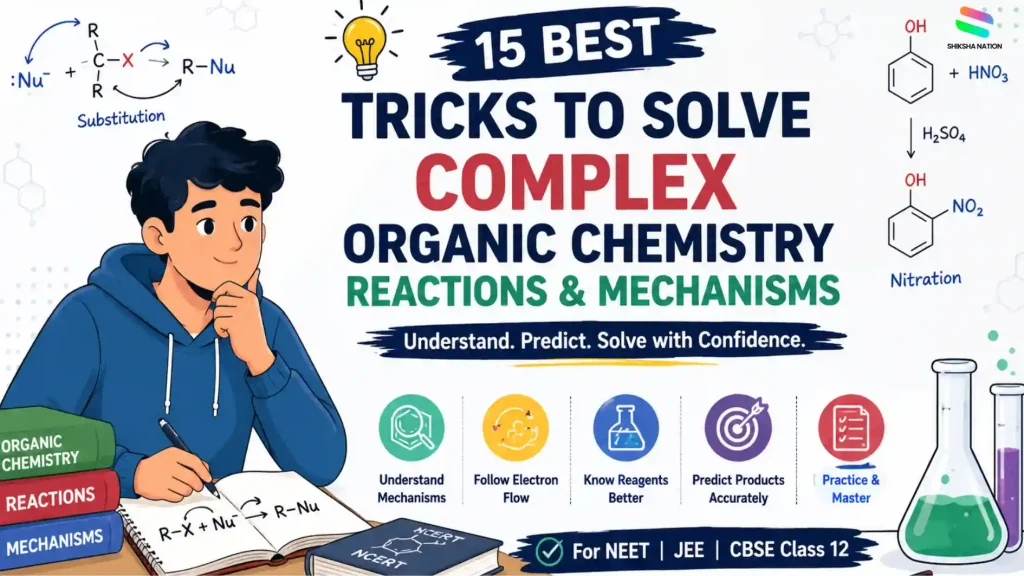
The Golden Rule of Organic Chemistry
If you remember only one concept from this guide, make it this.
Electrons decide everything.
Every organic reaction occurs because electrons move from an electron-rich region to an electron-deficient region. If you can correctly identify where electrons are available and where they are needed, predicting the reaction becomes much easier.
Ask yourself these questions whenever you see a reaction.
- Which atom has excess electron density?
- Which atom is electron deficient?
- Where can a new bond form?
- Which bond is likely to break?
- Is there a stable intermediate that can form?
Answering these questions often leads you toward the correct product even when you have never seen the reaction before.
Do Check: Class 12 Chemistry Formulas
15 Best Tricks to Solve Complex Organic Chemistry Reactions and Mechanisms
1. Identify the Functional Group First
Before looking at the reagent, identify the functional group in the starting compound. Whether it is an alcohol, alkene, haloalkane, aldehyde, ketone, or carboxylic acid, each follows a limited set of reaction pathways. This simple habit narrows your options and makes predicting the reaction much easier.
2. Understand Electron Flow Instead of Memorizing Reactions
The best way to solve complex Organic Chemistry reactions and mechanisms is to understand how electrons move. Electrons always flow from an electron-rich region to an electron-deficient region. Once you can follow this movement, reaction mechanisms become logical instead of something you have to memorize.
3. Identify Nucleophiles and Electrophiles
Every reaction involves an electron donor and an electron acceptor. Learn to recognize common nucleophiles such as OH⁻, CN⁻, and NH₃, along with electrophiles like carbocations and positively polarized carbon atoms. Correctly identifying them makes product prediction much more accurate.
4. Classify the Reaction Type
Most Organic Chemistry questions belong to one of five reaction families: addition, substitution, elimination, oxidation, or reduction. Identifying the reaction type early helps you eliminate incorrect possibilities and focus on the correct mechanism.
5. Learn Reagents by Their Function
Instead of memorizing long reagent lists, understand what each reagent does. For example, KMnO₄ and PCC are oxidizing agents, while LiAlH₄ and NaBH₄ are reducing agents. Grouping reagents by function makes them easier to remember and apply.
6. Analyze the Stability of Intermediates
Many reactions proceed through carbocations, carbanions, or free radicals. The most stable intermediate usually determines the major product. Understanding stability trends helps you solve product prediction questions without relying on guesswork.
7. Follow Curved Arrow Mechanisms Carefully
Curved arrows represent the movement of electrons, not atoms. Drawing them step by step helps you visualize bond formation and bond breaking, making even unfamiliar reaction mechanisms easier to understand.
8. Use Reaction Mapping
Connect functional groups through conversion pathways instead of studying reactions individually. For example, Alkene → Alcohol → Aldehyde → Carboxylic Acid forms a logical sequence that is easier to remember than isolated reactions.
9. Work Backwards in Conversion Questions
For multi-step synthesis problems, begin with the final product and think about the reaction needed to produce it. Continue tracing the pathway backwards until you reach the starting compound. This approach simplifies difficult conversion questions.
10. Solve Unfamiliar Reactions Regularly
Practicing only familiar textbook questions limits your problem-solving ability. Include unknown reaction mechanisms and product prediction questions in your study routine to improve analytical thinking and exam readiness.
11. Build Strong NCERT Fundamentals
Most NEET, JEE, and CBSE Organic Chemistry questions are based on NCERT concepts. Master the textbook reactions, reaction conditions, and exceptions before moving on to advanced problems or reference books.
12. Create a One Page Reagent Sheet
Prepare a quick-reference sheet that groups important reagents into oxidizing agents, reducing agents, nucleophiles, electrophiles, acids, and bases. Revising this sheet regularly improves recall and saves valuable revision time.
13. Maintain an Error Notebook
Whenever you answer a question incorrectly, write down the mistake and its reason. Reviewing these errors regularly helps you avoid repeating them and strengthens your understanding of reaction mechanisms.
14. Revise with Active Recall
Instead of reading notes repeatedly, test yourself without looking at the answers. Active recall improves long-term memory and helps you remember reaction mechanisms, reagents, and product predictions during exams.
15. Practice Previous Year Questions Consistently
Previous year questions reveal how concepts are actually tested in NEET, JEE, and CBSE examinations. Solve them chapter by chapter, analyze your mistakes, and revisit weak topics. Consistent practice builds confidence and improves both speed and accuracy.
Common Mistakes While Solving Organic Chemistry Reactions
Even students with good preparation lose marks because of avoidable mistakes.
Here are the most common ones.
- Memorizing Without Understanding
- Ignoring Reaction Conditions
- Forgetting Intermediate Stability
- Confusing Similar Reagents
- Skipping Mechanism Practice
- Studying Without Revision
How Top Students Revise Organic Chemistry
Students who consistently score well usually follow a structured revision plan instead of reading chapters randomly.
A practical weekly routine looks like this.
Day 1
Revise one functional group and its reactions.
Day 2
Practice reaction mechanisms.
Day 3
Revise important reagents and their functions.
Day 4
Solve product prediction questions.
Day 5
Practice conversion and synthesis questions.
Day 6
Solve previous year questions.
Day 7
Review mistakes and revise weak areas.
Following this cycle every week gradually improves speed, confidence, and accuracy.
Conclusion
Learning the best tricks to solve complex Organic Chemistry reactions and mechanisms is not about finding shortcuts or memorizing hundreds of equations. It is about developing a logical way of thinking.
Start every question by identifying the functional group. Understand the role of the reagent instead of simply remembering its name. Follow the movement of electrons, analyze the stability of intermediates, and classify the reaction into its correct family. These habits make even unfamiliar questions easier to solve.
With consistent practice, reaction mechanisms become predictable rather than confusing. Over time, you will spend less effort memorizing individual reactions and more time applying concepts with confidence. This approach not only improves your performance in NEET, JEE, and CBSE examinations but also builds a strong foundation for advanced Organic Chemistry.