

A system containing an ideal gas was subjected to a number of changes as shown in the P-V diagram. Temperatures at different points are indicated in the diagram.
(i) Name the type of process at each step.
(ii) What will be the value of ∆U for the complete process ?
(iii) At which point, the number of moles of the gas will be maximum?
(i) AB = isothermal and isobaric expansion
BC = adiabatic expansion (temperature falls)
CD = isochoric and isothermal
DE = isothermal and isobaric compression
EF = adiabatic compression (temperature rises)
FA = isothermal and isochoric.
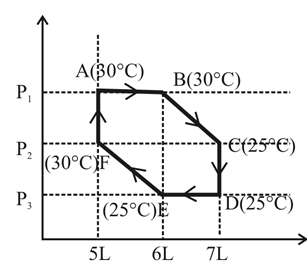
(ii) As complete process is cyclic, therefore, ∆U= 0
(iii) process AB is accompanied by increases of volume due to increased in the number of moles. Process BC is accompanied by increase in volume due to fall of temperature. Process CD is accompanied by fall of pressure due to decrease in the number of moles. Process DE is due to decrease in the number of moles. In process EF, therefore will be no change in the number of moles of A. But as already explained, at B number of moles is greater than that at A. Hence, the number of moles is maximum at point B.