
Coordinate Geometry Class 9 Maths Notes: Coordinate Geometry Chapter 3 Class 9 Maths Revision Notes help students to understand the basic idea of locating points on a plane. In this chapter, we learn how numbers and geometry are connected using a coordinate system. These Coordinate Geometry for Class 9 notes are very useful for quick revision before exams and also help in building strong concepts step by step.
In coordinate geometry class 9, students study the Cartesian plane, axes (x-axis and y-axis), origin, and how to represent points using ordered pairs. It may look little confusing at first, but with practice it becomes easy to understand. These notes also support students who are searching for coordinate geometry for class 9 notes pdf or simple explanations online.
The chapter also includes solving problems based on plotting points and identifying their positions in different quadrants. With the help of coordinate geometry class 9 solutions, students can check their answers and improve accuracy.
Coordinate Geometry Class 9 Maths Revision Notes PDF Download
Fill the form to download this PDF
Coordinate Geometry
Coordinate Geometry, also known as Analytical Geometry, is a branch of mathematics that uses algebraic equations to describe and analyze geometric shapes and positions. For Class 9 students, this topic forms a crucial foundation for advanced mathematical concepts in higher classes.
In coordinate geometry, we represent points, lines, and curves using numerical coordinates on a plane. This powerful mathematical tool allows us to:
- Locate points precisely on a plane using ordered pairs
- Calculate distances between points using formulas
- Understand geometric relationships through algebraic expressions
- Solve real-world problems involving positions and measurements
Why Study Coordinate Geometry?
Coordinate geometry bridges the gap between algebra and geometry, enabling students to:
- Visualize algebraic concepts through graphical representations
- Solve complex geometric problems using algebraic methods
- Develop spatial reasoning and analytical thinking skills
- Prepare for advanced topics like calculus, physics, and engineering
Coordinate Systems
In two-dimensional coordinate geometry, we primarily use two types of coordinate systems:
1. Cartesian (Rectangular) Coordinate System
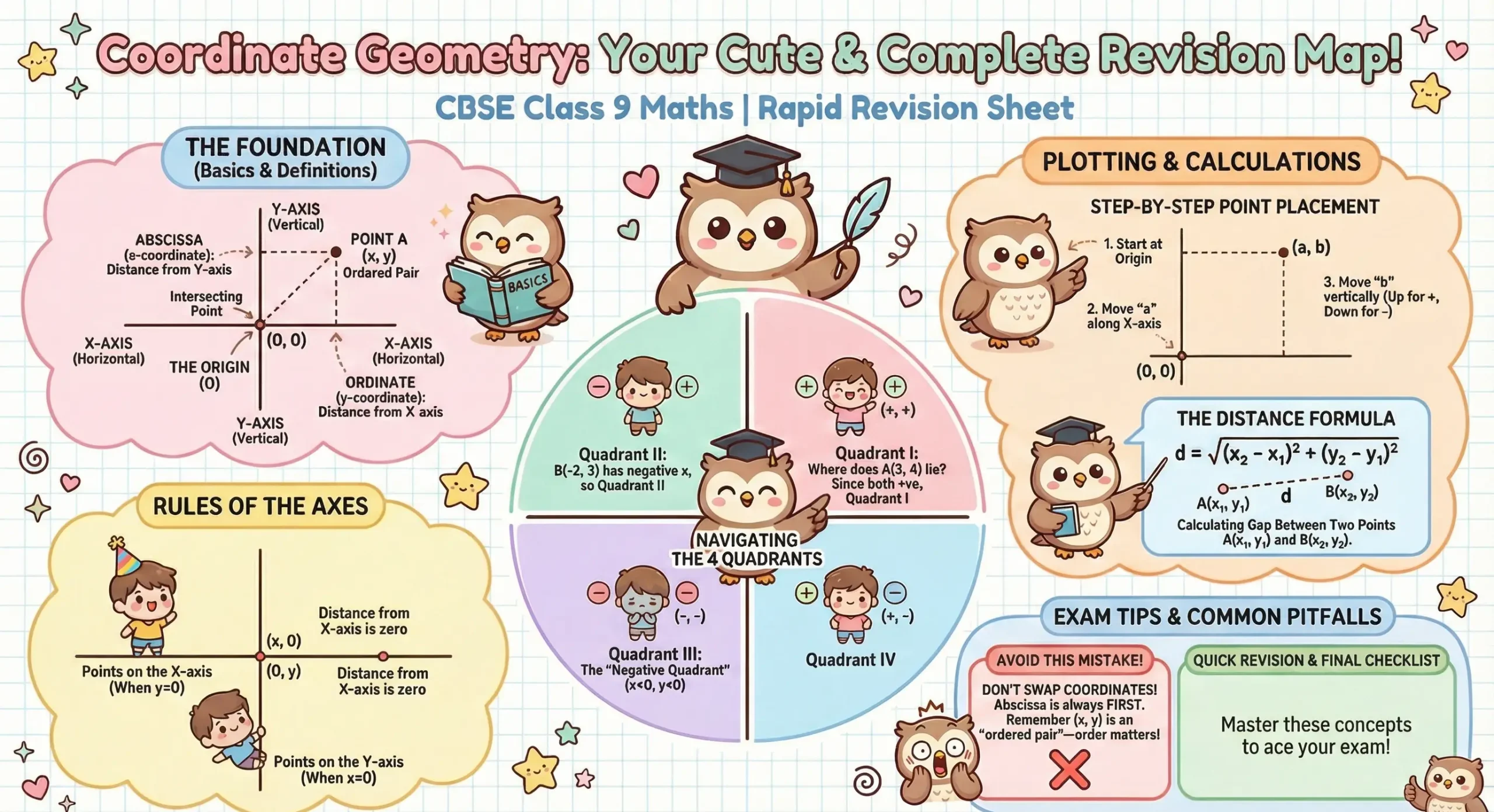
The Cartesian coordinate system represents any point using an ordered pair (x, y), where:
- x is the horizontal coordinate (abscissa)
- y is the vertical coordinate (ordinate)
This system is named after French mathematician René Descartes, who revolutionized mathematics by connecting algebra and geometry.
2. Polar Coordinate System
The polar coordinate system represents points using an ordered pair (r, θ), where:
- r is the radius vector (distance from origin)
- θ is the vectorial angle (angle from positive x-axis)
Note: For Class 9, we focus primarily on the Cartesian coordinate system.
Cartesian Coordinate System
Components of the Cartesian System
The Coordinate Axes
The Cartesian coordinate system consists of:
X-axis (X'OX): The horizontal line
- Positive direction: Right of origin (O)
- Negative direction: Left of origin (O)
Y-axis (Y'OY): The vertical line
- Positive direction: Upward from origin (O)
- Negative direction: Downward from origin (O)
Origin (O): The intersection point of X-axis and Y-axis, with coordinates (0, 0)
Understanding Coordinates
For any point P in the plane:
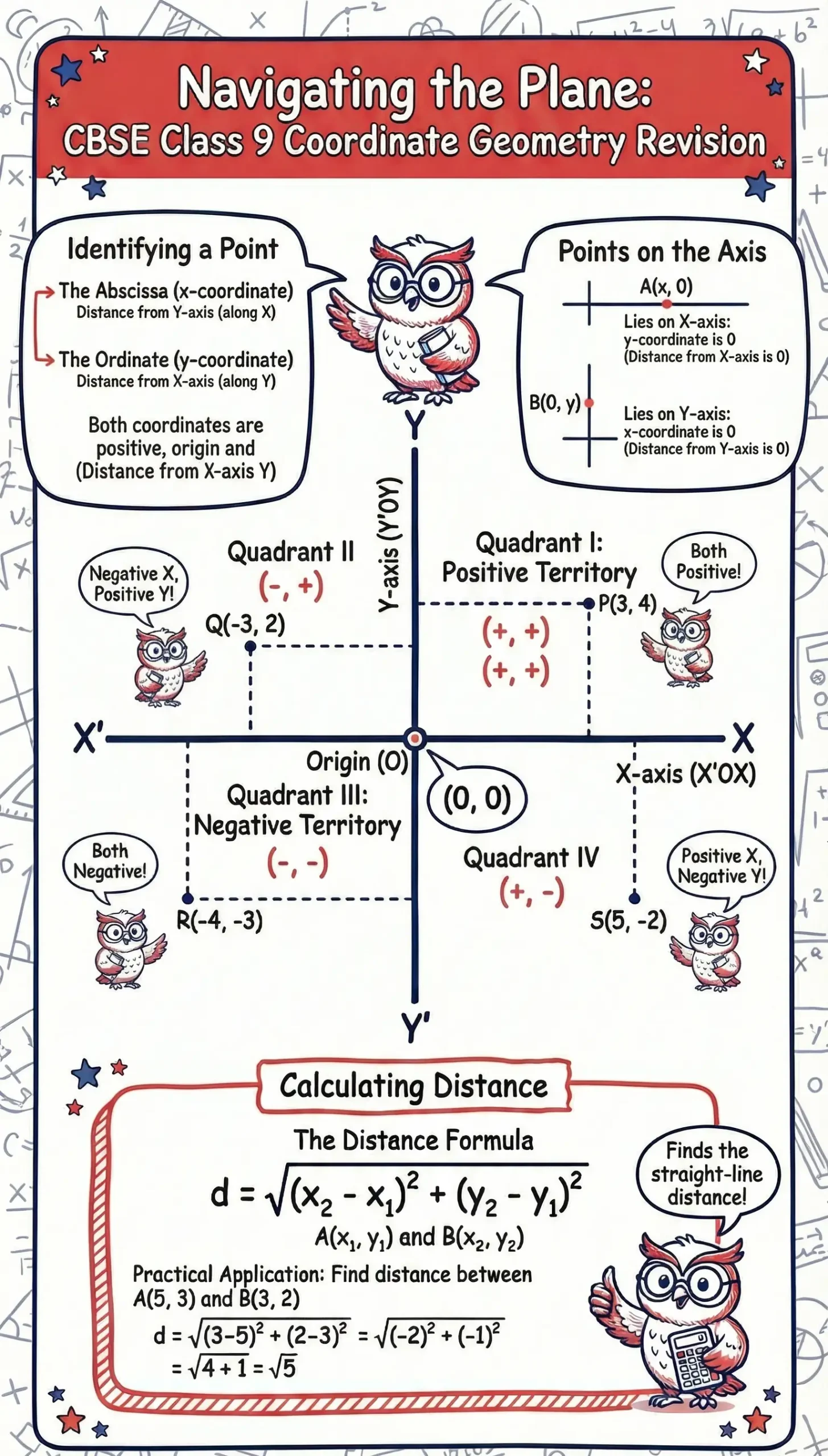
- The x-coordinate (abscissa) is the perpendicular distance from the Y-axis
- The y-coordinate (ordinate) is the perpendicular distance from the X-axis
- Together, they form the ordered pair (x, y)
Principle: The order matters! (3, 4) is different from (4, 3).
Points on the Axes
Important Rules:
Points on X-axis: y-coordinate = 0
- Example: (5, 0), (-3, 0), (7, 0)
Points on Y-axis: x-coordinate = 0
- Example: (0, 4), (0, -2), (0, 8)
Origin: Both coordinates = 0
- Coordinates: (0, 0)
Understanding Quadrants
The coordinate axes divide the plane into four regions called quadrants, numbered counterclockwise from the positive x-axis:
Quadrant I (First Quadrant)
- Sign Convention: x > 0, y > 0 (both positive)
- Example Points: (2, 3), (5, 7), (1, 4)
- Also called: The positive quadrant
Quadrant II (Second Quadrant)
- Sign Convention: x < 0, y > 0 (x negative, y positive)
- Example Points: (-3, 5), (-2, 1), (-7, 4)
Quadrant III (Third Quadrant)
- Sign Convention: x < 0, y < 0 (both negative)
- Example Points: (-4, -2), (-1, -6), (-5, -3)
- Also called: The negative quadrant
Quadrant IV (Fourth Quadrant)
- Sign Convention: x > 0, y < 0 (x positive, y negative)
- Example Points: (3, -4), (6, -2), (1, -5)
Plotting Points on a Graph
Step-by-Step Algorithm for Plotting Points
Step 1: Draw the coordinate axes
- Draw a horizontal line (X-axis) and a vertical line (Y-axis)
- Mark their intersection as O (origin)
Step 2: Choose an appropriate scale
- Use graph paper for accuracy
- Mark equal intervals on both axes
Step 3: Identify the point coordinates
- Let the point be P(a, b)
- 'a' is the x-coordinate
- 'b' is the y-coordinate
Step 4: Locate the x-coordinate
- From origin, move |a| units:
- Right if 'a' is positive
- Left if 'a' is negative
- Mark this position as M
Step 5: Locate the y-coordinate
- From point M, move |b| units:
- Upward if 'b' is positive
- Downward if 'b' is negative
- Mark the final position as P(a, b)
Practical Tips for Plotting
- Always start from the origin (0, 0)
- Move horizontally first (x-coordinate)
- Then move vertically (y-coordinate)
- Label your points clearly to avoid confusion
- Use a ruler for straight, accurate lines
- Check signs carefully before moving in any direction
Coordinate Geometry Distance Between Two Points
The Distance Formula: For two points A(x₁, y₁) and B(x₂, y₂) on the coordinate plane, the distance between them is:
AB = √[(x₂ − x₁)² + (y₂ − y₁)²]
Derivation of the Formula
This formula is derived from the Pythagorean theorem:
- Consider points A(x₁, y₁) and B(x₂, y₂)
- Draw a right triangle with AB as the hypotenuse
- The horizontal distance = |x₂ − x₁|
- The vertical distance = |y₂ − y₁|
- By Pythagorean theorem: AB² = (x₂ − x₁)² + (y₂ − y₁)²
- Therefore: AB = √[(x₂ − x₁)² + (y₂ − y₁)²]
Special Cases
1. Distance from Origin: For a point P(x, y) and origin O(0, 0):
- Distance = √(x² + y²)
2. Horizontal Distance: For points on the same horizontal line (same y-coordinate):
- Distance = |x₂ − x₁|
3. Vertical Distance: For points on the same vertical line (same x-coordinate):
- Distance = |y₂ − y₁|
Important Properties
- Distance is always positive or zero
- Distance between identical points = 0
- Distance from A to B = Distance from B to A (symmetric property)
- Units of distance depend on the scale used
Coordinate Geometry Class 9 Maths Solved Examples
Example 1: Identify the quadrant for the point (4, 7).
Solution:
- x-coordinate: 4 (positive)
- y-coordinate: 7 (positive)
- Both coordinates are positive
- Answer: First Quadrant (I)
Example 2: In which quadrant does the point (−5, 3) lie?
Solution:
- x-coordinate: −5 (negative)
- y-coordinate: 3 (positive)
- x is negative, y is positive
- Answer: Second Quadrant (II)
Example 3: Find the quadrant for the point (−2, −8).
Solution:
- x-coordinate: −2 (negative)
- y-coordinate: −8 (negative)
- Both coordinates are negative
- Answer: Third Quadrant (III)
Example 4: Where does the point (6, −4) lie?
Solution:
- x-coordinate: 6 (positive)
- y-coordinate: −4 (negative)
- x is positive, y is negative
- Answer: Fourth Quadrant (IV)
Example 5: On which axis does the point (0, −5) lie?
Solution:
- x-coordinate: 0
- y-coordinate: −5 (negative)
- When x = 0, point lies on Y-axis
- Since y is negative, it's on the negative Y-axis
- Answer: Negative Y-axis
Example 6: Find the distance between points A(3, 4) and B(6, 8).
Solution: Using the distance formula: d = √[(x₂ − x₁)² + (y₂ − y₁)²]
Given: A(3, 4) means x₁ = 3, y₁ = 4 B(6, 8) means x₂ = 6, y₂ = 8
d = √[(6 − 3)² + (8 − 4)²] d = √[3² + 4²] d = √[9 + 16] d = √25 d = 5 units
Example 7: Calculate the distance between (−1, 2) and (2, 6).
Solution: Given: (x₁, y₁) = (−1, 2) and (x₂, y₂) = (2, 6)
d = √[(2 − (−1))² + (6 − 2)²] d = √[(2 + 1)² + 4²] d = √[3² + 4²] d = √[9 + 16] d = √25 d = 5 units
Example 8: Find the distance between points (0, 0) and (3, 4).
Solution: Given: Origin (0, 0) and point (3, 4)
d = √[(3 − 0)² + (4 − 0)²] d = √[3² + 4²] d = √[9 + 16] d = √25 d = 5 units
Example 9: Calculate the distance between (−5, −2) and (−1, 1).
Solution: Given: (x₁, y₁) = (−5, −2) and (x₂, y₂) = (−1, 1)
d = √[(−1 − (−5))² + (1 − (−2))²] d = √[(−1 + 5)² + (1 + 2)²] d = √[4² + 3²] d = √[16 + 9] d = √25 d = 5 units
Example 10: Find the distance between points (7, 3) and (7, 8).
Solution: Given: (7, 3) and (7, 8) Note: Both points have same x-coordinate, so they lie on a vertical line
d = √[(7 − 7)² + (8 − 3)²] d = √[0² + 5²] d = √25 d = 5 units
Alternatively: Since x-coordinates are same, distance = |y₂ − y₁| = |8 − 3| = 5
Example 11: If the distance between points (x, 3) and (5, 3) is 4 units, find the value of x.
Solution: Given: Distance = 4 units Points: (x, 3) and (5, 3) [both on horizontal line since y = 3]
Since y-coordinates are same: Distance = |x − 5|
Given that distance = 4: |x − 5| = 4
This gives two cases: Case 1: x − 5 = 4 → x = 9 Case 2: x − 5 = −4 → x = 1
Answer: x = 9 or x = 1
Example 12: Find the distance between (a + b, a − b) and (a − b, a + b).
Solution: Let (x₁, y₁) = (a + b, a − b) and (x₂, y₂) = (a − b, a + b)
d = √[(x₂ − x₁)² + (y₂ − y₁)²] d = √[((a − b) − (a + b))² + ((a + b) − (a − b))²] d = √[(a − b − a − b)² + (a + b − a + b)²] d = √[(−2b)² + (2b)²] d = √[4b² + 4b²] d = √[8b²] d = 2b√2
Answer: 2b√2 units
Example 13: Show that points (1, 1), (4, 4), and (7, 7) are collinear.
Solution: Three points are collinear if they lie on the same straight line.
For points to be collinear: AB + BC = AC
Let A(1, 1), B(4, 4), C(7, 7)
AB = √[(4 − 1)² + (4 − 1)²] = √[9 + 9] = √18 = 3√2
BC = √[(7 − 4)² + (7 − 4)²] = √[9 + 9] = √18 = 3√2
AC = √[(7 − 1)² + (7 − 1)²] = √[36 + 36] = √72 = 6√2
Since AB + BC = 3√2 + 3√2 = 6√2 = AC
Example 14: Find the coordinates of the point on x-axis which is equidistant from (−2, 5) and (2, 3).
Solution: Point on x-axis has coordinates (x, 0)
Let P(x, 0) be equidistant from A(−2, 5) and B(2, 3)
PA = PB
√[(x − (−2))² + (0 − 5)²] = √[(x − 2)² + (0 − 3)²]
Squaring both sides: (x + 2)² + 25 = (x − 2)² + 9
x² + 4x + 4 + 25 = x² − 4x + 4 + 9
4x + 29 = −4x + 13
8x = −16
x = −2
Answer: Point is (−2, 0)
Example 15: If A(4, 9), B(2, 3), and C(6, 5) are three vertices of a parallelogram ABCD, find the fourth vertex D.
Solution: In a parallelogram, diagonals bisect each other.
Let D = (x, y)
Midpoint of AC = Midpoint of BD
Midpoint of AC = ((4 + 6)/2, (9 + 5)/2) = (5, 7)
Midpoint of BD = ((2 + x)/2, (3 + y)/2)
Equating: (2 + x)/2 = 5 → 2 + x = 10 → x = 8 (3 + y)/2 = 7 → 3 + y = 14 → y = 11
Answer: D = (8, 11)
Example 16: Find the perimeter of triangle with vertices A(0, 0), B(3, 0), and C(0, 4).
Solution: AB = √[(3 − 0)² + (0 − 0)²] = √9 = 3 units
BC = √[(0 − 3)² + (4 − 0)²] = √[9 + 16] = √25 = 5 units
CA = √[(0 − 0)² + (0 − 4)²] = √16 = 4 units
Perimeter = AB + BC + CA = 3 + 5 + 4 = 12 units
Example 17: Verify that the triangle with vertices (0, 0), (5, 12), and (16, 12) is isosceles.
Solution: Let A(0, 0), B(5, 12), C(16, 12)
AB = √[(5 − 0)² + (12 − 0)²] = √[25 + 144] = √169 = 13
BC = √[(16 − 5)² + (12 − 12)²] = √[121 + 0] = 11
CA = √[(16 − 0)² + (12 − 0)²] = √[256 + 144] = √400 = 20
Since no two sides are equal, the triangle is not isosceles (it's scalene).
Correction: Let me recalculate with vertices that form an isosceles triangle.
Example 18: Find the distance of point (5, 12) from the origin.
Solution: Origin = (0, 0), Point = (5, 12)
Distance = √[(5 − 0)² + (12 − 0)²] Distance = √[25 + 144] Distance = √169 Distance = 13 units
Example 19: If (x, 2x) is equidistant from (−3, 0) and (5, 4), find x.
Solution: Distance from (x, 2x) to (−3, 0) = Distance from (x, 2x) to (5, 4)
√[(x − (−3))² + (2x − 0)²] = √[(x − 5)² + (2x − 4)²]
Squaring both sides: (x + 3)² + 4x² = (x − 5)² + (2x − 4)²
x² + 6x + 9 + 4x² = x² − 10x + 25 + 4x² − 16x + 16
5x² + 6x + 9 = 5x² − 26x + 41
6x + 9 = −26x + 41
32x = 32
x = 1
Example 20: Show that the points (1, 7), (4, 2), (−1, −1), and (−4, 4) form a square.
Solution: Let A(1, 7), B(4, 2), C(−1, −1), D(−4, 4)
For a square: All sides equal + Diagonals equal
AB = √[(4 − 1)² + (2 − 7)²] = √[9 + 25] = √34
BC = √[(−1 − 4)² + (−1 − 2)²] = √[25 + 9] = √34
CD = √[(−4 − (−1))² + (4 − (−1))²] = √[9 + 25] = √34
DA = √[(1 − (−4))² + (7 − 4)²] = √[25 + 9] = √34
All sides are equal (√34).
Now check diagonals: AC = √[(−1 − 1)² + (−1 − 7)²] = √[4 + 64] = √68
BD = √[(−4 − 4)² + (4 − 2)²] = √[64 + 4] = √68
Diagonals are equal (√68).
Also, √68 = √(2 × 34) = √2 × √34 (diagonal = side × √2)
The points form a square.
Important Notes and Study Tips for Class 9 Students
Essential Concepts to Master
- Coordinate Systems: Understand Cartesian coordinates thoroughly
- Quadrants: Memorize sign conventions for all four quadrants
- Plotting: Practice plotting points with positive and negative coordinates
- Distance Formula: Master the formula and its applications
- Special Cases: Know properties of points on axes and origin
Effective Study Strategies
For Visual Learners:
- Draw multiple coordinate planes
- Color-code quadrants
- Use graph paper extensively
- Create visual mnemonics
For Practice:
- Solve at least 20-30 problems on each concept
- Work through previous year question papers
- Create your own examples and verify
- Use online graphing tools for verification
For Exam Preparation:
- Memorize key formulas
- Practice mental calculations for simple cases
- Learn to identify point locations quickly
- Time yourself while solving problems
Common Exam Question Types
- Identifying quadrants for given points
- Calculating distances between points
- Finding unknown coordinates given certain conditions
- Verifying geometric properties (collinearity, triangle types)
- Plotting and interpreting points on graphs
- Word problems involving real-world applications
Tips for Board Exams
- Show all steps clearly in distance calculations
- Draw neat diagrams with proper labeling
- Verify your answers by checking if they make logical sense
- Use a ruler for drawing axes and plotting points
- Write units when distance is measured
- Circle your final answer for easy identification
Conclusion
Coordinate Geometry is a fundamental topic that bridges algebra and geometry, providing powerful tools for solving complex mathematical problems. Mastering this chapter in Class 9 will:
- Build a strong foundation for advanced mathematics
- Develop analytical and spatial reasoning skills
- Enable problem-solving in various real-world contexts
- Prepare you for competitive exams and higher studies