
Construction Class 9 Maths Revision Notes: Construction Class 9 Maths Revision Notes are very helpful for students who want to understand geometric constructions in a clear and simple way. These notes cover all important topics like line segments, angles, triangles, and basic geometric tools such as compass, ruler, and protractor. With the help of class 9th maths revision notes, students can quickly revise concepts before exams and improve their problem-solving skills.
The construction class 9 maths revision notes pdf format is also useful because students can easily download and study anytime, anywhere. These notes are prepared based on the latest CBSE Board syllabus and follow NCERT guidelines, so they are reliable and exam-focused. It also includes step-by-step methods, diagrams, and examples which makes learning more easy.
Sometimes students find constructions confusing, but with proper revision notes, it becomes simple and intresting. These CBSE notes also focus on important terms like geometric construction, bisector, perpendicular lines, and angles formation.
Overall, these Construction Class 9 Maths Revision Notes help students build strong basics and confidence. If you practice regularly and revise properly, you can score better marks in Class 9 exams, even if maths feels little difficult at first.
Construction Class 9 Maths Revision Notes PDF Download
Fill the form to download this PDF
What is Geometric Construction?
In mathematics, geometric construction refers to the precise drawing of geometric figures using only two instruments: a compass and a straightedge (ruler without markings). This ancient discipline, dating back to Euclid's Elements (~300 BCE), forms the foundation of classical geometry.
In CBSE Class 9 , the Construction chapter teaches students to draw specific angles, bisectors, and triangles with mathematical accuracy. Every construction is accompanied by a formal proof using congruence criteria (SSS, SAS, cpctc), ensuring each figure is not merely drawn but proven to be correct.
Why Construction Matters: Construction develops spatial reasoning, logical thinking, and proof-writing skills all critical for higher mathematics. It directly supports other chapters: Triangles, Circles, and Coordinate Geometry.
- Euclidean Basis
All constructions follow Euclid's five postulates. Only a compass and straightedge are permitted no measurements of angle or length during drawing.
- Congruence Proofs
Every construction is validated using triangle congruence SSS, SAS, or ASA and the principle of CPCTC (Corresponding Parts of Congruent Triangles are Congruent).
- Exam Relevance
Construction problems typically carry 3–5 marks in CBSE board exams. Accuracy in drawing and completeness of steps are both evaluated.
Tools Required for Construction
Class 9 geometric constructions require only the following tools. Using additional measuring tools (like a protractor or scale for measurement) is not permitted in formal constructions.
- Compass
- Straightedge (Ruler)
- Sharp Pencil (HB or H)
Exam Tip: Always draw arcs lightly first, then darken only the final figure. Label all key points (A, B, O, P, Q) clearly. Neatness and accuracy of construction are awarded separately from the proof in marking schemes.
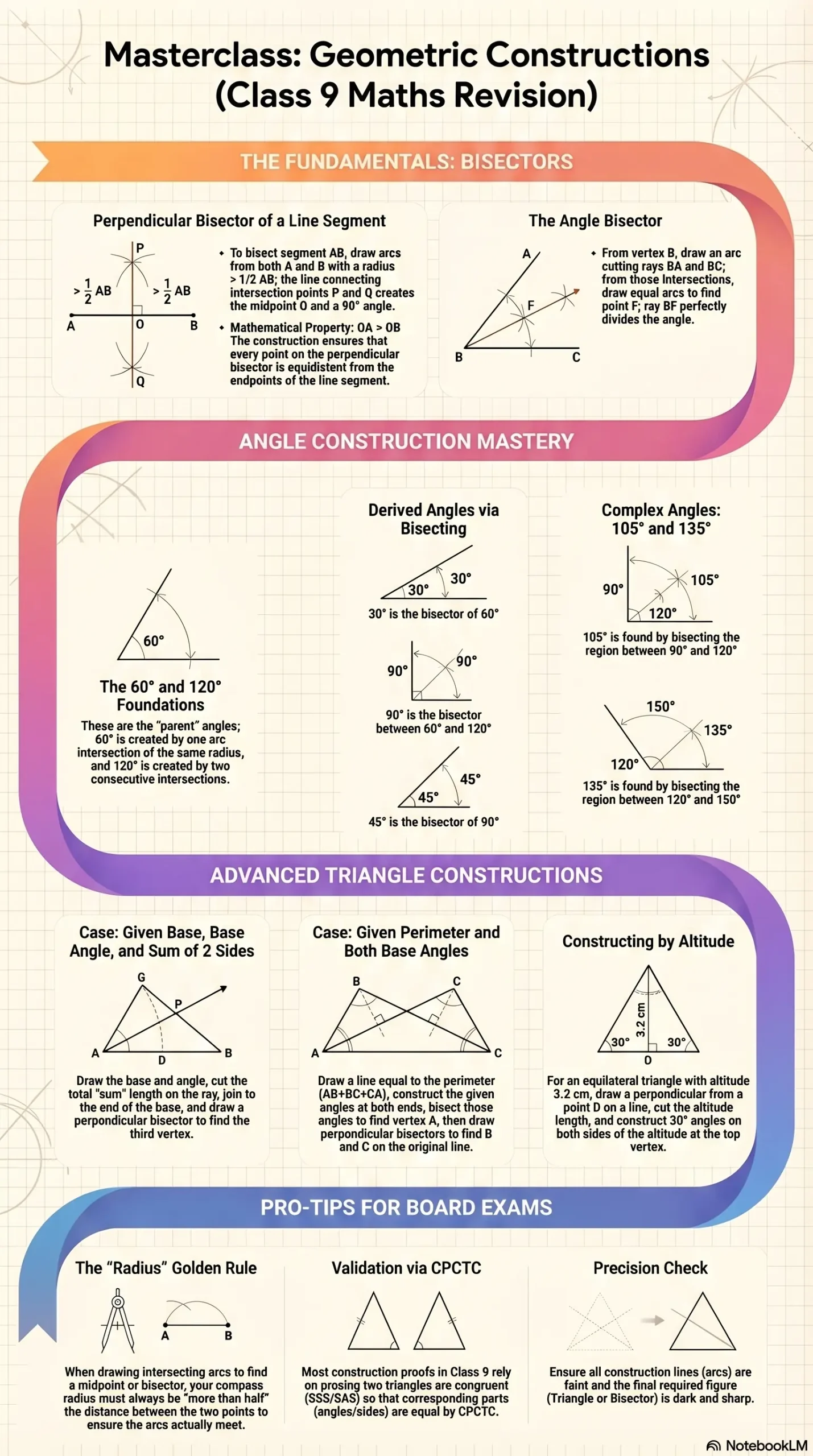
Perpendicular Bisector of a Line Segment
The perpendicular bisector of a line segment AB is a line that: (a) cuts AB exactly at its midpoint, and (b) is perpendicular (at 90°) to AB. It is one of the most fundamental constructions in geometry.
Construction Steps
- Draw the line segment AB of the given length (e.g., 7.8 cm).
- With point A as centre, draw arcs on both sides of AB using a radius greater than half of AB.
- With point B as centre, draw arcs of the same radius on both sides of AB. Let these arcs intersect at points P (above) and Q (below).
- Draw a straight line through P and Q. Line PQ is the required perpendicular bisector.
Proof (Using SSS and SAS Congruence)
In △APQ and △BPQ:
AP = BP [By construction same compass radius]
AQ = BQ [By construction same compass radius]
PQ = PQ [Common side]
∴ △APQ ≅ △BPQ [By SSS]
∴ ∠APQ = ∠BPQ [By CPCTC]
In △APO and △BPO:
AP = BP [By construction]
OP = OP [Common side]
∠APO = ∠BPO [Proved above]
∴ △APO ≅ △BPO [By SAS]
∴ ∠POA = ∠POB, and since ∠POA + ∠POB = 180°, each = 90°
∴ PQ is the perpendicular bisector of AB. Hence Proved.
Result: The perpendicular bisector of AB ensures OA = OB (O is the midpoint) and ∠POA = ∠POB = 90°.
Bisector of a Given Angle
The angle bisector of ∠ABC is a ray BF that divides the angle into two equal halves: ∠ABF = ∠CBF.
Construction Steps
- With B as centre and a suitable radius, draw an arc that cuts ray BA at point D and ray BC at point E.
- With D and E as centres (equal radii, each more than ½ DE), draw arcs that intersect at point F.
- Join B and F and extend to form ray BF. Ray BF is the required angle bisector.
Proof
Join DF and EF. In △BDF and △BEF:
BD = BE [Radii of the same arc]
DF = EF [Radii of equal arcs same compass opening]
BF = BF [Common side]
∴ △BDF ≅ △BEF [By SSS]
∴ ∠DBF = ∠EBF [By CPCTC]
i.e., ∠ABF = ∠CBF → BF bisects ∠ABC. Hence Proved.
Constructing Special Angles
Using a compass and straightedge alone, we can construct a specific set of angles. The table below summarises all key constructions taught in Class 9, along with the strategy for each.
| Angle | Strategy | Principle |
|---|---|---|
| 60° | Draw an equilateral arc from D (same radius as BD); E is the intersection point; join BE extended to A. | Equilateral triangle → all angles = 60° |
| 120° | Draw two consecutive 60° arcs (D→E, then E→F) on the same initial arc; join BF extended to A. | Two equilateral-arc steps = 120° |
| 30° | Construct 60°, then bisect it. | 60° ÷ 2 = 30° |
| 90° | Construct 120°, then bisect ∠EBG (the 60° arc between 60° and 120° marks). | 60° + 60°/2 = 90° |
| 45° | Construct 90°, then bisect it. Alt: Construct 60°, bisect twice. | 90° ÷ 2 = 45° |
| 105° | Construct 120° and 90°; bisect the angle between them (∠ABP). | (120° + 90°) ÷ 2 = 105° |
| 150° | Construct 3 consecutive 60° arcs; bisect ∠EBG (third segment). | 90° + 60° = 150° |
| 135° | Construct 150° and 120°; bisect ∠PBG. | (150° + 120°) ÷ 2 = 135° |
Detailed Steps: Constructing 60°
- Draw a ray BC of any suitable length.
- With B as centre and any suitable radius, draw an arc cutting BC at point D.
- With D as centre and the same radius, draw another arc cutting the first arc at point E.
- Join B and E; extend to point A. Then ∠ABC = 60°.
Detailed Steps: Constructing 90° (Alternative Method)
- Draw line segment BC; produce CB to an arbitrary point O.
- With B as centre, draw an arc cutting OC at points D and E.
- With D and E as centres (equal radii, more than half DE), draw arcs cutting each other at point P.
- Join BP and produce. ∠PBC = 90°.
Constructing Triangles Four Cases
The CBSE Class 9 syllabus specifies four cases for constructing a triangle when specific measurements are given. Each case uses a unique approach involving perpendicular bisectors or angle bisectors.
Case I: Equilateral Triangle (One Side Given)
When all sides of a triangle are equal, only one side length is needed.
- Draw BC = given side length (e.g., 2.5 cm).
- Through B, construct ray BP so that ∠PBC = 60°.
- Through C, construct ray CQ so that ∠QCB = 60°.
- Let BP and CQ meet at A. △ABC is the required equilateral triangle.
Since ∠ABC = ∠ACB = 60°, by the angle sum property: ∠BAC = 180° − (60° + 60°) = 60°. All three angles are equal, so all three sides are equal. △ABC is equilateral. Hence Proved.
Case II: Base + One Base Angle + Sum of Other Two Sides
- Draw BC = given base.
- At B, construct ray BP so that ∠PBC = given base angle.
- Cut BD = (given sum AB + AC) from ray BP.
- Join D and C.
- Draw perpendicular bisector of DC; let it meet BD at point A.
- Join A and C. △ABC is the required triangle.
Since OA is the perpendicular bisector of CD: OC = OD, ∠AOC = ∠AOD = 90°, and OA is common. By SAS, △AOC ≅ △AOD → AC = AD.
∴ BD = BA + AD = BA + AC = given sum. Hence Proved.
Case III: Base + One Base Angle + Difference of Other Two Sides
This has two sub-cases depending on which side is longer.
Sub-case (a): AB > AC (i.e., AB − AC = given difference)
- Draw BC = given base.
- At B, draw ray BP so that ∠PBC = given base angle.
- Cut BD = given difference from BP.
- Join D and C; draw the perpendicular bisector of DC meeting BP at A.
- Join A and C. △ABC is the required triangle.
Sub-case (b): AC > AB (i.e., AC − AB = given difference)
- Draw BC = given base.
- At B, draw ray BP; produce it backward to Q.
- Cut BD = given difference from BQ.
- Join D and C; draw the perpendicular bisector of DC meeting BP at A.
- Join A and C. △ABC is the required triangle.
Case IV: Perimeter + Both Base Angles Given
- Draw PQ = given perimeter (AB + BC + CA).
- At P, draw ray PR so that ∠RPQ = given base angle B. At Q, draw ray QS so that ∠SQP = given base angle C.
- Draw bisectors of ∠RPQ and ∠SQP; let them meet at A.
- Draw perpendicular bisector of AP, meeting PQ at B.
- Draw perpendicular bisector of AQ, meeting PQ at C.
- Join AB and AC. △ABC is the required triangle.
PB = AB and CQ = AC (by perpendicular bisector properties).
∴ PQ = PB + BC + CQ = AB + BC + AC = given perimeter.
Also, ∠ABC = 2∠BPA = ∠RPB = given ∠B, and ∠ACB = 2∠CQA = ∠SQC = given ∠C.
Hence Proved.
Advanced Triangle Constructions
Equilateral Triangle from Altitude
When the altitude (height) of an equilateral triangle is given instead of its side:
- Draw a line PQ; mark point D on it.
- Construct ray DE perpendicular to PQ at D.
- Cut DA = given altitude length (e.g., 3.2 cm) from DE.
- At A, construct ∠DAR = 30° (= ½ × 60°). Ray AR intersects PQ at B.
- Cut DC = DB. Join A and C. △ABC is the required equilateral triangle.
Right-Angled Triangle (Hypotenuse + One Side)
- Draw AC = hypotenuse length (e.g., 8 cm).
- Mark midpoint O of AC.
- With O as centre and radius OA, draw a semicircle on AC.
- With A as centre and radius = given side (e.g., 6 cm), draw an arc cutting the semicircle at B.
- Join AB and BC. △ABC is the required right-angled triangle (∠B = 90°).
Why the Semicircle Works: Any angle inscribed in a semicircle is 90° (Thales' theorem). Since B lies on the semicircle with diameter AC, ∠ABC = 90°.
Triangle with Given Side, Altitude, and Median
Given: BC = 6.4 cm, altitude AD = 3.2 cm, median AL = 4 cm.
- Draw BC = 6.4 cm; find midpoint L of BC.
- Draw line EF parallel to BC at a distance of 3.2 cm (= altitude).
- With L as centre and radius 4 cm, draw an arc cutting EF at A.
- Join AB and AC. △ABC is the required triangle.
Triangle from Given Medians
Given: Median AD = 6 cm, BE = 7 cm, CF = 6 cm.
- Construct △APQ with AP = 6 cm, PQ = 7 cm, AQ = 6 cm.
- Draw medians AE and PF of △APQ, intersecting at G.
- Produce AE to B such that GE = EB.
- Join B and Q; produce to C such that BQ = QC.
- Join A and C. △ABC is the required triangle.
Class 9 Maths Construction Solved Examples
Example 01 Perpendicular Bisector
Given: Draw a line segment AB = 7.8 cm and construct its perpendicular bisector.
- Draw AB = 7.8 cm.
- With A as centre (radius > 3.9 cm), draw arcs above and below AB.
- With B as centre (same radius), draw arcs intersecting the previous ones at P and Q.
- Join PQ. PQ is the perpendicular bisector of AB.
PQ bisects AB at O (OA = OB = 3.9 cm) and ∠POA = 90°.
Example 02 Angle Bisector
Given: Bisect a given angle ∠ABC.
- With B as centre, draw an arc cutting BA at D and BC at E.
- With D and E as centres (equal radii), draw intersecting arcs at F.
- Join BF. Ray BF bisects ∠ABC.
∠ABF = ∠CBF (each half of ∠ABC).
Example 03 Construct 60°
Given: Construct an angle of 60° at point B.
- Draw ray BC; with B as centre, mark arc at D on BC.
- With D as centre (same radius), mark arc at E on first arc.
- Join BE extended to A. ∠ABC = 60°.
△BDE is equilateral → ∠DBE = 60°.
Example 04 Construct 30°
Given: Construct an angle of 30°.
- Construct ∠ABC = 60° using compass.
- Draw BD, the bisector of ∠ABC.
∠DBC = 30°.
Example 05 Construct 90°
Given: Construct an angle of 90° at B.
- Produce CB to O; with B as centre draw arc cutting OC at D and E.
- With D and E as centres (equal radii > ½DE), draw arcs meeting at P.
- Join BP. ∠PBC = 90°.
∠PBC = 90° (alternate construction method).
Example 06 Construct 120°
Given: Construct ∠ABC = 120°.
- Draw BC; with B as centre draw arc at D on BC.
- With D as centre (same radius), mark E on first arc.
- With E as centre (same radius), mark F on first arc.
- Join BF extended to A. ∠ABC = 120°.
Two equilateral-arc steps each contribute 60°; total = 120°.
Example 07 Construct 45°
Given: Construct ∠ABC = 45°.
- Construct ∠PBC = 90°.
- Draw AB as the bisector of ∠PBC.
∠ABC = 45°.
Example 08 Construct 105°
Given: Construct ∠OBC = 105°.
- Construct ∠ABC = 120° and ∠PBC = 90°.
- Draw BO, the bisector of ∠ABP.
∠OBC = 105° = (120° + 90°)/2.
Example 09 Construct 150°
Given: Construct ∠PBC = 150°.
- Produce CB to O; with B as centre draw arc at D and E on OC.
- Mark F (60° from E) and G (120° from E) on the arc.
- Draw PB bisecting ∠EBG.
∠PBC = 150° (since ∠FBD = ∠GBF = ∠EBG = 60°).
Example 10 Construct 135°
Given: Construct ∠QBC = 135°.
- Construct ∠PBC = 150° and ∠GBC = 120°.
- Draw BQ, the bisector of ∠PBG.
∠QBC = 135° = (150° + 120°)/2.
Example 11 Equilateral Triangle (2.5 cm side)
Given: Draw an equilateral △ABC with each side = 2.5 cm.
- Draw BC = 2.5 cm.
- With B as centre, draw arc of radius 2.5 cm.
- With C as centre, draw arc of radius 2.5 cm.
- Both arcs intersect at A. Join AB and AC.
AB = BC = CA = 2.5 cm. △ABC is equilateral.
Example 12 Triangle: Base + Base Angle + Sum of Other Sides
Given: BC = 3 cm, ∠B = 60°, AB + AC = 8 cm.
- Draw BC = 3 cm; at B, draw ray BP with ∠PBC = 60°.
- Cut BD = 8 cm from BP.
- Join DC; draw perpendicular bisector of DC meeting BD at A.
- Join AC. △ABC is complete.
AB + AC = 8 cm, ∠B = 60°, BC = 3 cm all conditions satisfied.
Example 13 Right Triangle: Sum of Two Sides
Given: AB = 3.8 cm, ∠B = 90°, BC + AC = 6 cm.
- Draw AB = 3.8 cm; at B, draw BP so that ∠ABP = 90°.
- Cut BD = 6 cm from BP.
- Join AD; draw perpendicular bisector of AD meeting BD at C.
- Join AC. △ABC is the required right triangle.
∠B = 90°, AB = 3.8 cm, BC + AC = 6 cm.
Example 14 Triangle: Base + Angle + Difference (AB > AC)
Given: BC = 8 cm, ∠B = 60°, AB − AC = 3 cm.
- Draw BC = 8 cm; at B, draw ray BP with ∠PBC = 60°.
- Cut BD = 3 cm from BP.
- Join DC; draw perpendicular bisector of DC meeting BP at A.
- Join AC. △ABC is complete.
AB − AC = 3 cm. Verified by congruence: AD = AC.
Example 15 Triangle: Base + Angle + Difference (AC > AB)
Given: BC = 8 cm, ∠B = 60°, AC − AB = 3 cm.
- Draw BC = 8 cm; at B draw BP (∠PBC = 60°); extend BP backward to Q.
- Cut BD = 3 cm from BQ.
- Join DC; draw perpendicular bisector of DC meeting BP at A.
- Join AC. △ABC is complete.
AC − AB = 3 cm. Since AD = AC, BD = AD − AB = AC − AB.
Example 16 Triangle: Perimeter + Both Base Angles
Given: AB + BC + CA = 12 cm, ∠B = 45°, ∠C = 60°.
- Draw PQ = 12 cm.
- At P, draw PR so that ∠RPQ = 45°; at Q, draw QS so that ∠SQP = 60°.
- Bisect ∠RPQ and ∠SQP; let bisectors meet at A.
- Draw perp. bisectors of AP (meets PQ at B) and AQ (meets PQ at C).
- Join AB and AC. △ABC is complete.
Perimeter = 12 cm, ∠ABC = 45°, ∠ACB = 60°.
Example 17 Equilateral Triangle from Altitude
Given: Altitude AD = 3.2 cm. Construct equilateral △ABC.
- Draw PQ; mark D. Construct DE ⊥ PQ. Cut DA = 3.2 cm.
- At A, construct ∠DAR = 30°; ray AR meets PQ at B.
- Cut DC = DB. Join AC. △ABC is equilateral.
All sides equal, altitude = 3.2 cm.
Example 18 Right Triangle: Hypotenuse + One Side
Given: Hypotenuse AC = 8 cm, AB = 6 cm, ∠B = 90°.
- Draw AC = 8 cm; mark midpoint O.
- With O as centre, draw semicircle of radius OA on AC.
- With A as centre, radius 6 cm arc cuts semicircle at B.
- Join AB and BC. △ABC is the right-angled triangle.
∠ABC = 90° (angle in semicircle, Thales' theorem).
Example 19 Triangle: Side + Altitude + Median
Given: BC = 6.4 cm, altitude from A = 3.2 cm, median bisecting BC = 4 cm.
- Draw BC = 6.4 cm; bisect BC at L.
- Draw EF ∥ BC at 3.2 cm distance from BC.
- With L as centre, draw arc of radius 4 cm cutting EF at A.
- Join AB and AC. △ABC is complete.
Altitude = 3.2 cm, median = 4 cm, BC = 6.4 cm all verified.
Example 20 Triangle from All Three Medians
Given: Median AD = 6 cm, BE = 7 cm, CF = 6 cm.
- Construct △APQ: AP = 6, PQ = 7, AQ = 6 cm.
- Draw medians AE and PF of △APQ, meeting at centroid G.
- Extend AE to B so that GE = EB.
- Extend BQ to C so that BQ = QC. Join AC.
The medians of △ABC are AD = 6, BE = 7, CF = 6 cm.