
Chapter 9 Circles Class 9 Maths Notes: Chapter 9 Circles Class 9 Maths Notes is an important part of geometry that helps students understand basic concepts related to circles in a simple and clear way. In Class 9 Maths Circles notes, students learn about the definition of a circle, radius, diameter, chord, arc, and different parts of a circle. This chapter builds a strong base for higher classes, so it is very important to study it carefully.
In these class 9 maths circles notes chapter 9, the focus is also on understanding key properties and theorems. The theorems of circles class 9 explain relationships between chords, angles, and arcs. Students will also study all theorems of circles class 9 with proof, which helps in improving logical thinking and problem-solving skills.
Along with theory, circles class 9 notes exercise questions are given to practice concepts step by step. Regular practice helps students to avoid confusion and gain confidence. Some times students feel circle chapter is difficult, but with proper notes and revision it becomes easy to understand. Overall, this chapter is not only scoring but also very useful for developing geometry concepts for future learning.
Circles in Class 9 Mathematics
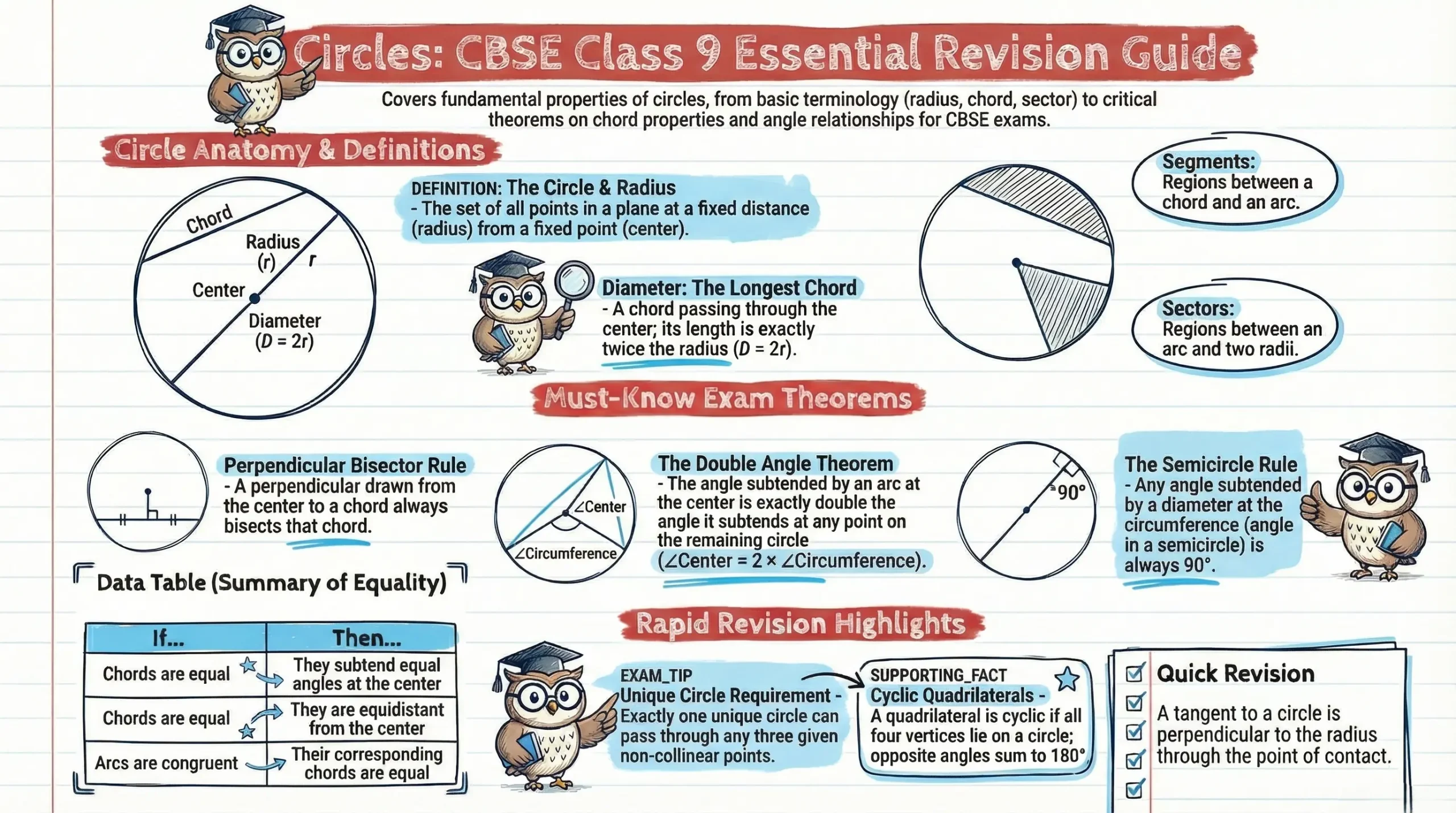
Circles form one of the most fundamental and elegant chapters in Class 9 Mathematics. Understanding circle properties, theorems, and their applications is crucial not only for board examinations but also for developing spatial reasoning and geometric intuition. This comprehensive guide covers all essential concepts from the CBSE Class 9 curriculum, including definitions, theorems with rigorous proofs, and extensively solved examples.
Circle Class 9 Maths Revision Notes PDF Download
Fill the form to download this PDF
Fundamental Definitions
What is a Circle?
A circle is the collection of all points in a plane that are at a fixed distance (called the radius) from a fixed point (called the centre) in that plane.
Mathematical Definition:
If O is the centre and r is the radius, then a circle is the set of all points P such that OP = r.
Components of a Circle
1. Centre (O)
The fixed point from which all points on the circle are equidistant.
2. Radius
The fixed distance from the centre to any point on the circle. All radii of a circle are equal in length.
3. Chord
A line segment whose endpoints lie on the circle. A chord PQ connects two points P and Q on the circle.
4. Diameter
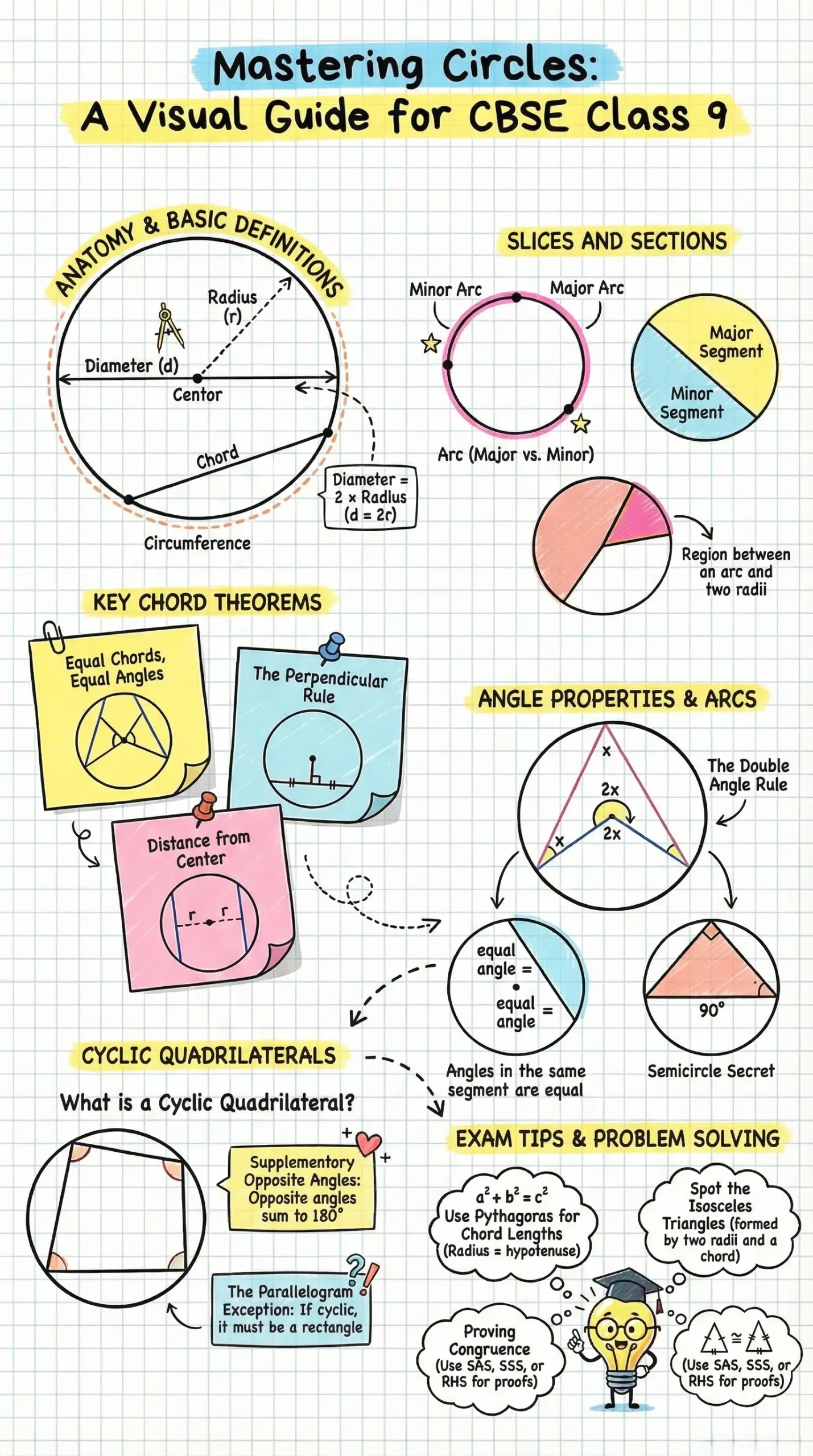
A chord that passes through the centre of the circle. The diameter is the longest chord of a circle and equals twice the radius (d = 2r).
5. Arc
A continuous portion of a circle between two points.
- Minor Arc: The shorter arc between two points
- Major Arc: The longer arc between two points
- Semicircle: When the two points are endpoints of a diameter, each arc is called a semicircle
6. Circumference
The total length (perimeter) of the circle. Formula: C = 2πr
7. Segment
The region between a chord and either of its arcs.
- Minor Segment: Region between chord and minor arc
- Major Segment: Region between chord and major arc
8. Sector
The region between an arc and the two radii joining the centre to the endpoints of the arc.
- Minor Sector: Formed with minor arc
- Major Sector: Formed with major arc
9. Interior and Exterior
- Interior: All points inside the circle (distance from centre < radius)
- Exterior: All points outside the circle (distance from centre > radius)
10. Circular Region
The circle together with its interior.
Core Theorems on Circles
Theorem 1: Equal Chords and Central Angles
Statement: Equal chords of a circle subtend equal angles at the centre.
Given: AB and CD are two equal chords of a circle with centre O.
To Prove: ∠AOB = ∠COD
Proof: In triangles △AOB and △COD:
- OA = OC (radii of the same circle)
- OB = OD (radii of the same circle)
- AB = CD (given)
Therefore, △AOB ≅ △COD (by SSS congruence)
Hence, ∠AOB = ∠COD (by CPCT - Corresponding Parts of Congruent Triangles)
Converse: If the angles subtended by chords at the centre are equal, then the chords are equal.
Theorem 2: Perpendicular from Centre to Chord
Statement: The perpendicular from the centre of a circle to a chord bisects the chord.
Given: A circle with centre O, AB is a chord, and OM ⊥ AB.
To Prove: MA = MB
Proof: In right triangles △OMA and △OMB:
- OA = OB (radii of the same circle)
- OM = OM (common side)
- ∠OMA = ∠OMB = 90° (given)
Therefore, △OMA ≅ △OMB (by RHS congruence)
Hence, MA = MB (by CPCT)
Converse: The line drawn through the centre of a circle to bisect a chord is perpendicular to the chord.
Theorem 3: Circle Through Three Points
Statement: There is one and only one circle passing through three given non-collinear points.
Proof: Let A, B, and C be three non-collinear points. Draw the perpendicular bisectors of AB and BC. These bisectors intersect at point O (they cannot be parallel since A, B, C are non-collinear).
Since O lies on the perpendicular bisector of AB: OA = OB Since O lies on the perpendicular bisector of BC: OB = OC
Therefore, OA = OB = OC
This means A, B, and C are equidistant from O, so a circle with centre O and radius OA will pass through all three points.
Uniqueness: Since two perpendicular bisectors can intersect at only one point, there can be only one such circle.
Note: This circle is called the circumcircle of triangle ABC, with O as the circumcentre and OA as the circumradius.
Theorem 4: Equal Chords Equidistant from Centre
Statement: Equal chords of a circle are equidistant from the centre.
Given: AB and CD are equal chords of a circle with centre O. OM ⊥ AB and ON ⊥ CD.
To Prove: OM = ON
Proof: Since OM ⊥ AB, we have BM = (1/2)AB (perpendicular from centre bisects chord) Since ON ⊥ CD, we have DN = (1/2)CD
Given AB = CD, therefore BM = DN
In right triangles △OMB and △OND:
- OB = OD (radii of the same circle)
- BM = DN (proved above)
- ∠OMB = ∠OND = 90° (given)
Therefore, △OMB ≅ △OND (by RHS congruence)
Hence, OM = ON (by CPCT)
Converse: Chords equidistant from the centre of a circle are equal in length.
Theorem 5: Angle Subtended by Arc at Centre
Statement: The angle subtended by an arc at the centre is double the angle subtended by it at any point on the remaining part of the circle.
Given: An arc PQ subtending angle ∠POQ at centre O and ∠PAQ at point A on the circle.
To Prove: ∠POQ = 2∠PAQ
Proof: Join AO and extend it to point B.
In △OAQ: OA = OQ (radii) ⇒ ∠OAQ = ∠OQA (angles opposite equal sides)
By exterior angle property: ∠BOQ = ∠OAQ + ∠OQA = 2∠OAQ ... (i)
Similarly, in △OAP: ∠BOP = 2∠OAP ... (ii)
Adding (i) and (ii): ∠BOP + ∠BOQ = 2(∠OAP + ∠OAQ) ∠POQ = 2∠PAQ
Theorem 6: Angles in Same Segment
Statement: Angles in the same segment of a circle are equal.
Proof: Let P and Q be any two points on a circle forming chord PQ. Let A and C be any other points on the same side of PQ.
∠POQ = 2∠PAQ (angle at centre is double angle at circumference) ∠POQ = 2∠PCQ (same reasoning)
Therefore, 2∠PAQ = 2∠PCQ Hence, ∠PAQ = ∠PCQ
Theorem 7: Angle in Semicircle
Statement: An angle in a semicircle is a right angle.
Proof: Let ∠PAQ be an angle in a semicircle, meaning PQ is a diameter.
Since PQ is a diameter, ∠POQ = 180° (straight line)
By Theorem 5: ∠PAQ = (1/2)∠POQ = (1/2) × 180° = 90°
Theorem 8: Cyclic Quadrilateral Property
Statement: The sum of opposite angles of a cyclic quadrilateral is 180°.
Given: A cyclic quadrilateral ABCD inscribed in a circle.
To Prove: ∠A + ∠C = ∠B + ∠D = 180°
Proof: ∠ACB = ∠ADB (angles in same segment) ∠BAC = ∠BDC (angles in same segment)
Therefore: ∠ACB + ∠BAC = ∠ADB + ∠BDC = ∠ADC
Adding ∠ABC to both sides: ∠ACB + ∠BAC + ∠ABC = ∠ADC + ∠ABC
The left side equals 180° (angle sum of triangle ABC)
Therefore: ∠ADC + ∠ABC = 180°
Similarly, ∠A + ∠C = 180°
Converse: If the sum of a pair of opposite angles of a quadrilateral is 180°, then the quadrilateral is cyclic.
Properties of Chords
Important Properties
- Equal chords are equidistant from the centre and vice versa
- Perpendicular from centre bisects the chord and vice versa
- Equal chords subtend equal angles at the centre and at any point on the circumference
- Longer chord is closer to the centre than a shorter chord
- Diameter is the longest chord of a circle
Applications
These properties are extensively used in:
- Finding unknown lengths in geometric constructions
- Proving congruence of triangles
- Solving problems involving parallel chords
- Calculating distances from centre to chords
Circles Class 9 Maths Solved Examples
Question: AB = CB and O is the centre of the circle. Prove that BO bisects ∠ABC.
Solution: Join OA and OC.
In △OAB and △OCB:
- OA = OC (radii)
- AB = CB (given)
- OB = OB (common)
∴ △OAB ≅ △OCB (by SSS)
Hence, ∠ABO = ∠CBO (by CPCT)
Therefore, BO bisects ∠ABC.
Question: Two circles with centres A and B intersect at C and D. Prove that ∠ACB = ∠ADB.
Solution: Join AC, AD, BC, BD, and AB.
In △ACB and △ADB:
- AC = AD (radii of circle with centre A)
- BC = BD (radii of circle with centre B)
- AB = AB (common)
∴ △ACB ≅ △ADB (by SSS)
Hence, ∠ACB = ∠ADB (by CPCT)
Question: In a circle, AB ≅ AC and O is the centre. Prove that OA is the perpendicular bisector of BC.
Solution: Join OB and OC.
Since AB ≅ AC (given arcs are congruent) ⇒ chord AB = chord AC (equal arcs have equal chords)
⇒ ∠AOB = ∠AOC (equal chords subtend equal angles at centre)
In △OBD and △OCD:
- ∠DOB = ∠DOC (proved above)
- OB = OC (radii)
- OD = OD (common)
∴ △OBD ≅ △OCD (by SAS)
⇒ ∠ODB = ∠ODC (by CPCT) And BD = CD (by CPCT)
But ∠BDC = 180° (straight line) ⇒ ∠ODB + ∠ODC = 180° ⇒ 2∠ODB = 180° ⇒ ∠ODB = 90°
Therefore, OA ⊥ BC and BD = CD
Hence, OA is the perpendicular bisector of BC.
Question: Prove that the line joining the midpoints of two parallel chords passes through the centre of the circle.
Solution: Let AB and CD be two parallel chords with midpoints L and M respectively.
Join OL and OM. Draw OX ∥ AB (or CD).
Since L is the midpoint of chord AB: ∠OLB = 90° (perpendicular from centre bisects chord)
Since OX ∥ AB: ∠LOX = 90° (consecutive interior angles sum to 180°)
Similarly, since M is the midpoint of chord CD: ∠OMD = 90°
Since OX ∥ CD: ∠MOX = 90°
Therefore: ∠LOX + ∠MOX = 90° + 90° = 180°
⇒ ∠LOM = 180°
Hence, LM is a straight line passing through centre O.
Question: A line ℓ intersects two concentric circles with common centre O at A, B, C, and D. Prove that AB = CD.
Solution: Draw OE ⊥ ℓ
Since the perpendicular from centre bisects the chord:
- AE = ED (for the outer circle)
- BE = EC (for the inner circle)
Subtracting: AE - BE = ED - EC ⇒ AB = CD
Question: PQ and RS are two parallel chords of a circle with centre O and radius 10 cm. If PQ = 16 cm and RS = 12 cm, find the distance between PQ and RS when they lie on the same side of centre O.
Solution: Draw perpendicular bisectors OL ⊥ PQ and OM ⊥ RS.
Since PQ ∥ RS, O, L, and M are collinear.
In right △OLP: OP² = OL² + PL² (Pythagoras theorem) 10² = OL² + (16/2)² 100 = OL² + 64 OL² = 36 OL = 6 cm
In right △OMR: OR² = OM² + RM² 10² = OM² + (12/2)² 100 = OM² + 36 OM² = 64 OM = 8 cm
Distance between chords = LM = OM - OL = 8 - 6 = 2 cm
Question: Using the same setup as Example 6, find the distance if chords lie on opposite sides of centre O.
Solution: Using the same calculations: OL = 6 cm OM = 8 cm
When on opposite sides: Distance = LM = OL + OM = 6 + 8 = 14 cm
Question: In a cyclic quadrilateral ABCD, ∠ABC = 69° and ∠ACB = 31°. Find ∠BDC.
Solution: In △ABC: ∠BAC + ∠ABC + ∠ACB = 180° ∠BAC + 69° + 31° = 180° ∠BAC = 80°
∠BDC = ∠BAC = 80° (angles in same segment)
Answer: 80°
Question: ABCD is a cyclic quadrilateral whose diagonals intersect at E. If ∠DBC = 70° and ∠BAC = 30°, find ∠BCD. If AB = BC, find ∠ECD.
Solution: ∠CDB = ∠BAC = 30° (angles in same segment)
In △BCD: ∠BCD + ∠DBC + ∠CDB = 180° ∠BCD + 70° + 30° = 180° ∠BCD = 80°
Since AB = BC: ∠BCA = ∠BAC = 30° (angles opposite equal sides)
Now, ∠BCD = 80° ⇒ ∠BCA + ∠ECD = 80° ⇒ 30° + ∠ECD = 80° ⇒ ∠ECD = 50°
Question: If the non-parallel sides of a trapezium are equal, prove it is cyclic.
Solution: Let ABCD be a trapezium with AB ∥ DC and AD = BC.
Draw BE ∥ AD.
Then ABED is a parallelogram (AB ∥ DE, AD ∥ BE)
∴ ∠BAD = ∠BED (opposite angles of parallelogram) And AD = BE (opposite sides of parallelogram)
But AD = BC (given) ∴ BE = BC
⇒ ∠BEC = ∠BCE (angles opposite equal sides)
Now, ∠BEC + ∠BED = 180° (linear pair) ⇒ ∠BCE + ∠BAD = 180°
Therefore, ABCD is cyclic (sum of opposite angles = 180°)
Question: Prove that a cyclic parallelogram is a rectangle.
Solution: Let ABCD be a cyclic parallelogram.
Since ABCD is cyclic: ∠A + ∠C = 180° (opposite angles of cyclic quadrilateral)
Since ABCD is a parallelogram: ∠A = ∠C (opposite angles of parallelogram)
From these two conditions: ∠A = ∠C = 90°
Therefore, ABCD is a rectangle.
Question: Bisectors of angles A, B, and C of triangle ABC intersect its circumcircle at D, E, and F respectively. Prove that the angles of △DEF are 90° - A/2, 90° - B/2, and 90° - C/2.
Solution: ∠FDE = ∠FDA + ∠EDA = ∠FCA + ∠EBA (angles in same segment) = C/2 + B/2 = (B + C)/2 = (180° - A)/2 (since A + B + C = 180° in △ABC) = 90° - A/2
Similarly: ∠DEF = 90° - B/2 ∠DFE = 90° - C/2
Question: Find the area of a right-angled triangle whose circumradius is 3 cm and the altitude from the right angle to the hypotenuse is 2 cm.
Solution: The hypotenuse of a right-angled triangle is the diameter of its circumcircle.
∴ BC = 2 × 3 = 6 cm (diameter)
Given: AD ⊥ BC and AD = 2 cm
Area of △ABC = (1/2) × BC × AD = (1/2) × 6 × 2 = 6 cm²
Question: PQ is a diameter with centre O. If ∠PQR = 65°, ∠SPR = 40°, and ∠PQM = 50°, find ∠QPR, ∠PRS, and ∠QPM.
Solution: (i) Finding ∠QPR:
Since PQ is diameter: ∠PRQ = 90° (angle in semicircle)
In △PQR: ∠QPR + ∠PRQ + ∠PQR = 180° ∠QPR + 90° + 65° = 180° ∠QPR = 25°
(ii) Finding ∠PRS:
PQRS is cyclic: ∠PSR + ∠PQR = 180° (opposite angles) ∠PSR = 180° - 65° = 115°
In △PSR: ∠PSR + ∠SPR + ∠PRS = 180° 115° + 40° + ∠PRS = 180° ∠PRS = 25°
(iii) Finding ∠QPM:
Since PQ is diameter: ∠PMQ = 90° (angle in semicircle)
In △PMQ: ∠PMQ + ∠PQM + ∠QPM = 180° 90° + 50° + ∠QPM = 180° ∠QPM = 40°
Question: O is the centre of the circle. Prove that ∠x + ∠y = ∠z.
Solution: ∠EBF = (1/2)∠EOF = z/2 (angle at circumference is half of angle at centre)
∴ ∠ABF = 180° - z/2 (linear pair)
∠EDF = (1/2)∠EOF = z/2
∴ ∠ADE = 180° - z/2 (linear pair)
∠BCD = ∠ECF = y (vertically opposite angles) ∠BAD = x
In quadrilateral ABCD: ∠ABC + ∠BCD + ∠CDA + ∠BAD = 360°
(180° - z/2) + y + (180° - z/2) + x = 360° x + y = z
Question: AB is a diameter with centre O. Chord CD equals radius OC. AC and BD produced meet at P. Prove that ∠CPD = 60°.
Solution: In △OCD: OC = OD = CD (given OC = radius and CD = radius)
∴ △OCD is equilateral ∴ ∠COD = 60°
∠CAD = (1/2)∠COD = 30° (angle at circumference)
∠ADB = 90° (angle in semicircle)
In △PAD: ∠APD + ∠PAD + ∠ADP = 180° ∠APD + 30° + 90° = 180° ∠APD = 60°
∴ ∠CPD = 60°Proved.
Question: AB and CD are equal chords of a circle with centre O. When produced, they meet at E. Prove that EB = ED.
Solution: Draw OP ⊥ AB and OQ ⊥ CD.
Since AB = CD (given): OP = OQ (equal chords are equidistant from centre)
In right triangles △OPE and △OQE:
- OE = OE (common)
- OP = OQ (proved)
- ∠OPE = ∠OQE = 90°
∴ △OPE ≅ △OQE (by RHS) ∴ PE = QE (by CPCT)
Also, PE - (1/2)AB = QE - (1/2)CD ⇒ PE - PB = QE - QD ⇒ EB = ED
Question: Bisector AD of ∠BAC of △ABC passes through centre O of the circumcircle. Prove that AB = AC.
Solution: Draw OP ⊥ AB and OQ ⊥ AC.
In △APO and △AQO:
- ∠OPA = ∠OQA = 90°
- ∠OAP = ∠OAQ (given)
- OA = OA (common)
∴ △APO ≅ △AQO (by AAS) ∴ OP = OQ (by CPCT)
Since chords equidistant from centre are equal: AB = AC
Question: AB and CD are chords intersecting at P. If PO bisects ∠APD, prove that AB = CD.
Solution: Draw OR ⊥ AB and OQ ⊥ CD.
In △OPR and △OPQ:
- ∠OPR = ∠OPQ (given)
- OP = OP (common)
- ∠ORP = ∠OQP = 90°
∴ △ORP ≅ △OPQ (by AAS) ∴ OR = OQ (by CPCT)
Since chords equidistant from centre are equal: AB = CD
Question: Chord ED is parallel to diameter AC. If ∠CBE = 50°, find ∠CED.
Solution: ∠CBE = ∠1 = 50° (angles in same segment)
∠AEC = 90° (angle in semicircle, since AC is diameter)
In △AEC: ∠1 + ∠AEC + ∠2 = 180° 50° + 90° + ∠2 = 180° ∠2 = 40°
Since ED ∥ AC: ∠2 = ∠3 = 40° (alternate angles)
∴ ∠CED = 40°
Important Notes for Class 9 Students
- Master the fundamental definitions - Understanding terms like chord, arc, segment, and sector is crucial
- Memorize key theorems - The six major theorems form the foundation of circle geometry
- Practice constructions - Drawing accurate diagrams helps visualize problems
- Focus on proof techniques - Understand SSS, SAS, RHS, and AAS congruence criteria
- Use properties strategically - Combine multiple properties to solve complex problems
- Apply Pythagoras theorem - Most chord-distance problems require this
- Watch for cyclic quadrilaterals - Recognize when to apply the 180° property
- Practice extensively - Solve varied problems to build confidence
Conclusion
Circles in Class 9 Mathematics represent a beautiful synthesis of algebraic thinking and geometric reasoning. The theorems and properties discussed here not only prepare students for board examinations but also develop critical thinking skills applicable across mathematics.
By understanding the logical structure of proofs, recognizing patterns in problems, and practicing systematically, students can master this chapter with confidence. Remember that every theorem connects to others—equal chords relate to central angles, which connect to inscribed angles, which tie into cyclic quadrilaterals. This interconnectedness is what makes circle geometry both challenging and rewarding.
Continue practicing the solved examples, work through additional problems from your textbook, and don't hesitate to revisit fundamental definitions when needed. With dedication and systematic practice, excellence in circle geometry is well within reach.