
The chapter Area of Parallelograms and Triangles Class 9 Maths Revision Notes is an important part of geometry that helps students understand how to calculate areas of different shapes using simple formulas and logic. In these area of parallelograms and triangles class 9 ncert notes, students learn the basic concepts of shapes like parallelogram and triangle, and how their areas are related. The area of parallelogram and triangle class 9 focuses on understanding base, height, and how figures on the same base and between the same parallels have equal areas.
These area of parallelogram and triangle class 9 notes also explain important properties and results which are useful for solving numerical problems. Students will study area of parallelogram and triangle class 9 theorems, such as triangles on the same base and between same parallels are equal in area. This chapter builds strong foundation for mensuration and coordinate geometry in higher classes.
By practicing these concepts, students can improve problem-solving skills and logical thinking. It is also helpful for exams because questions are often asked from this topic.
Areas of Parallelograms and Triangles Class 9 Maths Revision Notes PDF Download
Fill the form to download this PDF
Areas of Parallelograms and Triangles
The chapter "Areas of Parallelograms and Triangles" is one of the most conceptually rich topics in Class 9 Mathematics. It bridges the ideas of Euclidean geometry with mensuration, helping students understand how shapes with the same base and height share equal areas — even when they look completely different.
Why This Chapter Matters
- It forms the geometric foundation for coordinate geometry and integration in higher classes.
- It helps in solving real-world problems related to land measurement, architecture, and engineering.
- This chapter typically carries 8–12 marks in CBSE Class 9 board examinations.
What You Will Learn
- The concept of polygonal regions and area axioms.
- Conditions under which parallelograms and triangles have equal areas.
- Proofs of 7 core theorems using SSS, SAS, ASA congruence criteria and area axioms.
- How medians, diagonals, and midpoints divide figures into equal-area parts.
Polygonal Region and Area Axioms
What is a Polygonal Region?
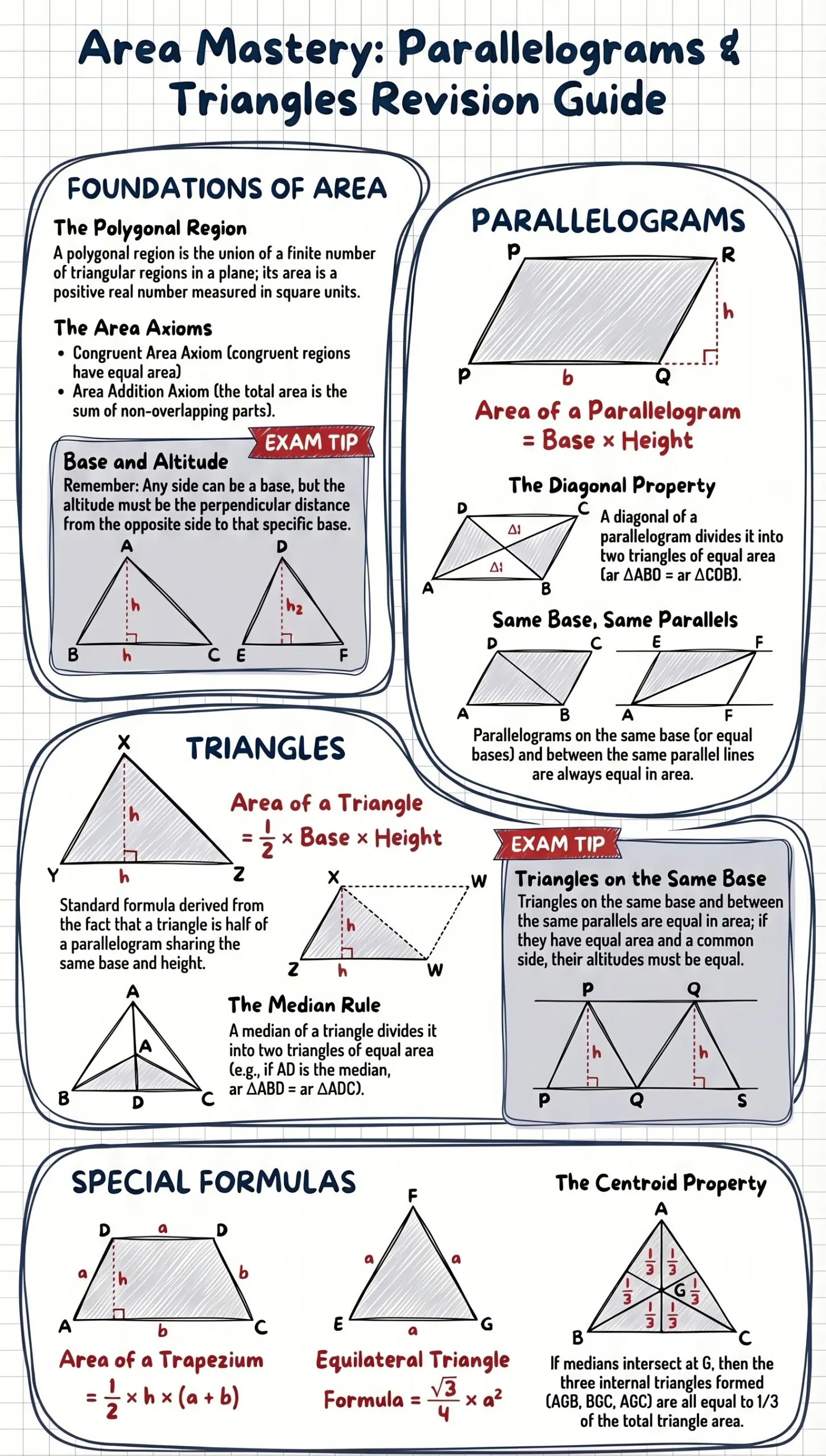
A polygonal region is the union of a finite number of triangular regions in a plane such that if any two of these triangular regions intersect, their intersection is either a point or a line segment. In simple terms, it is the interior of a polygon together with its boundary (sides).
Think of it this way: A polygon drawn on paper, along with its shaded interior, forms the polygonal region.
Area Axioms
Every polygonal region R has an area (measured in square units), denoted ar(R). The four foundational area axioms are:
Axiom 1 — Congruent Area Axiom
If R₁ ≅ R₂ (two regions are congruent), then ar(R₁) = ar(R₂).
Congruent figures have identical shapes and sizes, and therefore identical areas.
Axiom 2 — Area Monotone Axiom
If R₁ ⊂ R₂ (R₁ lies completely within R₂), then ar(R₁) ≤ ar(R₂).
A smaller region cannot have a larger area than the region containing it.
Axiom 3 — Area Addition Axiom
If polygonal regions R₁ and R₂ overlap only along a boundary (points or line segments), and R = R₁ ∪ R₂, then:
ar(R) = ar(R₁) + ar(R₂)
This is the geometric equivalent of "the whole equals the sum of its parts."
Axiom 4 — Rectangular Area Axiom
If a rectangle ABCD has sides AB = a metres and AD = b metres, then:
ar(Rectangle ABCD) = ab square metres
This is the origin of the formula: Area = Length × Breadth, which all other area formulas are derived from.
Unit of Area
The standard unit of area is a square metre (m²). One square metre is the area of a square with side 1 metre. Area of any polygonal region is always expressed as a positive real number in square units.
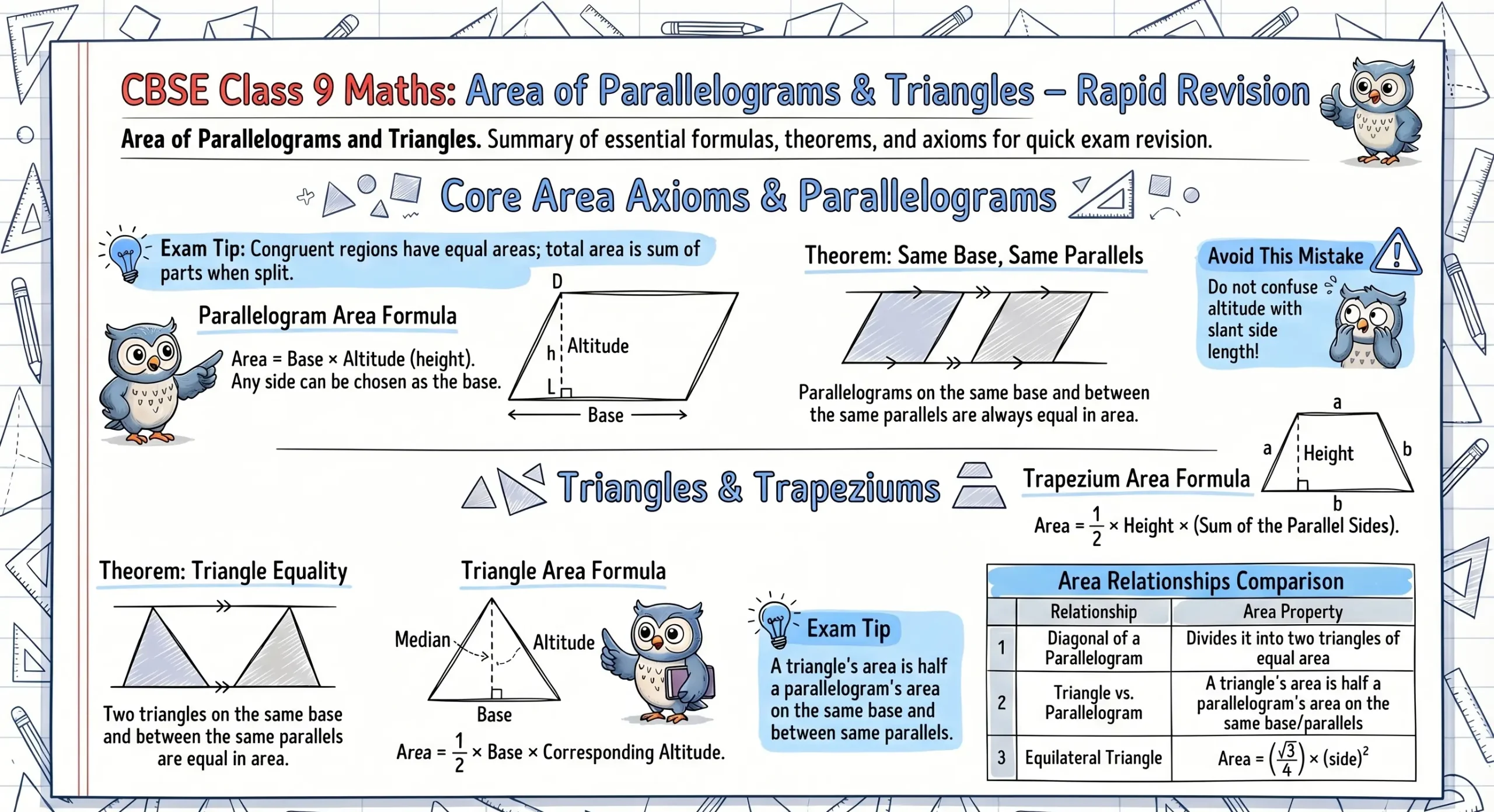
Base and Altitude of a Parallelogram
Base
Any side of a parallelogram can be chosen as its base. The choice of base changes the corresponding altitude.
Altitude (Height)
The altitude is the perpendicular distance between the chosen base and the opposite parallel side. Formally:
The altitude corresponding to a given base is the length of the line segment drawn perpendicular to the base from any point on the opposite side.
Key Insight
A parallelogram ABCD has two pairs of altitudes:
- DL — altitude corresponding to base AB (DL ⊥ AB)
- DM — altitude corresponding to base BC (DM ⊥ BC)
Both can be used to calculate the area of the same parallelogram:
ar(parallelogram ABCD) = AB × DL = BC × DM
This means: Base × Corresponding Height = Constant (same parallelogram, different base-altitude pairs).
Theorems with Proofs
Theorem 1: Diagonal Divides Parallelogram into Equal-Area Triangles
Statement: A diagonal of a parallelogram divides it into two triangles of equal area.
Given: Parallelogram ABCD with diagonal BD.
To Prove: ar(△ABD) = ar(△CDB)
Proof:
In △ABD and △CDB:
| Step | Reason |
|---|---|
| AB = DC | Opposite sides of a parallelogram are equal |
| AD = BC | Opposite sides of a parallelogram are equal |
| BD = BD | Common side |
| ∴ △ABD ≅ △CDB | By SSS congruence rule |
| ∴ ar(△ABD) = ar(△CDB) | Congruent area axiom |
Conclusion: Each diagonal of a parallelogram divides it into two congruent triangles of equal area. ∎
Theorem 2: Parallelograms on Same Base Between Same Parallels Have Equal Areas
Statement: Parallelograms on the same base (or equal bases) and between the same parallel lines are equal in area.
Given: Two parallelograms ABCD and ABEF on the same base AB, between parallels AB and FC.
To Prove: ar(‖ᵍᵐ ABCD) = ar(‖ᵍᵐ ABEF)
Proof:
In △ADF and △BCE:
| Step | Reason |
|---|---|
| AD = BC | Opposite sides of ‖ᵍᵐ ABCD |
| AF = BE | Opposite sides of ‖ᵍᵐ ABEF |
| ∠DAF = ∠CBE | AD ‖ BC and AF ‖ BE → alternate/corresponding angles |
| ∴ △ADF ≅ △BCE | By SAS congruence |
| ∴ ar(△ADF) = ar(△BCE) | ...(i) |
Now:
- ar(‖ᵍᵐ ABCD) = ar(ABED) + ar(△BCE) = ar(ABED) + ar(△ADF) [from (i)] = ar(‖ᵍᵐ ABEF)
∴ ar(‖ᵍᵐ ABCD) = ar(‖ᵍᵐ ABEF) ∎
Note: Since a rectangle is also a parallelogram, this theorem applies to rectangles as well.
Theorem 3: Area of Parallelogram = Base × Corresponding Altitude
Statement: The area of a parallelogram equals the product of its base and the corresponding altitude.
Given: ‖ᵍᵐ ABCD with base AB and corresponding height AL.
To Prove: ar(‖ᵍᵐ ABCD) = AB × AL
Construction: Draw BM ⊥ DC so that rectangle ABML is formed.
Proof: ‖ᵍᵐ ABCD and rectangle ABML are on the same base AB and between the same parallels AB and LC.
By Theorem 2:
- ar(‖ᵍᵐ ABCD) = ar(Rectangle ABML) = AB × AL
∴ Area of a Parallelogram = Base × Height ∎
Theorem 4: Parallelograms on Equal Bases Between Same Parallels Are Equal
Statement: Parallelograms on equal bases and between the same parallels are equal in area.
Given: Two ‖ᵍᵐ ABCD and PQRS with AB = PQ, between parallel lines AQ and DR.
Proof:
- Since AB ‖ DR and AL ⊥ DR, PM ⊥ DR → AL = PM (perpendicular distance between same parallels)
- ar(‖ᵍᵐ ABCD) = AB × AL = PQ × PM [∵ AB = PQ, AL = PM] = ar(‖ᵍᵐ PQRS) ∎
Theorem 5: Triangles on Same Base Between Same Parallels Have Equal Areas
Statement: Two triangles on the same base (or equal bases) and between the same parallels are equal in area.
Given: △ABC and △PBC on same base BC, between parallels BC and AP.
To Prove: ar(△ABC) = ar(△PBC)
Construction: Through B, draw BD ‖ CA (meeting PA produced at D); through C, draw CQ ‖ BP (meeting line AP at Q).
Proof:
- BCAD is a parallelogram (BD ‖ CA, BC ‖ DA)
- BCQP is a parallelogram (CQ ‖ BP, BC ‖ PQ)
- Both are on same base BC between same parallels → ar(‖ᵍᵐ BCQP) = ar(‖ᵍᵐ BCAD) ...(i)
- ar(△PBC) = ½ ar(‖ᵍᵐ BCQP) ...(ii)
- ar(△ABC) = ½ ar(‖ᵍᵐ BCAD) ...(iii)
- From (i), (ii), (iii): ar(△ABC) = ar(△PBC) ∎
Theorem 6: Area of Trapezium
Statement: The area of a trapezium is half the product of its height and the sum of the parallel sides.
Given: Trapezium ABCD with AB ‖ DC, AL ⊥ DC, CN ⊥ AB, AL = CN = h, AB = a, DC = b.
To Prove: ar(Trapezium ABCD) = ½ × h × (a + b)
Construction: Join diagonal AC.
Proof:
- ar(Trap. ABCD) = ar(△ABC) + ar(△ACD)
- = ½ × h × a + ½ × h × b
- = ½ × h × (a + b) ∎
Theorem 7: Equal-Area Triangles with One Equal Side Have Equal Altitudes
Statement: If two triangles have equal areas and one pair of equal corresponding sides, then their corresponding altitudes are equal.
Given: △ABC and △PQR where ar(△ABC) = ar(△PQR) and AB = PQ; CN and RT are altitudes to AB and PQ respectively.
Proof:
- ar(△ABC) = ½ × AB × CN ...(i)
- ar(△PQR) = ½ × PQ × RT ...(ii)
- Since ar(△ABC) = ar(△PQR) and AB = PQ → CN = RT ∎
Area Formulas
| Shape | Formula |
|---|---|
| Rectangle | Length × Breadth |
| Parallelogram | Base × Corresponding Height |
| Triangle | ½ × Base × Height |
| Equilateral Triangle (side a) | (√3/4) × a² |
| Trapezium | ½ × h × (sum of parallel sides) |
| Rhombus | ½ × d₁ × d₂ (product of diagonals) |
Critical Relationships to Remember
| Result | Statement |
|---|---|
| Diagonal of ‖ᵍᵐ | Divides it into 2 equal-area triangles |
| Median of triangle | Divides it into 2 equal-area triangles |
| Medians intersect at G (centroid) | Each small triangle = ⅓ ar(△ABC) |
| Midpoint triangle DEF | ar(△DEF) = ¼ ar(△ABC) |
| Midpoint parallelogram BDEF | ar(BDEF) = ½ ar(△ABC) |
Area of Parallelograms and Triangles Class 9 Maths Solved Examples
Problem: In parallelogram ABCD, AB = 8 cm. Altitudes to AB and AD are 4 cm and 5 cm respectively. Find AD.
Solution: Since area of a parallelogram = Base × Corresponding altitude:
ar(ABCD) = AB × (altitude to AB) = AD × (altitude to AD)
∴ 8 × 4 = AD × 5
∴ AD = 32/5 = 6.4 cm
Problem: In ‖ᵍᵐ ABCD, AE ⊥ DC and CF ⊥ AD. If AB = 16 cm, AE = 8 cm, CF = 10 cm. Find AD.
Solution:
- ar(ABCD) = CD × AE = 16 × 8 = 128 cm² (using base CD = AB = 16 cm)
- Also, ar(ABCD) = AD × CF → 128 = AD × 10
- ∴ AD = 12.8 cm
Problem: ABCD is a quadrilateral where ∠CDB = ∠ABD = 90°. Show it is a parallelogram and find its area if DC = AB = 2.5 units and height = 4 units.
Solution:
- Transversal DB intersects DC and AB making alternate angles ∠CDB = ∠ABD = 90°.
- ∴ DC ‖ AB; also DC = AB = 2.5 units → ABCD is a parallelogram.
- ar(ABCD) = Base × Height = 2.5 × 4 = 10 sq. units
Problem: Diagonals of ‖ᵍᵐ ABCD intersect at O. A line through O meets AB at X and CD at Y. Show that ar(quad. AXYD) = ½ ar(‖ᵍᵐ ABCD).
Solution:
- AC is a diagonal: ar(△ACD) = ½ ar(ABCD) ...(i)
- In △AOX and △COY: AO = CO (diagonals bisect each other), ∠AOX = ∠COY (vertically opposite), ∠OAX = ∠OCY (alternate angles)
- ∴ △AOX ≅ △COY (ASA) → ar(△AOX) = ar(△COY) ...(ii)
- Adding ar(quad. AOYD) to both sides of (ii):
- ar(quad. AXYD) = ar(△ACD) = ½ ar(‖ᵍᵐ ABCD)
Problem: E is any point on median AD of △ABC. Show that ar(△ABE) = ar(△ACE).
Solution:
- D is midpoint of BC (AD is median) → ar(△ABD) = ar(△ADC) ...(i)
- D is midpoint of BC → ar(△EBD) = ar(△EDC) ...(ii)
- Subtracting (ii) from (i):
- ar(△ABD) − ar(△EBD) = ar(△ADC) − ar(△EDC)
- ∴ ar(△ABE) = ar(△ACE)
Problem: Triangles ABC and DBC are on the same base BC with A and D on opposite sides, such that ar(△ABC) = ar(△DBC). Show that BC bisects AD.
Solution:
- Draw AL ⊥ BC and DM ⊥ BC.
- ar(△ABC) = ar(△DBC) → ½ × BC × AL = ½ × BC × DM → AL = DM ...(i)
- In △OAL and △OMD: AL = DM, ∠ALO = ∠DMO = 90°, ∠AOL = ∠MOD (vertically opposite)
- ∴ △OAL ≅ △OMD (ASA) → OA = OD
- ∴ BC bisects AD
Problem: In △ABC, D is the midpoint of BC and E is the midpoint of AD. Prove that ar(△BED) = ¼ ar(△ABC).
Solution:
- AD is median of △ABC → ar(△ABD) = ½ ar(△ABC) ...(i)
- BE is median of △ABD → ar(△BED) = ½ ar(△ABD) ...(ii)
- Combining: ar(△BED) = ½ × ½ ar(△ABC) = ¼ ar(△ABC)
Problem:Medians of △ABC intersect at G. Show ar(△AGB) = ar(△BGC) = ar(△AGC) = ⅓ ar(△ABC).
Solution:
- AD is median → ar(△ABD) = ar(△ACD) ...(i)
- GD is median of △GBC → ar(△GBD) = ar(△GCD) ...(ii)
- Subtracting: ar(△AGB) = ar(△AGC)
- Similarly ar(△AGB) = ar(△AGC) = ar(△BGC) ...(iii)
- ar(△ABC) = ar(△AGB) + ar(△AGC) + ar(△BGC) = 3 ar(△AGB)
- ∴ ar(△AGB) = ⅓ ar(△ABC)
Problem: D, E, F are midpoints of BC, CA, AB of △ABC. Show: (i) BDEF is a ‖ᵍᵐ, (ii) ar(BDEF) = ½ ar(△ABC), (iii) ar(△DEF) = ¼ ar(△ABC).
Solution:(i) F is midpoint of AB, E is midpoint of AC → EF ‖ BD (midpoint theorem). Similarly ED ‖ FB. ∴ BDEF is a parallelogram.
(ii) FD is a diagonal of ‖ᵍᵐ BDEF → ar(△FBD) = ar(△DEF). Similarly ar(△FAE) = ar(△DEF) and ar(△DCE) = ar(△DEF).
- ar(△ABC) = 4 × ar(△DEF)
- 2[ar(△FBD) + ar(△DEF)] = ar(△ABC)
- ∴ ar(‖ᵍᵐ BDEF) = ½ ar(△ABC)
(iii) From above: ar(△ABC) = 4 × ar(△DEF) → ar(△DEF) = ¼ ar(△ABC)
Problem: Prove that area of an equilateral triangle with side a = (√3/4)a².
Solution:
- Draw AD ⊥ BC. By RHS congruence, △ABD ≅ △ACD → BD = DC = a/2.
- In right △ABD: AD² = AB² − BD² = a² − (a/2)² = a² − a²/4 = 3a²/4
- ∴ AD = (√3a)/2
- ar(△ABC) = ½ × BC × AD = ½ × a × (√3a/2) = √3a²/4
Problem: P is a point inside rectangle ABCD. Show: (i) ar(△APB) + ar(△PCD) = ½ ar(rect. ABCD) and (ii) ar(△APD) + ar(△PBC) = ar(△APB) + ar(△PCD).
Solution:
- Draw EPF ‖ AB and LPM ‖ AD through P.
- ar(△APD) + ar(△BPC) = ½ × AD × PE + ½ × BC × PF = ½ × AD × (PE + PF) = ½ × AD × EF = ½ × AD × AB = ½ ar(rect. ABCD) ...(i)
- ar(△APB) + ar(△PCD) = ½ × AB × PL + ½ × DC × PM = ½ × AB × (PL + PM) = ½ × AB × LM = ½ × AB × AD = ½ ar(rect. ABCD) ...(ii)
- From (i) and (ii): ar(△APD) + ar(△PBC) = ar(△APB) + ar(△PCD)
Problem: Diagonals AC and BD of quadrilateral ABCD intersect at P. Show that ar(△APB) × ar(△CPD) = ar(△APD) × ar(△BPC).
Solution:
- Draw AF ⊥ BD and CE ⊥ BD.
- ar(△APB) × ar(△CPD) = (½ × PB × AF) × (½ × PD × CE) = ¼ × PB × AF × PD × CE
- ar(△APD) × ar(△BPC) = (½ × PD × AF) × (½ × BP × CE) = ¼ × PD × AF × BP × CE
- Both products are equal. ∴ ar(△APB) × ar(△CPD) = ar(△APD) × ar(△BPC)
Problem: A parallelogram has base 12 cm and height 7 cm. Find its area.
Solution: ar = Base × Height = 12 × 7 = 84 cm²
Problem: Triangle ABC has base BC = 10 cm. Triangle PBC has the same base BC, and both are between the same parallel lines. Find ar(△PBC) if ar(△ABC) = 45 cm².
Solution: By Theorem 5 (same base, same parallels): ar(△PBC) = ar(△ABC) = 45 cm²
Problem: Find the area of a trapezium with parallel sides 8 cm and 14 cm, and height 6 cm.
Solution: ar(Trapezium) = ½ × h × (a + b) = ½ × 6 × (8 + 14) = ½ × 6 × 22 = 66 cm²
Problem:In ‖ᵍᵐ PQRS, a point T is on QR. Show that ar(△PTS) = ½ ar(‖ᵍᵐ PQRS).
Solution:
- Draw diagonal PS. Diagonal PS divides ‖ᵍᵐ PQRS into two equal triangles.
- △PQS and △PSR each have area = ½ ar(PQRS).
- Triangles △PTS and △PSR are on the same base PS and between the same parallels PS and QR.
- ∴ ar(△PTS) = ar(△PSR) = ½ ar(‖ᵍᵐ PQRS)
Problem: ABCD is a parallelogram with diagonal AC = 10 cm. A triangle ABC has base BC = 8 cm. Find height of △ABC.
Solution:
- In ‖ᵍᵐ ABCD: area = base × height = BC × h_corresponding
- AC divides it into 2 equal triangles.
- If we know ar(ABCD), we can find h. This problem needs the total area or another measurement to resolve fully. Given data: this illustrates how the diagonal halves the parallelogram.
Problem: In △ABC, G is the centroid. If ar(△ABC) = 60 cm², find ar(△AGB).
Solution: The centroid divides △ABC into three triangles of equal area.
∴ ar(△AGB) = ⅓ × ar(△ABC) = ⅓ × 60 = 20 cm²
Problem: △ABC and △PQR have equal areas. AB = PQ = 9 cm. The altitude from C to AB in △ABC is 6 cm. Find the altitude from R to PQ in △PQR.
Solution: By Theorem 7: If ar(△ABC) = ar(△PQR) and AB = PQ, then corresponding altitudes are equal.
∴ Altitude from R to PQ = 6 cm
Problem: In △ABC, D is the midpoint of BC. E is a point on AD such that AE = ⅓ AD. Find ar(△BEA) in terms of ar(△ABC).
Solution:
- AD is median → ar(△ABD) = ½ ar(△ABC) ...(i)
- BE is a cevian in △ABD. Since AE = ⅓ AD, the point E divides AD in ratio 1:2.
- ar(△BEA)/ar(△ABD) = AE/AD = 1/3
- ∴ ar(△BEA) = ⅓ × ar(△ABD) = ⅓ × ½ ar(△ABC) = ⅙ ar(△ABC)
Area of Parallelograms and Triangles Practice Problems
- A parallelogram has base 15 cm and height 9 cm. Find its area.
- An equilateral triangle has side 6 cm. Find its area. (Use √3 = 1.732)
- Two parallelograms ABCD and EFCD share the same base CD and are between the same parallels. If ar(ABCD) = 72 cm², find ar(EFCD).
- The area of a trapezium is 112 cm². Its height is 8 cm and one parallel side is 11 cm. Find the other parallel side.
- In △PQR, S is the midpoint of QR. T is the midpoint of PS. Prove that ar(△PTQ) = ¼ ar(△PQR).
- ABCD is a rhombus with diagonals d₁ = 10 cm and d₂ = 24 cm. Find its area using the formula ½ × d₁ × d₂. Verify using Base × Height if the side is 13 cm.
- Medians BE and CF of △ABC intersect at G. Prove ar(△BCG) = ⅓ ar(△ABC).
- In ‖ᵍᵐ ABCD, E is the midpoint of AB and F is the midpoint of CD. Show that AEFD is a parallelogram and ar(AEFD) = ½ ar(ABCD).
- Diagonals of a quadrilateral ABCD intersect at O. If ar(△AOB) = ar(△COD), prove that ABCD is a trapezium.
- In △ABC, D is a point on BC such that BD = ⅓ BC. Prove that ar(△ABD) = ⅓ ar(△ABC). Generalise your result.
Important Note for Board Exam Preparation
- Same base + Same parallels → Equal areas (for both ‖ᵍᵐs and triangles)
- Diagonal of ‖ᵍᵐ → Two equal-area triangles
- Median of triangle → Two equal-area triangles
- Centroid → Three equal-area triangles (each = ⅓ total)
- Triangle area = ½ × parallelogram area (same base, same parallels)
- Midpoint triangle DEF area = ¼ × original triangle area
- Area of ‖ᵍᵐ = Base × Perpendicular Height (not slant height!)