
The Human Eye and the Colourful World Class 10 Notes: The chapter The Human Eye and the Colourful World is an important part of Class 10 Science because it explains how we see objects and why the world looks colourful around us. In simple words, the human eye works like a natural camera that captures light and sends signals to the brain. In many the human eye class 10 notes, students learn about the structure of the eye, the role of retina, lens, iris, and how light helps us to see different colours.
These the human eye and the colourful world class 10 notes help students understand important concepts like refraction of light, dispersion, scattering of light, defects of vision, and correction of vision. All these topics are useful not only for board exams but also for basic understanding of how our eyes work in real life. Sometimes students search for class 10 human eye and the colourful world notes pdf or the human eye class 10 notes pdf to revise the chapter quickly before exams.
In human eye and colourful world class 10, students also study why the sky looks blue, why the sun appears red during sunrise and sunset, and how rainbows are formed. These concepts are explained using simple examples and diagrams so that students can understand them easily. This chapter builds a strong base in optics and helps students see science in the real world, which is actually very interesting if we observe it carefully.
Structure of the Human Eye
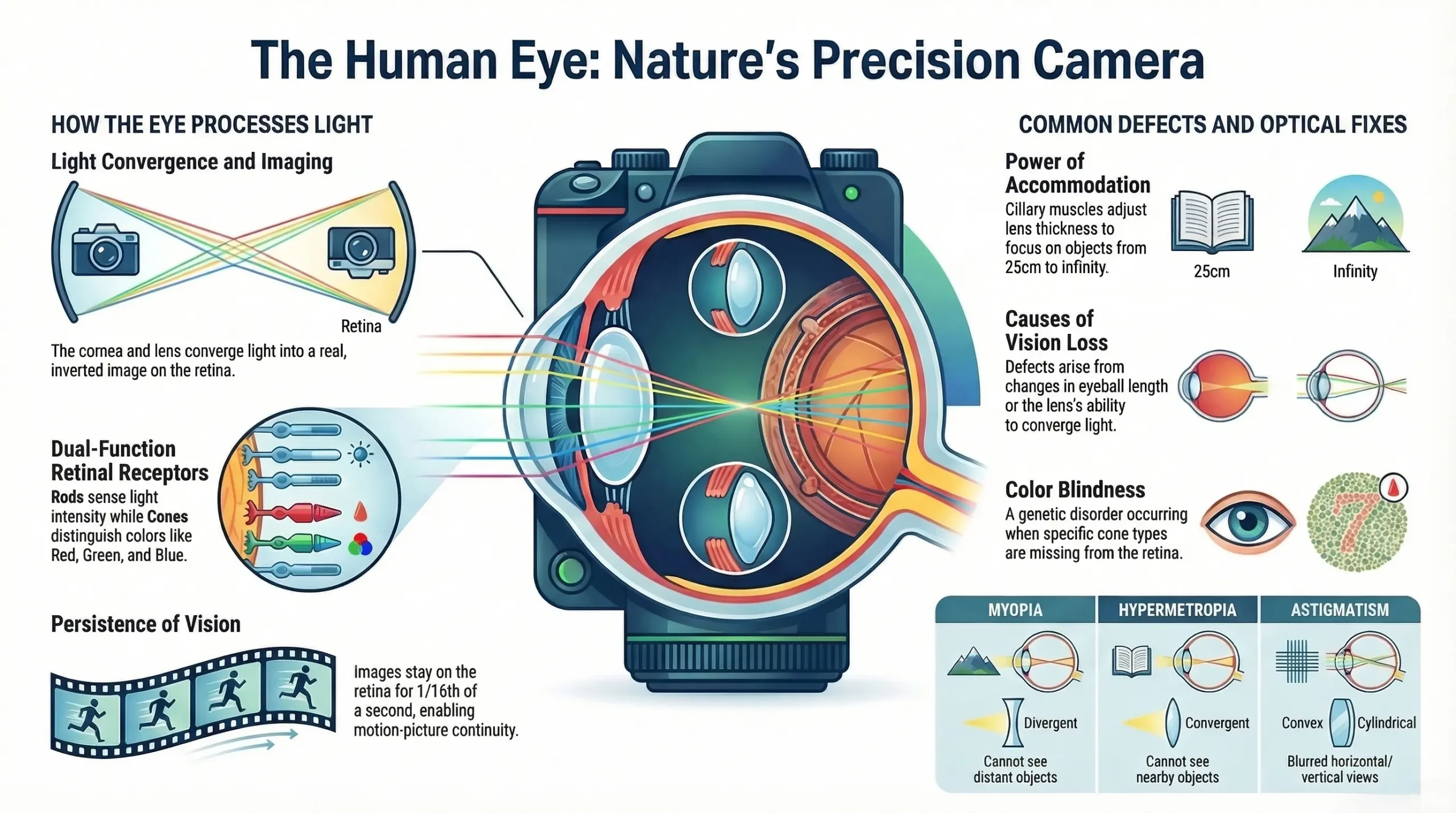
The human eye is the most important natural optical instrument. It is nearly spherical in shape and functions much like a camera — capturing light, focusing it, and sending signals to the brain to form images.
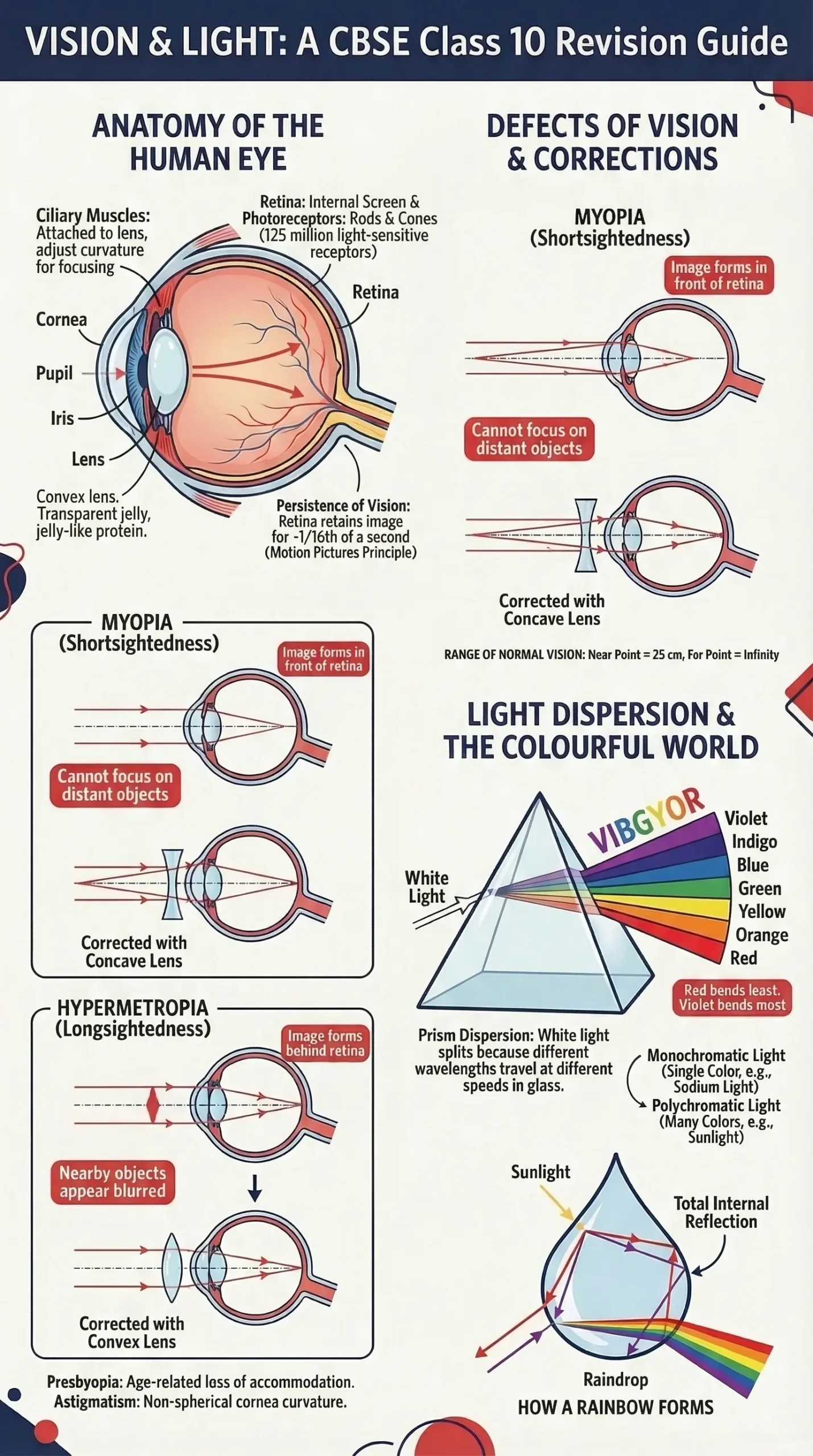
Essential Parts of the Human Eye and Their Functions
| Part | Description | Function |
|---|---|---|
| Cornea | Transparent, spherical membrane at the front of the eye | Allows light to enter; primary refracting surface |
| Aqueous Humor | Clear liquid behind the cornea | Maintains pressure and nourishes the cornea |
| Iris | Dark-coloured, muscular diaphragm with a central opening | Regulates amount of light entering the eye |
| Pupil | Central circular aperture of the iris | Acts as the aperture (opening) through which light passes |
| Eye Lens | Convex (converging) lens made of transparent, jelly-like proteinaceous material | Focuses light onto the retina |
| Ciliary Muscles | Muscles holding the eye lens | Change the curvature and focal length of the eye lens |
| Retina | Light-sensitive inner surface at the rear of the eyeball | Receives focused image; converts light into electrical signals |
| Vitreous Humor | Liquid between the eye lens and retina | Maintains shape of the eyeball |
| Optic Nerve | Bundle of nerve fibres | Transmits electrical signals from the retina to the brain |
| Blind Spot | Point where optic nerve exits the eyeball | No rods or cones here — no vision at this point |
| Sclerotic | Tough outer white coat of the eyeball | Protects the eyeball |
| Choroid | Dark layer between sclerotic and retina | Absorbs stray light, prevents internal reflection |
CBSE Class 10 Science Notes - The Human Eye and the Colourful World Revision Notes PDF
Fill the form to download this PDF
The Iris and Pupil: The Eye's Automatic Aperture
The iris automatically adjusts the size of the pupil depending on available light:
- Bright Light (e.g., sunny day): Iris contracts the pupil → less light enters → protects the retina.
- Dim Light (e.g., dark room): Iris expands the pupil → more light enters → better visibility.
Why does it take time to see clearly when entering a dim room from bright sunlight?
In bright light, the pupil is contracted. On entering a dim room, the iris gradually expands the pupil to allow more light in. This adjustment process takes some time, which is why vision takes a moment to adapt.
The Eye Lens
- It is a convex (converging) lens made of transparent, jelly-like proteinaceous material.
- It is hard at the centre and gradually softer toward the outer edges.
- Held in position by ciliary muscles, which can change the lens curvature and therefore its focal length as needed.
The Retina
- Inner surface at the rear of the eyeball where light is focused.
- Contains approximately 125 million light-sensitive receptor cells.
- These receptors are of two types: rods and cones (discussed in detail under Colour Vision).
- Light falling on these receptors generates electrical signals sent to the brain via the optic nerve.
The Blind Spot
- Located where the optic nerve exits the eyeball.
- No rods or cones are present at this point.
- Any image formed here is not perceived by the brain hence the name blind spot.
Working of the Human Eye
- Light from an object enters through the cornea and then the pupil.
- The eye lens (a convex lens) converges the light rays.
- A real, inverted, and highly diminished image is formed on the retina.
- The light-sensitive cells (rods and cones) are activated and generate electrical signals.
- These signals travel via the optic nerve to the brain.
- The brain interprets these signals and perceives the object as an erect, actual-sized image.
Note: The image on the retina is inverted, but the brain corrects this interpretation, so we perceive things as upright.
Vision Terms
Far Point
The farthest point up to which an eye can see clearly.
- Normal eye: Far point is at infinity.
Near Point
The closest point up to which an eye can see clearly without strain.
- Normal adult eye: Near point is approximately 25 cm from the eye.
Least Distance of Distinct Vision (D)
The minimum distance at which the eye can see an object clearly without any strain.
- Also called the least distance of distinct vision, denoted by D.
- For a normal adult: D = 25 cm
- This distance generally increases with age.
Power of Accommodation of the Human Eye
What is Accommodation?
A normal eye can see both distant and nearby objects clearly. Since the distance between the eye lens and retina (image distance, v) is fixed, the eye must change the focal length of its lens for objects at different distances to always focus the image on the retina.
Accommodation is the ability of the eye lens to change its focal length by changing its curvature (thickness), controlled by the ciliary muscles.
How It Works
| Situation | Ciliary Muscles | Lens Shape | Focal Length |
|---|---|---|---|
| Viewing distant objects (at infinity) | Fully relaxed | Thin (less curved) | Maximum |
| Viewing nearby objects | Tense (strained) | Thick (more curved) | Minimum |
- When relaxed, the lens is at its thinnest parallel rays from distant objects are focused on the retina.
- When tense, the lens bulges diverging rays from nearby objects are brought to focus on the retina.
These adjustments happen so rapidly and automatically that we are unaware of them.
Limit of Accommodation
The eye can only accommodate up to a limit. For a normal adult, this limit is 25 cm (the least distance of distinct vision). Objects closer than 25 cm produce a blurred image.
Range of Vision
The range of vision of a normal human eye extends from infinity down to 25 cm from the eye i.e., from the far point to the near point.
Persistence of Vision
What is Persistence of Vision?
The image formed on the retina does not disappear immediately after the object is removed. It persists for approximately 1/16th of a second after we stop looking at the object.
This property is called persistence of vision: the ability of the eye to retain an impression of light for about 1/16 second after the stimulus is removed.
Application: Motion Pictures (Cinematography)
Persistence of vision is the scientific basis behind movies and animation:
- A movie camera records a sequence of still photographs (frames) of a moving subject.
- These frames are projected on a screen at a speed of approximately 24 frames per second.
- Because each image persists on the retina for 1/16 second, successive images merge smoothly into one another.
- This creates the illusion of continuous motion the movies as we know them.
Colour Vision — Rods, Cones, and Colour Blindness
Rods and Cones
The retina contains two types of photoreceptor cells:
| Feature | Rod Cells | Cone Cells |
|---|---|---|
| Function | Detect intensity of light (brightness/darkness) | Detect colour and fine detail |
| Active in | Dim light | Bright light only |
| Colour sensitivity | No colour differentiation | Sensitive to Red, Green, Blue |
| Number | ~120 million | ~6–7 million |
There are three types of cone cells, each sensitive to a different primary colour of light:
- Cones sensitive to Red
- Cones sensitive to Green
- Cones sensitive to Blue
All other colours we perceive are combinations of these three signals.
Why can't we distinguish colours in dim light?
Cone cells are only active in bright light. In dim light, only rod cells function, which detect only brightness not colour. This is why everything looks grey or colourless in near-darkness.
How Different Animals See Colour
- Bees: Have cones sensitive to ultraviolet (UV) light they can see UV wavelengths in sunlight that are invisible to humans.
- Humans: Cannot see UV light because their cones are not sensitive to it.
- Chickens: Their retina has mostly cone cells and very few rod cells, which is why they can only see in bright light and sleep at sunset.
Colour Blindness
Colour blindness is a defect of vision in which a person cannot distinguish between certain colours.
- It is a genetic disorder passed from parents to children (inherited).
- It occurs when a person lacks one or more types of cone cells in their retina.
- For example, a person without cones sensitive to blue light will be unable to perceive blue colour.
- The most common form is red-green colour blindness.
Defects of Vision and Their Correction
Abnormalities in normal eye function are called defects of vision. The four main defects are:
- Myopia (shortsightedness / nearsightedness)
- Hypermetropia (longsightedness / farsightedness)
- Presbyopia
- Astigmatism
a. Myopia (Shortsightedness / Nearsightedness)
A defect in which the eye can see nearby objects clearly but cannot see distant objects clearly. In a myopic eye, the far point is closer than infinity.
Causes of Myopia
- Decrease in the focal length of the eye lens the lens becomes more convergent (too curved).
- Elongation of the eyeball the eyeball is longer than normal, so the retina is farther from the lens.
In both cases, light from a distant object is focused in front of the retina instead of on it.
Correction of Myopia
Myopia is corrected using a concave lens (diverging lens) of suitable focal length placed before the eye.
- The concave lens diverges the incoming parallel rays slightly.
- These diverged rays appear to come from the far point of the myopic eye.
- The eye lens then focuses them correctly on the retina.
Calculating the Focal Length for Myopia Correction
The corrective lens must form the virtual image of a distant object (at infinity) at the far point (d) of the myopic eye.
Given: u = −∞, v = −d
Using the lens formula:
1/f = 1/v - 1/u = 1/-d - 1/−∞, = 1/-d
∴ f = -d
Power of corrective lens = 1/f (in metres) will be negative (concave lens).
b. Hypermetropia (Longsightedness, Farsightedness, Hyperopia)
A defect in which the eye can see distant objects clearly but cannot see nearby objects clearly. In a hypermetropic eye, the near point is farther than the normal 25 cm.
Causes of Hypermetropia
- Increase in the focal length of the eye lens the lens becomes less convergent (too flat).
- Shortening of the eyeball the eyeball is shorter than normal.
In both cases, light from a nearby object is focused behind the retina instead of on it.
Correction of Hypermetropia
Hypermetropia is corrected using a convex lens (converging lens) of suitable focal length placed before the eye.
- The convex lens converges the rays from a nearby object slightly.
- These converged rays appear to come from the near point of the hypermetropic eye.
- The eye lens then focuses them correctly on the retina.
Calculating the Focal Length for Hypermetropia Correction
The corrective lens must form the virtual image of an object at the normal near point (25 cm = D) at the near point of the hypermetropic person (d).
Given: u = −D = −25 cm, v = −d
1/f = 1/v - 1/u = 1/-d - 1/-25
Power of corrective lens = 1/f (in metres) will be positive (convex lens).
Comparison: Myopia vs Hypermetropia
| Feature | Myopia | Hypermetropia |
|---|---|---|
| Also called | Shortsightedness / Nearsightedness | Longsightedness / Farsightedness |
| Clear vision | Nearby objects | Distant objects |
| Blurred vision | Distant objects | Nearby objects |
| Far point | Closer than infinity | At infinity (normal) |
| Near point | Closer than 25 cm (normal) | Farther than 25 cm |
| Cause | Eye lens too convergent OR eyeball too long | Eye lens too flat OR eyeball too short |
| Image formation | In front of retina | Behind retina |
| Corrective lens | Concave (diverging) | Convex (converging) |
| Power of lens | Negative | Positive |
c. Presbyopia
An age-related defect in which the power of accommodation of the eye gradually decreases, making it difficult to read or see nearby objects comfortably without eyeglasses.
Causes of Presbyopia
- Gradual weakening of the ciliary muscles with age.
- Diminishing flexibility of the crystalline (eye) lens the lens becomes stiffer and loses its ability to change curvature.
Correction of Presbyopia
- Reading glasses with convex lenses are typically prescribed.
- When a person suffers from both myopia and hypermetropia simultaneously (common in old age), bifocal lenses are used:
- Upper half: concave lens (for distant vision)
- Lower half: convex lens (for near vision)
d. Astigmatism
A defect in which light rays in the horizontal and vertical planes do not focus at the same point, causing blurred or distorted vision in certain directions.
A person with astigmatism cannot see all directions equally well some orientations appear blurred while others are clear.
Cause of Astigmatism
- The cornea or the eye lens (or both) is not perfectly spherical.
- It is more curved in one plane (e.g., horizontal) than in another (e.g., vertical).
- This unequal curvature means that light from a point source is focused as two separate lines rather than a single point.
Correction of Astigmatism
- Astigmatism is corrected using cylindrical lenses.
- Cylindrical lenses have different curvatures in the horizontal and vertical directions, compensating for the uneven curvature of the cornea or eye lens.
Refraction of Light Through a Prism
What is a Prism?
A prism is a transparent refracting medium bounded by two plane surfaces inclined to each other at a certain angle (commonly 60° or 45°).
Key components of a prism:
- Refracting surfaces: The two inclined faces (ABED and ACFD) through which light enters and exits.
- Base: The third face (BEFC) opposite to the apex.
- Prism angle (A): The angle BAC between the two refracting surfaces at the apex.
- Refracting edge: The line of intersection (AD) of the two refracting surfaces.
- Principal section: The cross-sectional triangle (ABC), perpendicular to the refracting edge.
Refraction Through a Prism
When a ray of light enters a prism:
- It refracts at the first surface bending toward the normal (as it enters a denser medium).
- It refracts again at the second surface bending away from the normal (as it exits to a less dense medium).
- The net result is that the ray bends toward the base of the prism.
The angle between the original incident ray direction and the emergent ray direction is called the angle of deviation (δ).
Minimum Deviation
The prism is in the position of minimum deviation when:
∠e = ∠i (angle of emegence = angle of incidence)
At this position, the ray passes symmetrically through the prism.
Refractive Index Formula for a Prism
μ = sin(A + δm/2) ⁄ sin (A/2)
Where:
- μ = refractive index of the prism material
- A = prism angle
- δₘ = angle of minimum deviation
Dispersion of White Light by a Glass Prism
What is Dispersion?
Dispersion is the process of splitting white light into its seven constituent colours (VIBGYOR) when it passes through a glass prism.
The band of seven colours formed on a screen is called the spectrum of white light (or spectrum of visible light).
Order of colours (least bent → most bent):
Red → Orange → Yellow → Green → Blue → Indigo → Violet
(Mnemonic: ROYGBIV or "Vibgyor" reversed)
- Red has the longest wavelength → bends the least
- Violet has the shortest wavelength → bends the most
Why Does Dispersion Occur?
- Different colours of light have different wavelengths.
- In a vacuum, all colours travel at the same speed (3 × 10⁸ m/s).
- In a transparent medium (glass, water), different colours travel at different speeds.
- Because of this speed difference, different colours refract (bend) by different amounts when passing through a prism.
- Red travels fastest in glass → least refraction.
- Violet travels slowest in glass → most refraction.
Monochromatic vs Polychromatic Light
| Type | Definition | Example |
|---|---|---|
| Monochromatic | Light of a single colour / single wavelength | Sodium lamp (golden yellow) |
| Polychromatic | Light composed of many colours / multiple wavelengths | White light / sunlight |
Recomposing Dispersed White Light
If the spectrum produced by one prism (P₁) is passed through an identical, inverted prism (P₂), the seven colours recombine to produce white light again. This is called recomposing of white light.
Rainbow Formation
How Does a Rainbow Form?
A rainbow is a natural example of the dispersion of white light.
Process:
- After rain, millions of tiny water droplets remain suspended in the air.
- Each water droplet acts like a tiny prism.
- When sunlight enters a droplet, it undergoes:
- Refraction (as it enters the drop rarer to denser medium)
- Total internal reflection (at the back surface of the drop)
- Refraction again (as it exits the drop denser to rarer medium)
- During these refractions, white light is dispersed into seven colours.
- Light from millions of droplets together forms a continuous coloured arc the rainbow.
Facts About Rainbows
- A rainbow is always seen when the sun is behind the observer.
- Red appears at the outer edge (top) and violet at the inner edge (bottom) of a primary rainbow.
- The red light exits at 42° and violet at 40° from the incident sunlight direction.
- A secondary rainbow (fainter, reversed colour order) can sometimes be seen it forms due to two internal reflections inside each droplet.
The Human Eye and the Colourful World Class 10 Science Quick Revision Summary
| Topic | Key Point |
|---|---|
| Cornea | Primary refracting surface; transparent |
| Pupil | Aperture of the eye; controlled by iris |
| Eye lens | Convex; focal length changed by ciliary muscles |
| Retina | Contains ~125 million rods and cones |
| Accommodation | Change in focal length to see near and far objects |
| Least Distance of Distinct Vision | 25 cm for normal adult |
| Persistence of Vision | 1/16 second; basis of cinema |
| Myopia | Can't see far; corrected by concave lens |
| Hypermetropia | Can't see near; corrected by convex lens |
| Presbyopia | Age-related; bifocal lens |
| Astigmatism | Cylindrical lens correction |
| Dispersion | Splitting of white light by prism |
| VIBGYOR | Violet bends most; Red bends least |
| Rainbow | Dispersion + total internal reflection in raindrops |
The Human Eye and the Colourful World Class 10 Solved Examples
Example 1: A person's far point is 2 m. What is the focal length and power of the corrective lens needed?
Solution: The person is myopic. f = −d = −2 m Power = 1/f = 1/(−2) = −0.5 D
Example 2: A myopic person has a far point of 80 cm. Find the focal length of the corrective lens.
Solution: f = −d = −80 cm = −0.8 m Power = 1/(−0.8) = −1.25 D
Example 3: What focal length should reading spectacles have for a person whose least distance of distinct vision is 50 cm?
Solution: Object distance u = −25 cm (normal reading distance), v = −50 cm (near point of the person)
Using lens formula: 1/f = 1/v − 1/u = 1/(−50) − 1/(−25) = −1/50 + 1/25 = −1/50 + 2/50 = 1/50
f = +50 cm = +0.5 m; Power = +2.0 D
Example 4: A hypermetropic person's near point is 75 cm. What power lens is needed to read at 25 cm?
Solution: u = −25 cm, v = −75 cm 1/f = 1/(−75) − 1/(−25) = −1/75 + 1/25 = −1/75 + 3/75 = 2/75 f = 75/2 = 37.5 cm = 0.375 m Power = 1/0.375 ≈ +2.67 D
Example 5: A person cannot see objects beyond 50 cm. What type of lens is required, and what is its power?
Solution: The person is myopic (cannot see beyond 50 cm = far point). Concave lens needed. f = −50 cm = −0.5 m Power = 1/(−0.5) = −2.0 D
Example 6: The angle of minimum deviation for a prism of angle 60° is also 60°. Find the refractive index.
Solution: μ = sin((A + δm)/2) / sin(A/2) = sin((60° + 60°)/2) / sin(60°/2) = sin(60°) / sin(30°) = (√3/2) / (1/2) μ = √3 ≈ 1.732
Example 7: A glass prism has a prism angle of 45° and angle of minimum deviation = 30°. Find the refractive index.
Solution: μ = sin((45 + 30)/2) / sin(45/2) = sin(37.5°) / sin(22.5°) ≈ 0.6088 / 0.3827 μ ≈ 1.59
Example 8: Which colour of light has the greatest wavelength? Which has the least?
Solution:
- Greatest wavelength: Red (~700 nm) bends least
- Shortest wavelength: Violet (~400 nm) bends most
Example 9: Why is the image on the retina inverted, yet we perceive objects as upright?
Solution: The eye lens forms a real, inverted, diminished image on the retina. However, the brain processes and interprets the electrical signals from the optic nerve, correcting the inversion so we perceive objects as upright.
Example 10: A person uses a lens of power −3.5 D. What defect does the person have? What is the far point?
Solution: Negative power → concave lens → the person has myopia. f = 1/P = 1/(−3.5) = −0.286 m ≈ −28.6 cm Far point = 28.6 cm from the eye.
Example 11: A person uses a lens of power +2.5 D for reading. What defect does this person have?
Solution: Positive power → convex lens → the person has hypermetropia (longsightedness).
Example 12: If movies are shot at fewer than 16 frames per second, what would happen to the viewer's experience?
Solution: Persistence of vision is 1/16 second. If frames are shown at fewer than 16 per second, each image fades before the next appears. The viewer would see flickering still images rather than smooth motion.
Example 13: Why can chickens only see in bright light?
Solution: The retina of a chicken contains mostly cone cells and very few rod cells. Cone cells are only active in bright light, so chickens can only see when there is adequate illumination. They effectively become "blind" in dim light or darkness.
Example 14: What is the range of vision of a normal human eye?
Solution: The range of vision of a normal adult eye is from infinity (far point) to 25 cm (near point / least distance of distinct vision).
Example 15: A man can read a book held at 15 cm clearly, but cannot see objects beyond 40 cm. Identify the defect and suggest correction.
Solution:
- Cannot see beyond 40 cm → Myopia (far point = 40 cm)
- Correction: Concave lens with f = −40 cm = −0.4 m
- Power = −2.5 D
Example 16: Why does a rainbow always appear opposite to the sun?
Solution: Raindrops disperse light back toward the observer via internal reflection. For the dispersed, coloured light to reach the observer's eyes, the sun must be behind the observer. The dispersed colours are reflected back at specific angles (40°–42°) toward the observer's eyes.
Example 17: A student observes that she can read a book clearly at 30 cm but the text on the blackboard at 10 m appears blurred. What type of lens does she need and why?
Solution: She can see nearby (30 cm) but not distant (10 m) → Myopia. She needs a concave (diverging) lens. It will diverge light from distant objects so the rays appear to come from her far point, allowing the eye lens to focus them on the retina.
Example 18: White light passes through a glass slab (parallel sides). Does it show dispersion?
Solution: A glass slab with parallel sides produces no net dispersion because the refraction at the second surface exactly reverses the dispersion caused at the first surface. The emergent beam is white light, merely displaced laterally. A prism (non-parallel surfaces) is needed for dispersion.
Example 19: What happens to the focal length of the eye lens when you look from a nearby object to a distant object?
Solution: The ciliary muscles relax, the lens becomes thinner (less curved), and its focal length increases to its maximum value. This allows parallel rays from distant objects to be focused on the retina.
Example 20: A person suffering from presbyopia also has myopia. What kind of corrective lens is prescribed?
Solution: The person needs bifocal lenses:
- Upper portion: Concave lens (to correct myopia for distant vision)
- Lower portion: Convex lens (to correct presbyopia for reading/near vision)