
Class 10 Notes Chapter 7 How Do Organisms Reproduce: Reproduction is one of the most important life processes that helps living organisms continue their species on Earth. In simple words, reproduction class 10 explains how plants, animals, and microorganisms produce new individuals similar to themselves. In Chapter 7 How Do Organism Reproduce Notes class 10 science notes, students learn the basic concepts of biological reproduction, types of reproduction, and the importance of reproduction for survival of species.
According to biology, reproduction is the process by which living organisms create new offspring. Without reproduction, no species would be able to survive for long time on this planet. In reproduction class 10 notes, this chapter explains two major types of reproduction: asexual reproduction and sexual reproduction. Asexual reproduction happens in organisms like bacteria, yeast, and some plants where only one parent is involved. On the other hand, sexual reproduction occurs in humans, animals, and flowering plants where two parents contribute genetic material.
These how do organisms reproduce class 10 notes pdf also help students understand topics like DNA copying, variation in organisms, reproductive organs in plants and humans, and the role of hormones in reproduction. These concepts are very important not only for exams but also for understanding how life continues in nature.
Students can also practice reproduction class 10 questions and answers to improve their understanding of key terms such as fertilization, gametes, reproduction in plants, and human reproductive system. This chapter sometimes looks easy but few concepts can be little confusing if not studied carefully.
What is Reproduction?
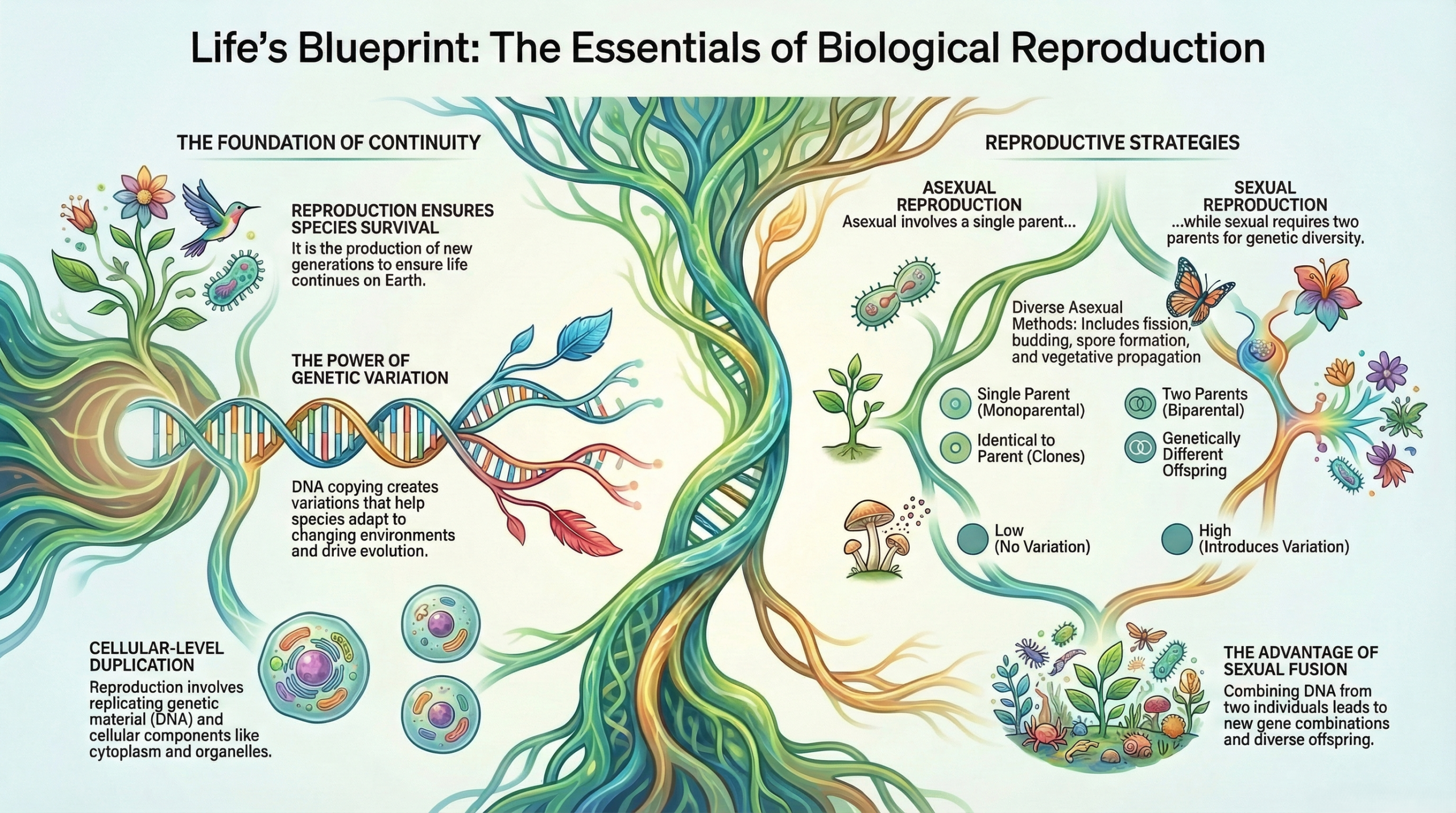
Reproduction is the biological process by which living organisms produce new individuals of the same species. It ensures the continuity of life on Earth and is essential for the survival of a species.
- Reproduction involves the transmission of genetic material (DNA) from one generation to the next.
- Offsprings produced are similar to parents but not identical due to small variations in DNA copying.
- At the cellular level, reproduction involves duplication of genetic material (DNA in the nucleus) and cellular components (cytoplasm and organelles).
CBSE Class 10 Biology Notes - How Do Organisms Reproduce? Revision Notes PDF
Fill the form to download this PDF
Why DNA Copying Matters in Reproduction
During reproduction, DNA is duplicated so that each new cell carries a complete genetic blueprint. Slight errors or alterations in this copying process lead to variations in the offspring.
- Alterations in DNA sequence → changes in proteins coded → altered enzymes → structural and metabolic variations.
- Consistency of DNA copying maintains the body design suited to a particular ecological niche.
Importance of Variations
| Benefit | Explanation |
|---|---|
| Survival | Variants may survive changing environments (e.g., heat-resistant bacteria surviving global warming) |
| Adaptation | Helps species adapt to new conditions |
| Evolution | Variations are the basis of evolution and genetic diversity |
| New Species | New species emerge due to accumulated variations |
Example: If water temperature rises due to global warming, most bacteria in temperate water die — but heat-resistant variants survive and reproduce, keeping the species alive.
Types of Reproduction
Reproduction is broadly classified into two types:
Reproduction:
Asexual Reproduction (one parent)
- Fission (Binary & Multiple)
- Budding
- Spore Formation
- Regeneration
- Fragmentation
- Vegetative Propagation
- Natural (root, stem, leaf)
- Artificial (cutting, layering, grafting)
Sexual Reproduction (two parents)
- In Flowering Plants
- In Animals (Human Reproductive System)
Asexual Reproduction
Definition: Production of offspring by a single parent without meiosis, gamete formation, or fertilisation. All genes come from one parent.
Organisms: Unicellular (bacteria, protozoa), some plants (algae, fungi, bryophytes), and some multicellular animals (Sponges, Hydra).
Fission
Fission is the splitting of a unicellular organism to produce new individuals.
Binary Fission
- One cell splits into two equal halves.
- Examples: Amoeba, Paramecium, Leishmania, many bacteria.
| Organism | Plane of Division |
|---|---|
| Amoeba | Any plane (irregular shape) |
| Paramecium | Horizontal/transverse axis |
| Leishmania | Longitudinal plane (due to whip-like flagellum) |
Multiple Fission
- One cell divides repeatedly to form many daughter cells simultaneously.
- Often occurs under unfavourable conditions (organism forms a cyst first).
- Examples: Plasmodium (malarial parasite), Amoeba (under stress).
Differences Between Binary vs Multiple Fission
| Feature | Binary Fission | Multiple Fission |
|---|---|---|
| Number of individuals | 2 | Many |
| Conditions | Favourable only | Favourable & unfavourable |
| Nuclear division | Once | Repeated |
| Cytoplasm division | After nuclear division | Not immediately |
| Residual body | None | Part of body/cytoplasm left |
Spore Formation
- A spore is a single or few-celled microscopic reproductive structure that detaches and forms new individuals.
- In fungi (e.g., Rhizopus): Hyphae develop enlarged sporangia → nucleus divides → each nucleus surrounded by cytoplasm → spores form inside sporangium → wall ruptures → spores released.
- Spores are light, air-borne, and dispersed widely by wind.
- Spores develop thick walls in unfavourable conditions for protection.
- Examples: Rhizopus, Mucor, Aspergillus, Penicillium
Budding
- An outgrowth (bud) forms on the parent body, grows, and eventually detaches to become a new organism.
- Examples:
- Yeast — The bud develops a nucleus by mitotic division, grows, and separates.
- Hydra — A bud grows from the body wall, develops tentacles, and detaches as a daughter Hydra.
Regeneration
- The ability of an organism to regrow lost or damaged body parts into a complete organism.
- Carried out by specialised stem cells that proliferate and differentiate into various tissues.
- Examples: Hydra, Planaria can be cut into any number of pieces, and each piece regenerates into a complete organism.
- Note: Regeneration is NOT a true mode of reproduction. Higher animals have limited regeneration (e.g., lizard tail, starfish arm). Human liver also has regeneration potential.
Fragmentation
- Breaking of the body of a multicellular organism into two or more pieces on maturing — each piece grows into a complete new organism.
- Examples: Spirogyra, Sea Anemones.
Differences Between Fragmentation vs Regeneration
| Feature | Fragmentation | Regeneration |
|---|---|---|
| Organism type | Simple multicellular | Fully differentiated, complex |
| Each piece | Always develops into new individual | May or may not develop |
| Specialised cells | Not involved | Specialised cells proliferate |
| Example | Spirogyra | Hydra, Planaria |
Vegetative Reproduction in Plants
A specialised form of asexual reproduction in plants where vegetative parts (root, stem, leaf) give rise to new plants.
Natural Vegetative Propagation
| Part Used | Example | Mechanism |
|---|---|---|
| Root | Sweet potato, Dahlia | Adventitious roots/buds develop into new plants |
| Underground stem | Potato (tuber), Ginger (rhizome), Onion (bulb) | Buds/eyes on stems sprout into new plants |
| Subaerial stem | Grasses (runner), Jasmine (stolon) | Lateral branches detach and grow |
| Leaf | Bryophyllum, Begonia, Kalanchoe | Adventitious buds in leaf notches develop into plantlets |
Artificial Vegetative Propagation
Developed by horticulturists and plant breeders for commercial production.
(a) Cutting
- A piece of stem/root/leaf is cut and planted to develop into a new plant.
- Examples: Rose, Grape, Sugarcane.
(b) Layering
- A branch is bent to the ground, covered with moist soil; roots develop; the branch is then cut from the parent.
- Mound Layering: Flexible branch buried in soil — Raspberry, Strawberry.
- Air Layering: For thick branches; bark removed, moss wrapped around cut → adventitious roots grow → stem cut and grown separately — Rubber plant, Bonsai.
- Example: Jasmine.
(c) Grafting
- Parts of two related plants are joined to grow as one.
- Stock = rooted plant receiving the graft.
- Scion = shoot/bud grafted onto the stock.
- Cambium of both must be in contact; joint sealed with wax/clay.
- One stock can support multiple scions (e.g., citrus stock for orange, lemon, lime).
- Example: Mango, Rose.
Advantages of Vegetative Propagation
- Quicker method; disease-free plants possible.
- Easy and economical.
- Preserves parent characteristics exactly (clones).
- Only method for plants that don't produce seeds.
- Useful for ornamental plants.
Disadvantages
- Induces overcrowding.
- No genetic variation → less adaptability.
Tissue Culture (Micropropagation / In-Vitro)
- A modern technique of vegetative propagation.
- Small piece of plant tissue (from growing tips) grown on artificial nutrient medium under aseptic conditions.
- Tissue forms an unorganised mass of cells called a callus.
- Callus transferred to hormone-containing medium → plantlets differentiate → transplanted to soil.
- Used for: Orchids, Asparagus, Chrysanthemum.
Parthenogenesis
- Development of an organism from an unfertilised egg.
- Discovered by Charles Bonnet (1745).
- Occurs in bees, wasps, beetles, spiders, turkeys.
- In honey bees: Fertilised eggs → queens and workers (females); Unfertilised eggs → drones (males).
Sexual Reproduction
Definition: Production of offspring by fusion of two gametes (one from male, one from female parent) to form a diploid zygote, which develops into a new organism.
- The fusion of gametes = fertilisation.
- Involves meiosis during gamete formation → new gene combinations → genetic diversity.
Significance of Sexual Reproduction
- Promotes diversity of characters in offspring.
- Reshuffles genes → increases genetic variation.
- Plays a key role in origin of new species.
- Basis of evolution.
Asexual vs Sexual Reproduction
| Feature | Asexual | Sexual |
|---|---|---|
| Parents | One (monoparental) | Two (biparental) |
| Sex organs | Not involved | Specialised organs involved |
| Gametes | Not formed | Formed |
| Cell division | Mitosis only | Involves meiosis |
| Fertilisation | Absent | Present |
| Genetic makeup | Same as parent | Different from parent |
| Variation | No variation | Introduces variation |
| Found in | Primitive organisms | Higher organisms |
| Evolutionary importance | None | High |
Sexual Reproduction in Flowering Plants
The flower is the reproductive organ of a plant.
Parts of a Flower
| Part | Description | Function |
|---|---|---|
| Receptacle | Base of flower | Supports all floral parts |
| Sepals (Calyx) | Green, outermost | Protect bud before opening |
| Petals (Corolla) | Colourful | Attract pollinators; protect reproductive organs |
| Stamen (Androecium) | Male organ | Produces pollen grains via anther |
| Carpel/Pistil (Gynoecium) | Female organ | Receives pollen; contains ovules |
Stamen Structure
- Anther — Pollen grains develop here; splits open when mature.
- Filament — Stalk supporting the anther.
Carpel Structure
- Stigma — Receives pollen grains.
- Style — Connects stigma to ovary.
- Ovary — Contains ovules (female gametes/ovum).
Unisexual flowers: Only stamens OR carpels — Papaya, Watermelon.
Bisexual flowers: Both stamens AND carpels — Hibiscus, Mustard.
Pollination
Transfer of pollen grains from anther to stigma.
| Type | Definition | Example |
|---|---|---|
| Self-pollination (Autogamy) | Same flower | Pea |
| Self-pollination (Geitonogamy) | Different flowers on same plant | Oxalis |
| Cross-pollination | Different plants of same species | Mango |
Agencies of Pollination:
- Abiotic: Wind (Anemophily), Water (Hydrophily), Gravity (Geophily)
- Biotic: Insects (Entomophily), Birds (Ornithophily), Bats (Chiropterophily), Snails (Malacophily), Animals (Zoophily)
Differences Between Self vs Cross Pollination
| Feature | Self Pollination | Cross Pollination |
|---|---|---|
| Pollen transfer | Same plant | Different plant, same species |
| External agency | Not needed | Required |
| Pollen grains | Fewer | More |
| Genetic variation | None | Introduces variation |
Fertilisation in Flowering Plants
- Pollen germinates on stigma → forms pollen tube.
- Nucleus divides into two male gametes.
- Pollen tube grows through style → enters ovule via micropyle.
- Two male gametes released in embryo sac:
- 1st male gamete + egg cell → Syngamy → Zygote (2n)
- 2nd male gamete + 2 polar nuclei → Triple fusion → Triploid nucleus (Primary Endosperm Nucleus)
- Syngamy + Triple fusion = Double Fertilisation (unique to angiosperms)
Post-Fertilisation Changes
| Structure | Develops Into |
|---|---|
| Ovule | Seed |
| Ovary | Fruit |
| Fertilised egg | Embryo |
| Triploid nucleus | Endosperm (food for embryo) |
| Integuments | Seed coat |
- Sepals, petals, stamen wither. Style and stigma degenerate.
- Germination = embryo in seed developing into a seedling under suitable conditions.
Sexual Reproduction in Animals — Human Reproductive System
Puberty
The age at which sex hormones begin production and reproductive organs mature.
| Changes in Boys (13–14 years) | Changes in Girls (10–12 years) |
|---|---|
| Testes start producing sperms | Ovaries start releasing eggs |
| Testosterone secreted | Oestrogen and progesterone secreted |
| Hair in armpits, pubic region, beard | Hair in armpits and pubic region |
| Voice deepens | Mammary glands develop |
| Chest/shoulders broaden | Fat deposited in hips/thighs |
| Penis and testes enlarge | Uterus, fallopian tubes enlarge |
| — | Menstruation begins |
Male Reproductive System
Primary sex organ: Testes (located in scrotum, below normal body temperature for sperm production).
| Organ | Function |
|---|---|
| Testes | Produce sperms and testosterone |
| Epididymis | Stores and transports sperm from testes |
| Vas deferens | Carries sperms to seminal vesicle |
| Seminal vesicles | Secrete alkaline fluid (fructose for energy, prostaglandins) |
| Prostate gland | Secretes fluid that nourishes and activates sperms |
| Cowper's (Bulbourethral) glands | Secrete alkaline fluid; lubricates urethra |
| Urethra | Common passage for urine and semen |
| Penis | Organ for copulation; erectile tissue |
Semen: Secretions of seminal vesicles + prostate + Cowper's glands + sperms. Contains 200–300 million spermatozoa per 2.5–5 ml; pH 7.35–7.5.
Sperm structure: Head (genetic material + acrosome), neck, middle piece (mitochondria for energy), tail (for movement).
Female Reproductive System
Primary sex organs: Ovaries (produce ova + estrogen + progesterone).
| Organ | Function |
|---|---|
| Ovaries | Produce eggs; secrete estrogen and progesterone |
| Fallopian tube (Oviduct) | Carries egg from ovary to uterus; site of fertilisation |
| Uterus | Site of embryo development (implantation and growth) |
| Cervix | Opening between uterus and vagina |
| Vagina | Birth canal; entry for sperms |
Menstrual Cycle
A 28-day cycle of events in the female reproductive organs, controlled by hormones.
| Phase | Days | Events |
|---|---|---|
| Menstruation | 1–5 | Uterine lining breaks down and sheds as blood (if no fertilisation) |
| Proliferative phase | 6–14 | FSH stimulates follicle development; estrogen repairs uterine lining |
| Ovulation | 14th day | LH triggers release of egg from ovary (ovulation) |
| Secretory/Luteal phase | 15–28 | Progesterone maintains uterine lining; if no fertilisation, cycle repeats |
- Menarche: First menstruation (~11–13 years).
- Menopause: Menstruation stops permanently (~45–50 years).
Fertilisation in Humans
- Sperm enters vagina → moves to fallopian tube → meets egg.
- Capacitation occurs (sperm matures in female tract).
- Acrosomal enzymes dissolve egg's jelly coat → sperm enters egg.
- Membrane forms around egg → prevents polyspermy.
- Zygote formed (46 chromosomes: 23 from sperm + 23 from egg).
Implantation
- Zygote undergoes mitosis → morula (solid ball) → blastula → attaches to endometrium (uterine lining) after ~6 days.
- This attachment = implantation → female is pregnant.
Development of Placenta
- Embryo gets nutrients from mother's blood via the placenta.
- Connected to embryo by the umbilical cord.
- Placenta forms villi for large surface area.
- Functions: nutritive, respiratory, and excretory organ for the foetus.
- Gestation: ~280 days (40 weeks) from first day of last menstruation.
Parturition
- Expulsion of full-term foetus from uterus at end of gestation.
- Rhythmic uterine muscle contractions cause birth.
- Lactation: Milk production begins post-birth.
- Colostrum: First milk (yellowish); rich in antibodies provides immunity to newborn.
Reproductive Health
Birth Control Measures
Contraception = methods to deliberately prevent fertilisation.
| Method | Type | Examples |
|---|---|---|
| Barrier | Physical | Condom (male), Femidom (female), Diaphragm (cervical cap) |
| Chemical | Hormonal/spermicidal | Oral contraceptive pills (estrogen + progesterone), Vaginal pills |
| IUCD | Intrauterine | Copper-T (prevents implantation; Cu ions suppress sperm motility) |
| Surgical | Permanent | Vasectomy (male — vas deferens cut), Tubectomy (female — fallopian tube cut) |
Sexually Transmitted Diseases (STDs)
Infectious diseases spread through sexual contact.
| STD | Causative Organism | Symptoms |
|---|---|---|
| AIDS | HIV (virus) | Destroys immune system; persistent cough, fever; vulnerability to pneumonia, TB, cancers |
| Syphilis | Treponema pallidum (bacterium) | Sores/lesions in genital tract; burning urination |
| Gonorrhoea | Neisseria gonorrhoeae (bacterium) | Infects urinogenital tract; genital discharge, painful urination |
| Trichomoniasis | Trichomonas vaginalis (protozoan) | Vaginal irritation, itching, discharge |
AIDS is also transmitted by:
- Contaminated needles/syringes.
- Transfusion of infected blood.
- Use of contaminated razors.
- Mother to baby (vertical transmission).
Solved Examples
Example 1: Why do offspring produced by asexual reproduction show genetic similarity to parents?
Answer: Asexual reproduction involves only mitosis with no gamete formation or genetic recombination. All genetic material comes from a single parent, producing genetically identical offspring (clones).
Example 2: Why does Amoeba undergo binary fission in any plane while Leishmania divides longitudinally?
Answer: Amoeba has an irregular shape, so there is no fixed body axis — division can occur in any plane. Leishmania has a whip-like flagellum at one end, giving it a defined orientation, so division occurs along the longitudinal plane.
Example 3: What is the advantage of spore formation over binary fission as a survival strategy?
Answer: Spores develop thick walls under unfavourable conditions, protecting the organism. They are lightweight, easily dispersed by wind over large distances, and are produced in large numbers — making spore formation a more effective survival and dispersal strategy.
Example 4: Why are testes located outside the abdominal cavity in humans?
Answer: Spermatogenesis (sperm production) requires a temperature slightly lower than normal body temperature (~37°C). The scrotum maintains this lower temperature, ensuring healthy sperm production.
Example 5: Distinguish between syngamy and triple fusion.
Answer: Syngamy is the fusion of one male gamete with the egg cell to form a diploid zygote. Triple fusion is the fusion of the second male gamete with the two polar nuclei to form a triploid primary endosperm nucleus. Together, these constitute double fertilisation.
Example 6: Why is regeneration not considered a true mode of reproduction?
Answer: True reproduction is the deliberate production of new organisms. Regeneration is the replacement of lost or injured parts. While Hydra and Planaria can regenerate an entire organism from a fragment, this is a repair mechanism triggered by injury, not an intentional reproductive process.
Example 7: What is the role of FSH and LH in the menstrual cycle?
Answer: FSH (Follicle Stimulating Hormone) from the pituitary gland stimulates the development of ovarian follicles. LH (Luteinising Hormone) triggers ovulation — the release of a mature egg from the ovary — on around the 14th day.
Example 8: Why is cross-pollination considered advantageous over self-pollination?
Answer: Cross-pollination involves transfer of pollen between different plants of the same species, combining genetic material from two individuals. This introduces genetic variation in the offspring, increasing adaptability and evolutionary potential. Self-pollination produces no variation.
Example 9: How does a copper-T prevent pregnancy?
Answer: A copper-T (IUCD) is inserted into the uterus. It prevents implantation of the fertilised egg. Additionally, copper ions (Cu²⁺) released by the device suppress sperm motility and reduce the fertilising capacity of sperms.
Example 10: What is the significance of colostrum for a newborn?
Answer: Colostrum is the yellowish fluid produced by mammary glands in the first 2–3 days after birth. It is rich in antibodies (especially IgA) that provide passive immunity to the newborn, protecting it from infections before its own immune system is fully functional.
Example 11: Explain how a potato tuber helps in vegetative propagation.
Answer: A potato tuber is a modified underground stem with nodes called 'eyes' on its surface. These eyes contain buds. When a tuber is planted in soil, the buds germinate and grow into aerial shoots, producing a new potato plant — demonstrating vegetative propagation by underground stem.
Example 12: Why is tissue culture also called micropropagation?
Answer: Tissue culture involves growing a very small (micro) piece of plant tissue in a sterile nutrient medium. From this tiny explant, thousands of genetically identical plants (clones) can be propagated, hence the term "micropropagation."
Example 13: How does grafting combine desirable properties from two plants?
Answer: In grafting, the scion (shoot of the desired variety) is joined to the stock (rooted wild variety with strong roots). The scion contributes desired fruit/flower quality while the stock provides efficient nutrient uptake. The cambium layers must align for the graft to succeed.
Example 14: Why does menstruation occur?
Answer: If the released egg is not fertilised, progesterone and estrogen levels fall. The thickened uterine lining (endometrium), which had been prepared for implantation, breaks down along with blood vessels and exits as menstrual flow marking the beginning of the next cycle.
Example 15: Why is HIV/AIDS considered more dangerous than other STDs?
Answer: HIV targets and destroys the immune system (specifically CD4+ T cells), leaving the body unable to fight infections. This leads to AIDS, where opportunistic diseases like pneumonia, TB, and certain cancers attack the body currently incurable, making it uniquely dangerous.
Example 16: What is the difference between internal and external fertilisation?
Answer: External fertilisation occurs outside the female body (both gametes released into water e.g., frogs, fish); it is unreliable and embryos are unprotected. Internal fertilisation occurs inside the female reproductive tract (e.g., humans); it is reliable and the embryo is well protected.
Example 17: Explain why Bryophyllum leaves are considered a natural vegetative propagation tool.
Answer: The fleshy leaves of Bryophyllum bear adventitious buds in notches along the leaf margin. When leaves fall on moist soil, these buds germinate and develop into independent plantlets, demonstrating natural vegetative propagation by leaves.
Example 18: What is the role of the endosperm in a seed?
Answer: The endosperm develops from the triploid nucleus (formed by triple fusion). It stores food reserves (starch, proteins, fats) that nourish the growing embryo during germination, until the seedling can photosynthesise independently.
Example 19: Why is variation described as "beneficial to the species but not necessary for the individual"?
Answer: An individual organism doesn't need variations to survive in a stable environment. However, for the species as a whole, variations ensure that some individuals survive environmental changes (like disease outbreaks or climate shifts) and reproduce, keeping the species alive over time.
Example 20: How does multiple fission in Plasmodium help it survive unfavourable conditions?
Answer: Under unfavourable conditions, Plasmodium forms a protective cyst around itself. Inside the cyst, the nucleus undergoes repeated divisions (multiple fission), producing many daughter cells. When conditions improve, the cyst breaks open and releases all daughter cells simultaneously — dramatically increasing the population in a short time.
How Do Organisms Reproduce Quick Revision Summary
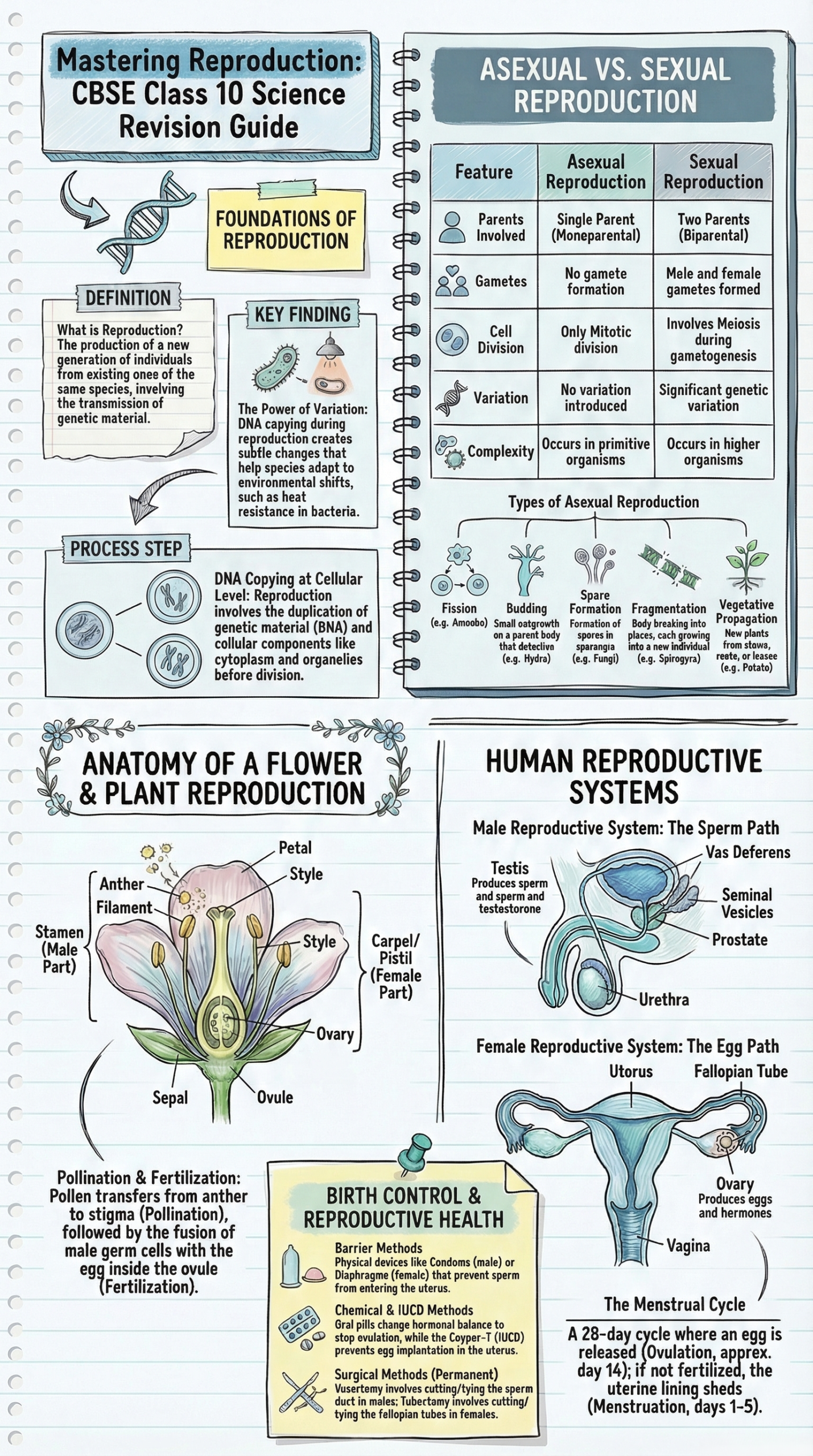
| Topic | Point |
|---|---|
| Reproduction | Ensures continuity of life; involves DNA copying |
| Variations | Enable evolution; important for species survival |
| Binary fission | 1 → 2 cells; Amoeba, Paramecium, Leishmania |
| Multiple fission | 1 → many cells; Plasmodium, Amoeba (unfavourable) |
| Budding | Outgrowth detaches; Yeast, Hydra |
| Spore formation | Rhizopus, Mucor; air-dispersed |
| Regeneration | Stem cells; Hydra, Planaria |
| Fragmentation | Spirogyra; breaks into pieces |
| Vegetative propagation | Natural/artificial; clones produced |
| Tissue culture | Callus → plantlets; aseptic conditions |
| Parthenogenesis | Unfertilised egg development; bees, wasps |
| Double fertilisation | Unique to angiosperms; syngamy + triple fusion |
| Pollination | Self (same plant) vs Cross (different plant) |
| Menstrual cycle | 28 days; FSH → LH → estrogen → progesterone |
| Placenta | Nutritive + respiratory + excretory organ of foetus |
| Gestation | ~280 days / 40 weeks |
| Contraception | Barrier / Chemical / IUCD / Surgical |
| STDs | AIDS (HIV), Syphilis, Gonorrhoea, Trichomoniasis |