
Heredity Notes Class 10 Chapter 8: Heredity is one of the most important topics in biology because it explains how traits are passed from parents to their children. In heredity and evolution class 10, students learn how characteristics like eye color, height, or blood group are inherited through genes. These heredity notes class 10 Chapter 8 Heredity Notes help students understand the basic ideas of inheritance, variation, and the role of DNA in living organisms.
In the heredity and evolution class 10 notes NCERT, heredity is defined as the transmission of genetic information from one generation to the next. The study of heredity mainly focuses on genes, chromosomes, and the process of reproduction. When organisms reproduce, they pass certain traits to their offspring, but not all traits are exactly same. This leads to variation, which is also an important part of evolution.
These heredity and evolution class 10 notes PDF are useful for quick revision and concept clarity before exams. Students can also practice heredity class 10 questions and answers to test their understanding of Mendel’s laws, dominant and recessive traits, and genetic inheritance.
Overall, the chapter heredity and evolution class 10 helps students understand how life continues and changes over generations. It also explains why children are similar to their parents but still have some different features, which makes every individual unique in some way.
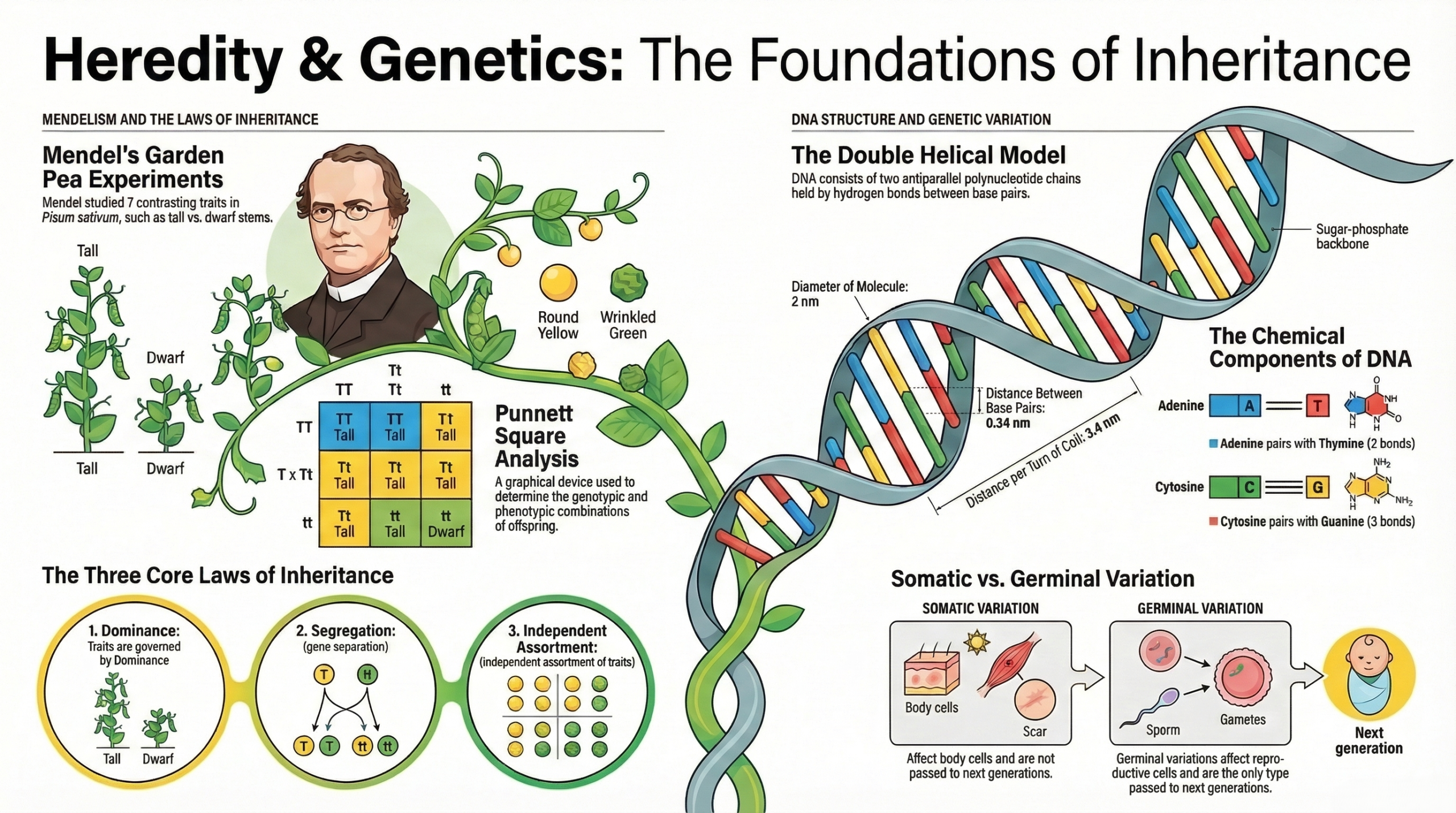
What is Heredity and Genetics?
What is Heredity?
Heredity is the biological process of transmission of characteristics genetically from one generation to another. It explains why children resemble their parents and why traits run in families.
What is Genetics?
Genetics is the scientific study of heredity and variations. Important milestones:
- The term "genetics" was first coined by W. Bateson in 1905.
- Gregor Johann Mendel (1822–1884) was the first scientist to systematically study genetics through controlled hybridisation experiments on garden pea plants (Pisum sativum).
- Mendel is universally honoured as the Father of Genetics.
Expert Note: Though Mendel published his findings in 1866, his work was unrecognised until 1900, when three scientists Hugo de Vries (Holland), Carl Correns (Germany), and Erich Tschermak-Seysenegg (Austria) independently rediscovered and validated his principles.
CBSE Class 10 Biology Notes - Heredity and Evolution Revision Notes PDF
Fill the form to download this PDF
Type of Variation and Importance
What is Variation?
Variation refers to the differences in characters or traits among individuals of the same species.
How Does Variation Accumulate?
| Reproduction Type | Source of Variation |
|---|---|
| Asexual Reproduction | Minor variation due to small inaccuracies in DNA copying |
| Sexual Reproduction | Greater diversity; offspring receive characters from both parents |
Types of Variation (Based on Cells Affected)
(a) Somatic Variations
- Affect somatic (body) cells only.
- Occur during the organism's lifetime.
- Not heritable cannot be passed to offspring.
- Caused by: environmental factors, use/disuse of organs, conscious efforts.
(b) Germinal Variations
- Affect germ cells (reproductive cells).
- Heritablepassed from parents to offspring.
- Form the raw material for evolution.
Importance of Variations
- Help individuals survive in the struggle for existence.
- Enable organisms to adapt to changing environments.
- Form the basis of heredity.
- Provide raw material for evolution and development of new species.
- Support breeders in improving plant and animal races.
- New characters develop through mutation.
Real-World Example: Heat-resistant bacteria survive in high-temperature environments because of a variation in their genetic makeup. Bacteria without this variation perish a classic demonstration of natural selection in action.
Mendel and Mendelism
Who Was Gregor Johann Mendel?
Born on July 22, 1822, in Heinzendorf (now Czech Republic), Mendel was an Augustinian friar and scientist. He began his first hybridisation experiments with garden peas in 1856 and spent the next 10 years meticulously recording results.
His landmark paper, Experiments on Plant Hybridization, was published in 1866 in the Proceedings of the Brunn Natural Science Society. He died on January 8, 1884, largely unrecognised.
Why Did Mendel Choose Garden Pea (Pisum sativum)?
- Reproduces sexually; has distinct male (pollen) and female (ovum) gametes.
- Has 7 pairs of clearly contrasting characters.
- Short life cycle many generations possible in limited time.
- Easy to cultivate, maintain, and cross-pollinate artificially.
- Produces many seeds per generation for statistically valid analysis.
Mendel's Experimental Technique
- Selected pure-breeding parent plants (true-breeding for each trait).
- Emasculation removed anthers (male parts) from flowers before maturity to prevent self-fertilisation.
- Covered emasculated flowers to prevent contamination by foreign pollen.
- Transferred pollen from the desired plant onto the stigma (female part) of the emasculated flower.
- Collected seeds from F₁ generation and raised them.
- Allowed F₁ plants to self-pollinate to produce F₂ generation.
Mendel's Experiments on Inheritance of Traits
Seven Contrasting Traits Studied by Mendel
| Character | Dominant Trait | Recessive Trait | Dominant:Recessive Ratio |
|---|---|---|---|
| Stem Height | Tall | Dwarf | 785:277 (~2.84:1) |
| Flower Colour | Violet | White | 705:224 (~3.15:1) |
| Flower Position | Axial | Terminal | 651:207 (~3.14:1) |
| Pod Shape | Inflated | Constricted | 882:152 (~5.8:1) |
| Pod Colour | Green | Yellow | 428:152 (~2.82:1) |
| Seed Shape | Round | Wrinkled | 5474:1850 (~2.96:1) |
| Seed Colour | Yellow | Green | 6022:2001 (~3.01:1) |
Observation: The ratios consistently approximated 3:1, pointing toward a fundamental mathematical pattern underlying inheritance.
Monohybrid Cross
A cross in which only one character (one pair of contrasting traits) is studied at a time.
Experiment: Tall (TT) × Dwarf (tt)
P Generation: TT (Tall) × tt (Dwarf)
↓
Gametes: T, t
↓
F1 Generation: Tt (All Tall – Heterozygous)
↓ (Self Pollination): Tt × Tt
F2 Generation:
T T
T → TT, Tt
t → Tt, tt
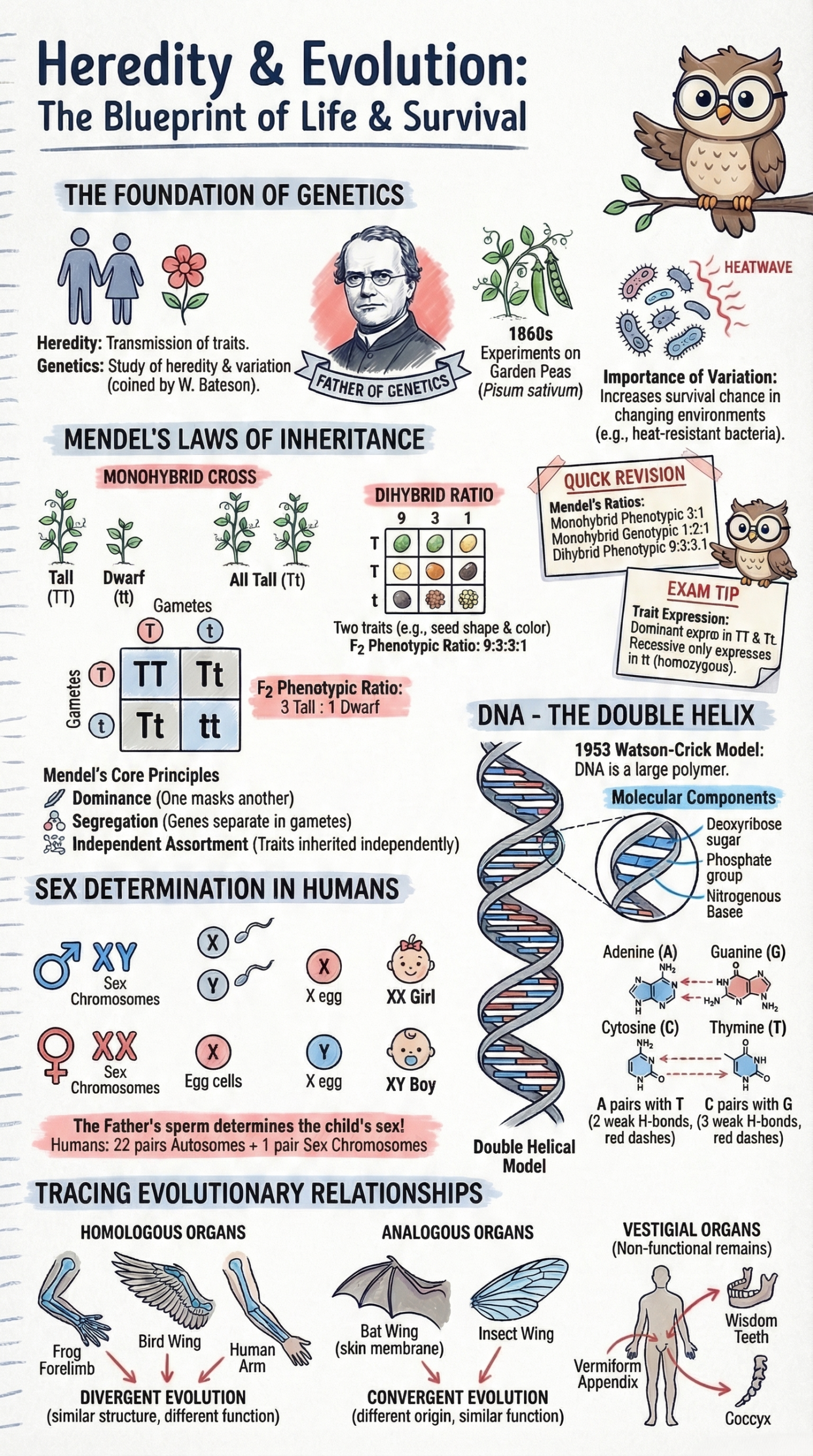
Phenotypic Ratio: 3 Tall : 1 Dwarf
Genotypic Ratio: 1 TT : 2 Tt : 1 tt
Observations:
- F₁ generation showed only tall plants dominance of tall over dwarf.
- F₂ generation showed both tall and dwarf in 3:1 ratio.
- Dwarfness "disappeared" in F₁ but reappeared in F₂ proving traits are not blended but retained separately.
Mendel's Conclusion: This led to the Principle of Dominance and the Principle of Segregation.
Dihybrid Cross
A cross in which two pairs of contrasting characters are studied simultaneously.
Experiment: Round Yellow (RRYY) × Wrinkled Green (rryy)
P Generation: RRYY (Round, Yellow) × rryy (Wrinkled, Green) Gametes: RY ry ↓ F₁ Generation: RrYy (All Round, Yellow) F₁ × F₁ (Self Pollination): RrYy × RrYy F₂ Phenotypic Ratio: 9 Round Yellow : 3 Round Green : 3 Wrinkled Yellow : 1 Wrinkled Green
Finding: Two new combinations (Round Green, Wrinkled Yellow) appeared in F₂, which were not present in the original parents. This proved genes assort independently during gamete formation.
Mendel's Conclusion: This led to the Principle of Independent Assortment.
Laws of Inheritance (Mendelism)
Important Definitions
| Term | Definition |
|---|---|
| Chromosomes | Thread-like structures in the nucleus containing hereditary information |
| DNA (Deoxyribonucleic Acid) | Chemical in chromosomes that carries hereditary traits in coded form |
| Gene / Mendelian Factor | Unit of heredity transferring traits from parents to offspring |
| Alleles | Two alternate forms of a gene lying on homologous chromosomes (e.g., T and t) |
| Dominant Allele | Expresses itself even in the presence of an alternative allele (e.g., T in Tt) |
| Recessive Allele | Expresses only in homozygous condition (e.g., t in tt) |
| Genotype | Genetic constitution of an organism (e.g., TT, Tt, tt) |
| Phenotype | Observable/external characteristic of an organism (e.g., Tall, Dwarf) |
| Homozygous | Both alleles of a gene are identical (e.g., TT or tt) |
| Heterozygous | Both alleles of a gene are different (e.g., Tt) |
| Genome | Complete set of chromosomes where every gene is found singly (as in a gamete) |
Mendel's Four Laws
(i) Law of Paired Factors (Unit Factors)
Each trait of an individual is determined by two factors (genes). The alternative form of a gene is called an allele.
(ii) Law of Dominance
Of two alleles, only one expresses itself (dominant) in the organism; the other remains hidden (recessive). The dominant allele produces an effective protein for its expression.
(iii) Law of Segregation (Law of Purity of Gametes)
A pair of contrasting factors (alleles) remains together in the organism but separates (segregates) during gamete formation. Each gamete carries only one allele for each trait.
- Basis: Monohybrid cross
(iv) Law of Independent Assortment
When two or more genes are inherited, their distribution into gametes and in the offspring of subsequent generations is independent of each other (each gene pair assorts independently).
- Basis: Dihybrid cross
Back Cross vs. Test Cross
| Type | Definition |
|---|---|
| Back Cross | A cross between a hybrid (F₁) and one of its parents (TT or tt) |
| Test Cross | A cross between an organism of unknown genotype and a homozygous recessive organism (tt) to determine the unknown genotype |
Exceptions to Mendelism
Incomplete Dominance
Discovered by Correns (1903). When neither allele is fully dominant, the F₁ hybrid shows an intermediate phenotype — a blend between the two parent traits.
Example: Snapdragon (Antirrhinum majus) / Four O'Clock plant (Mirabilis jalapa)
- Red (RR) × White (rr) → F₁: All Pink (Rr)
- F₂ (selfing): 1 Red (RR) : 2 Pink (Rr) : 1 White (rr)
Distinction: Incomplete dominance is NOT blending inheritance the original red and white phenotypes reappear in F₂ generation.
Phenotypic Ratio = Genotypic Ratio = 1:2:1
Co-dominance and Multiple Allelism
Co-dominance: Both alleles express themselves fully and simultaneously in the heterozygous condition no new phenotype is produced. Example: Blood Group AB (Iᴬ Iᴮ).
Multiple Allelism: When a gene has more than two allelic forms in a population. ABO blood group system is controlled by three alleles: Iᴬ, Iᴮ, and Iᴼ.
ABO Blood Group Inheritance
| Genotype | Blood Group (Phenotype) |
|---|---|
| Iᴬ Iᴬ or Iᴬ Iᴼ | A |
| Iᴮ Iᴮ or Iᴮ Iᴼ | B |
| Iᴬ Iᴮ | AB |
| Iᴼ Iᴼ | O |
- Iᴬ and Iᴮ are both dominant over Iᴼ
- Iᴬ and Iᴮ are co-dominant to each other
- Blood groups are determined by glycoprotein antigens on the surface of RBCs
Differences Between Dominance vs. Incomplete Dominance
| Feature | Dominance | Incomplete Dominance |
|---|---|---|
| F₁ resemblance | Similar to dominant parent | Different from both parents |
| Phenotypic:Genotypic ratio | Different | Same (1:2:1) |
| Dominant trait expression in F₁ | Complete | Incomplete |
| Alleles required | Single dominant allele (Tt) suffices | Two alleles (RR) needed for full expression |
Differences Between Incomplete Dominance vs. Co-dominance
| Feature | Incomplete Dominance | Co-dominance |
|---|---|---|
| Expression of alleles | One more conspicuous than other | Both equally conspicuous |
| Mixing of effects | Fine mixture produced | No mixing — both expressed independently |
| New phenotype | Produced (e.g., pink) | Not produced |
Structure of DNA
Discovery and Model
- DNA was first isolated by Friedrich Miescher (1869) from pus cells. He named it nuclein.
- The Double Helix Model was proposed by Watson, Crick, and Wilkins in 1953 the most widely accepted model of DNA structure.
Structural Features of DNA
DNA is a large polymer; its units are called deoxyribonucleotides.
Each deoxyribonucleotide has three components:
- Deoxyribose sugar (C₅H₁₀O₄)
- Phosphate group
- A nitrogenous base (one of four types)
Four nitrogenous bases:
- Purines: Adenine (A) and Guanine (G)
- Pyrimidines: Cytosine (C) and Thymine (T)
Nucleotides are joined by phosphodiester bonds forming a polynucleotide chain with a 5' end and a 3' end.
DNA has two antiparallel polynucleotide chains one runs 3'→5', the other runs 5'→3'.
The two strands are held by weak hydrogen bonds between complementary base pairs:
- A–T: 2 hydrogen bonds
- C–G: 3 hydrogen bonds
The double helix coils around a central axis for maximum stability.
- Distance between base pairs: 0.34 nm
- Distance per turn of coil: 3.4 nm (10 base pairs per turn)
- Diameter of DNA molecule: 2 nm
RNA Comparison: RNA contains uracil instead of thymine and consists of a single polynucleotide chain.
Sex Determination in Humans
Sex Chromosomes and Autosomes
- Human cells contain 46 chromosomes (23 pairs).
- 22 pairs are autosomes; 1 pair are sex chromosomes.
- Females: 44 autosomes + XX (homogametic)
- Males: 44 autosomes + XY (heterogametic)
Mechanism of Sex Determination
Mother (XX) Father (XY)
↓
Gametes: X (eggs) or X (sperm) / Y (sperm)
X (sperm) + X (egg) = XX → Female
Y (sperm) + X (egg) = XY → Male
- All eggs carry X chromosome mother always contributes X.
- Sperm carry either X or Y father determines the sex of the child.
- A child inheriting X from father → Girl (XX)
- A child inheriting Y from father → Boy (XY)
Important: The sex of a child is determined entirely by the father's contribution, not the mother's. This has significant social implications regarding blame for the sex of offspring.
Evolution – Origin of Life
What is Evolution?
Evolution is defined as a gradual change in the forms of life from simple to complex, giving rise to the existing diversity of life. The word derives from the Latin evolvere to unroll or unfold.
Theories on the Origin of Life
| Theory | Proposed By | Core Idea |
|---|---|---|
| Spontaneous Generation (Abiogenesis) | Aristotle (384–322 BC) | Life arises spontaneously from non-living matter (disproved by Pasteur, 1862) |
| Special Creation | Father Suarez (1600) | God created all life in 6 days |
| Catastrophism | Cuvier (1800) | Life is continuously created, destroyed, and recreated |
| Cosmozoic / Panspermia | Richter / Arrhenius | Life reached Earth as spores from other planets |
| Chemical (Naturalistic) Theory / Primary Abiogenesis | Oparin (1923) and Haldane (1929) | Life originated from chemical reactions on primitive Earth |
Oparin-Haldane Theory (Most Accepted)
Alexander Oparin (1923) and J.B.S. Haldane (1929) independently proposed that life arose from inanimate matter through a series of chemical reactions:
- Free atoms → Inorganic molecules (H₂, N₂, NH₃, CH₄, CO₂, H₂O)
- Inorganic → Simple organic molecules (sugars, amino acids, fatty acids, purines, pyrimidines)
- Simple → Complex organic molecules (polymers)
- Polymers → Aggregates (Protobionts)
- Protobionts → First living cells → Prokaryotes → Eukaryotes → Plants and Animals
Miller-Urey Experiment (1953) - Experimental Support
Stanley L. Miller and Harold C. Urey simulated primitive Earth conditions:
- Circulated CH₄, NH₃, H₂ (ratio 2:2:1) and water vapour
- Maintained temperature just below 100°C
- Applied electrical sparks (simulating lightning) as energy source
- Result: After one week, 15% of the carbon was converted to amino acids, sugars, purines, and pyrimidines the building blocks of life.
Darwin's Theory of Natural Selection
Darwinism
Charles Darwin proposed the theory of descent with modification and published The Origin of Species outlining the Theory of Natural Selection.
Pinciples:
- Variation exists in nature.
- Organisms with advantageous variations adapt better and pass those traits to the next generation.
- The struggle for survival within a population eliminates unfit individuals survival of the fittest.
- Darwin observed this while studying birds of the Galapagos Islands.
- Limitation: Darwin had no explanation for how variations arose.
Lamarckism
Jean-Baptiste Lamarck proposed the Theory of Inheritance of Acquired Characters (Philosophie Zoologique):
- Use and disuse of an organ leads to change in that organ.
- These acquired changes are inherited by offspring.
- Disproved by August Weismann — even after cutting mouse tails for 21 generations, no tailless mice were born.
Haeckel's Biogenetic Law
Proposed The Theory of Recapitulation (Biogenetic Law): Ontogeny repeats phylogeny an organism repeats its ancestral history during embryonic development.
Speciation and Genetic Drift
Speciation
Speciation is the formation of one or more new species from an existing species.
| Mode | Description |
|---|---|
| Allopatric Speciation | Occurs when a population splits into geographically isolated sub-populations |
| Sympatric Speciation | Occurs within a single population without geographical isolation |
Genetic Drift
Genetic Drift is the random change in gene frequency occurring by chance alone, irrespective of whether it is beneficial or harmful.
- More pronounced in small populations.
- Can lead to fixation of unfavourable characters or loss of beneficial ones.
- Works alongside natural selection to drive evolution.
Natural Selection
Natural selection leads to changes in gene frequencies and favours adaptation as a product of evolution. Together, genetic drift and natural selection result in increasingly different isolated sub-populations eventually forming new species incapable of interbreeding.
Tracing Evolutionary Relationships
Homologous Organs
Organs with similar basic structure and origin but performing different functions due to adaptation. They indicate common ancestry (divergent evolution).
Examples:
- Forelimbs of frog, lizard, bird, and human same pentadactyl structure, different functions.
- Thorn of Bougainvillea and tendril of Passiflora both modified branches (stems), different functions.
Analogous Organs
Organs with different origin and basic structure but performing similar functions. They indicate convergent evolution.
Example:
- Wings of insects, bats, and birds all used for flying, but structurally completely different.
Vestigial Organs
Reduced, non-functional organs in an organism that correspond to fully developed, functional organs in related organisms. Human vestigial organs (~180) include: nictitating membrane, coccyx (tail bone), vermiform appendix, wisdom teeth, body hair, ear muscles.
Differences: Homologous vs. Analogous Organs
| Feature | Homologous | Analogous |
|---|---|---|
| Appearance | Usually different | Generally similar |
| Function | Different | Same |
| Basic structure/origin | Similar | Different |
| Organisms | Related | Unrelated |
| Evolution type | Divergent | Convergent |
Fossils and Their Significance
What Are Fossils?
Fossils (Latin: fossilis dug up) are remains, traces, and impressions of past organisms found in sedimentary rocks, peat, amber, lava, and snow.
The study of fossils is called Palaeontology. Fossils are called written documents of evolution as they provide direct evidence.
Fossilisation
- Occurs in environments with little oxygen where decay is slow: bogs, lava, deep water, hot mud, acidic environments.
- Most fossils are found in sedimentary rocks.
Archaeopteryx — The Missing Link
- Lived about 180 million years ago.
- Size of a crow had features of both reptiles and birds.
- Bird features: feathers, wings.
- Reptile features: teeth, clawed fingers, solid bones, long tail.
- Also called lizard bird a classic connecting link between reptiles and birds.
Determining the Age of Fossils
| Method | Principle |
|---|---|
| Relative Dating | Fossils in deeper rock layers are older |
| Absolute Dating (Radioactive Dating) | Analysis of radioactive isotopes (¹⁴C carbon dating for recent fossils; uranium-lead or potassium-argon for older ones) |
Embryological Evidence
- Early embryos of fish, salamander, tortoise, chick, rabbit, and humans are strikingly similar, suggesting common ancestry.
- Ernst Haeckel's Biogenetic Law: Ontogeny recapitulates phylogeny an organism repeats its ancestral history during embryonic development.
Human Evolution
The study of human evolution and culture is called Anthropology.
Classification of Humans
| Taxonomic Rank | Classification |
|---|---|
| Phylum | Chordata |
| Sub-phylum | Vertebrata |
| Class | Mammalia |
| Order | Primates |
| Family | Hominidae |
| Genus | Homo |
| Species | sapiens |
Evolutionary Stages of Humans
| Stage | Time Period | Key Features |
|---|---|---|
| Dryopithecus (Ape-like man) | ~25 million years ago | Ape-like ancestor |
| Ramapithecus | 14–15 million years ago | Earliest man-like primate; fossil from Siwalik Hills, India |
| Australopithecus africanus (First Ape-man) | ~4 million years ago | Bipedal, small brain |
| Homo habilis (Able/Skillful Man) | ~2 million years ago | First tool-user; lived in Africa |
| Homo erectus (Erect Man) | ~1.7 million years ago | Migrated to Asia and Europe |
| Homo sapiens neanderthalensis (Neanderthal Man) | ~1,00,000 years ago | Appeared in North Africa; used fire |
| Homo sapiens fossils (Cro-Magnon Man) | ~35,000 years ago | Peak of stone age; successors to Neanderthals |
| Homo sapiens sapiens (Modern Man) | ~10,000 years ago | Spread across the world |
Fact: Humans did NOT evolve from chimpanzees. Both humans and chimpanzees evolved from a common ancestor. Evolution is not a ladder of progress it is a branching tree.
Pedigree Analysis
What is Pedigree Analysis?
A pedigree is a record of inheritance of genetic traits for two or more generations, presented as a family tree diagram. The starting individual is called the proband or propositus.
Common Pedigree Symbols
| Symbol | Meaning |
|---|---|
| Square (□) | Male |
| Circle (○) | Female |
| Solid/filled symbol | Affected individual (trait under study) |
| Open/clear symbol | Unaffected/normal individual |
| Half-filled symbol | Carrier of a recessive allele |
| Horizontal line between □ and ○ | Mating/Marriage |
| Vertical line below couple | Offspring |
| Roman numerals (I, II, III) | Generations |
| Arabic numerals (1, 2, 3) | Individuals within a generation |
Human Genetic Disorders Due to Chromosomal Abnormalities
| Disease | Genotype |
|---|---|
| Down's Syndrome | Trisomy of chromosome 21 |
| Turner's Syndrome | 44 + XO (females only) |
| Klinefelter's Syndrome | 44 + XXY (males only) |
Evolution and Classification
- Classification groups organisms based on similarities and differences, reflecting evolutionary relationships.
- Primitive organisms (e.g., bacteria) originated first, changed little.
- Advanced organisms (e.g., primates) originated later, changed significantly.
- The cell is the primary and basic unit of classification.
- First division of organisms: Prokaryotic vs. Eukaryotic.
Heredity and Evolution Chapter Solved Examples
Q. What is the phenotypic ratio in the F₂ generation of a monohybrid cross between pure tall (TT) and pure dwarf (tt) pea plants?
A: F₁ = all Tt (Tall). F₁ × F₁ = Tt × Tt. F₂ Punnett Square gives: TT, Tt, Tt, tt. Phenotypic ratio = 3 Tall : 1 Dwarf
Q. In a monohybrid cross, what is the genotypic ratio in F₂ generation?
A: TT : Tt : tt = 1 : 2 : 1 (1 homozygous tall : 2 heterozygous tall : 1 homozygous dwarf)
Q. What is the phenotypic ratio in the F₂ generation of a dihybrid cross?
A:9 : 3 : 3 : 1 (9 Round Yellow : 3 Round Green : 3 Wrinkled Yellow : 1 Wrinkled Green)
Q. A man with blood group A (homozygous IᴬIᴬ) marries a woman with blood group O (IᴼIᴼ). What blood groups will their children have?
A: Cross: IᴬIᴬ × IᴼIᴼ → All offspring = IᴬIᴼ → All children will have Blood Group A (heterozygous).
Q. A man with blood group AB (IᴬIᴮ) marries a woman with blood group AB (IᴬIᴮ). What blood groups are possible in their children?
A: Possible genotypes: IᴬIᴬ (25% Group A), IᴬIᴮ (50% Group AB), IᴮIᴮ (25% Group B). Children can have blood groups A, AB, or B. Group O is NOT possible.
Q. In snapdragon, red-flowered (RR) plants are crossed with white-flowered (rr) plants. What will be the F₂ phenotypic ratio?
A: F₁ = all Rr (Pink). F₂ = 1 RR (Red) : 2 Rr (Pink) : 1 rr (White). Phenotypic ratio = 1 Red : 2 Pink : 1 White
Q. A man with blood group B (IᴮIᴮ) marries a woman with blood group O (IᴼIᴼ). What are the possible blood groups of their children?
A: IᴮIᴮ × IᴼIᴼ → All offspring = IᴮIᴼ → All children will have Blood Group B.
Q. What will be the sex of a child who inherits an X chromosome from the father?
A: A child inheriting X from the father also inherits X from the mother (all eggs are X). The zygote becomes XX → Female (Girl).
Q. What is the difference between genotype and phenotype? Give examples.
A:
- Genotype = genetic makeup; e.g., TT, Tt, tt (not directly visible)
- Phenotype = observable trait; e.g., Tall, Tall, Dwarf (visible) Note: TT and Tt have the same phenotype (Tall) but different genotypes.
Q. Why did Mendel's work remain unrecognised for 34 years (1866–1900)?
A: Mendel's paper was published in a relatively obscure local journal (Proceedings of Brunn Natural Science Society) and was ahead of its time. The scientific community lacked the conceptual framework (chromosomes, DNA) to appreciate his statistical approach. His work was rediscovered in 1900 by de Vries, Correns, and Tschermak.
Q. A trait A exists in 10% of a population and a trait B exists in 60% of the same population in an asexually reproducing species. Which trait arose earlier?
A: Trait B arose earlier. In asexual reproduction, variations accumulate slowly over generations. The more widespread a trait, the longer it has been present.
Q. Explain why acquired traits cannot be inherited. Give an example.
A: Acquired traits affect somatic (body) cells only the DNA of germ cells is unchanged. Lamarck's experiment was disproved by Weismann: after cutting mouse tails for 21 generations, tailless mice were never born. Acquired changes (like a bodybuilder's muscles) do not alter the germline DNA passed to offspring.
Q. What are the hydrogen bonding details between DNA base pairs?
A:
- Adenine (A) — Thymine (T): 2 hydrogen bonds
- Cytosine (C) — Guanine (G): 3 hydrogen bonds This complementary base pairing ensures accurate DNA replication.
Q. Differentiate between homologous and analogous organs with one example each.
A:
- Homologous: Same origin/structure, different function. Example: Forelimbs of human (grasping) and bird (flying) same pentadactyl bone structure.
- Analogous: Different origin/structure, same function. Example: Wings of butterfly (chitinous extensions) and wings of bat (skin folds between elongated fingers) both used for flight.
Q. What is Archaeopteryx and why is it significant in evolution?
A: Archaeopteryx is a fossil organism that lived ~180 million years ago. It had characteristics of both reptiles (teeth, clawed fingers, solid bones, long tail) and birds (feathers, wings). It serves as a connecting link between reptiles and birds, providing direct fossil evidence of evolution.
Q. How does natural selection differ from genetic drift?
A:
- Natural Selection is a directed process traits beneficial to survival and reproduction are selected for, improving adaptation.
- Genetic Drift is a random process gene frequencies change by chance alone, regardless of whether the change is beneficial or harmful. It has a greater impact in small populations.
Q. If a human male has the genotype 44A + XY, what gametes will he produce?
A: During meiosis, the male produces two types of sperm:
- (22A + X) — carrying X chromosome
- (22A + Y) — carrying Y chromosome The 50:50 ratio of X and Y sperm is what determines sex in approximately equal proportions.
Q. What is the Miller-Urey experiment and what did it prove?
A: In 1953, Stanley Miller and Harold Urey simulated primitive Earth conditions. They circulated CH₄, NH₃, H₂, and water vapour, applied electrical sparks, and found amino acids, sugars, purines, and pyrimidines formed within a week. This supported the Oparin-Haldane theory that the building blocks of life can form from inorganic molecules under abiotic conditions.
Q. A person with blood group AB marries a person with blood group O. List the possible blood groups of their children.
A: IᴬIᴮ × IᴼIᴼ → Gametes from AB parent: Iᴬ and Iᴮ; gametes from O parent: Iᴼ only. Offspring: IᴬIᴼ (Blood Group A) and IᴮIᴼ (Blood Group B). Possible blood groups in children: A and B only (50% each). AB and O are NOT possible.
Q. Distinguish between allopatric and sympatric speciation.
A:
- Allopatric Speciation: New species form when populations are geographically isolated (e.g., a river separates a beetle population). Gene flow is blocked; populations diverge.
- Sympatric Speciation: New species form within the same geographic area, without physical separation, due to ecological, behavioural, or genetic barriers.
Heredity and Evolution Class 10 Quick Revision Summary
| Topic | Point |
|---|---|
| Heredity | Transmission of traits from parent to offspring |
| Father of Genetics | Gregor Johann Mendel |
| Mendel's plant | Garden pea (Pisum sativum) |
| Monohybrid F₂ ratio | 3:1 (Phenotypic); 1:2:1 (Genotypic) |
| Dihybrid F₂ ratio | 9:3:3:1 (Phenotypic) |
| DNA model | Double Helix (Watson & Crick, 1953) |
| Sex determination | Determined by father (X or Y chromosome in sperm) |
| Females | XX (homogametic) |
| Males | XY (heterogametic) |
| Miller-Urey | Proved organic molecules can form from inorganic ones |
| Genetic Drift | Random change in gene frequency |
| Homologous organs | Same origin, different function (divergent evolution) |
| Analogous organs | Different origin, same function (convergent evolution) |
| Archaeopteryx | Connecting link between reptiles and birds |
| First humans | Homo habilis (~2 million years ago) |
| Modern humans | Homo sapiens sapiens (~10,000 years ago) |