
Control and Coordination Class 10 Biology Notes: In biology, every living organism needs a proper system to manage and respond to changes happening inside the body and in the environment. This process is called control and coordination. In the chapter Control and Coordination Class 10 Biology Notes, students learn how the body controls different activities and how organs work together to maintain balance and proper functioning.
The control and coordination class 10 Chapter 6 Notes mainly explain the role of the nervous system, brain, spinal cord, neurons, and hormones in regulating body activities. These systems help the body react to stimuli such as light, sound, heat, or touch. For example, when we touch a hot object, the nervous system quickly sends signals to the brain and muscles so that we remove our hand immediately. This is an example of a reflex action.
In addition to the nervous system, the endocrine system also plays an important role in coordination by releasing hormones that control growth, development, and metabolism. Understanding these concepts through control and coordination class 10 notes helps students build a strong base for higher biology studies.
These Control and Coordination Class 10 Biology Notes are prepared in simple language so that students can easily understand the key ideas of the chapter. Many students also search for control and coordination class 10 notes pdf to revise quickly before exams, and these notes can be helpful for quick revision and concept clarity. Sometimes students feel this chapter is little confusing at first, but with proper explanation it becomes much easier.
What is Control and Coordination?
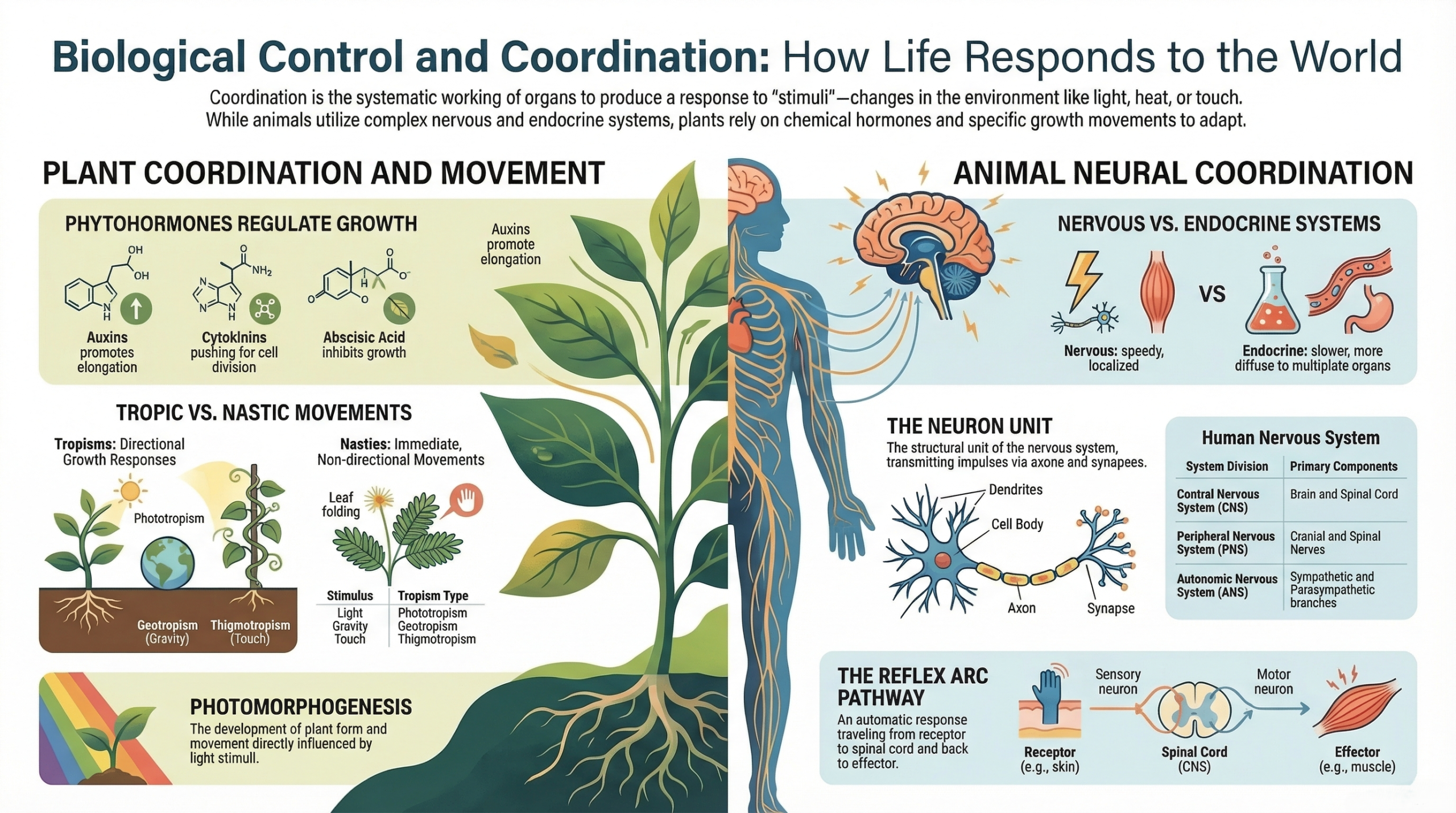
Control and Coordination refers to the systematic working together of an organism's organs to produce appropriate responses to changes in the environment.
- The environment constantly changes temperature, light, seasons and organisms must adapt to survive.
- Stimuli are changes in the internal or external environment that provoke a physiological or behavioural response.
- Examples of stimuli: light, heat, cold, sound, touch, chemicals.
- The organism's response to a stimulus is characteristic of that species.
- For a proper response, different parts of the body must work in coordination.
Definition: Coordination is the working of various organs of an organism in a systematic manner to produce a proper response to stimuli.
CBSE Class 10 Biology Chapter 6 Control and Coodination Revision Notes PDF
Fill the form to download this PDF
Difference between Plants vs Animals
| Feature | Plants | Animals |
|---|---|---|
| Mechanism | Chemical (hormones/tropism) | Nervous + Endocrine systems |
| Speed of response | Slow | Fast |
| Movement | Non-locomotory, localised | Locomotory |
| Examples | Stomata closure, bending toward light | Reflex action, walking |
Coordination in Plants
Plants lack a nervous system, muscles, and sense organs. Yet they respond effectively to stimuli such as light, gravity, water, touch, and chemicals.
- Plants use chemical messengers called phytohormones for coordination.
- Directional movements in response to stimuli are called tropisms.
- A stimulus is defined as any change in the internal or external environment that provokes a physiological and behavioural response.
Phytohormones (Plant Hormones)
Phytohormones are naturally occurring organic chemical substances produced in plants that regulate one or more physiological processes even when present in very low concentrations. They are also called Plant Growth Regulators (PGR).
Classification of Plant Hormones
Plant Hormones
- Growth Promoters
- Auxins (IAA)
- Gibberellins
- Cytokinins
- Growth Inhibitors
- Abscisic Acid (ABA)
Functions of Major Plant Hormones
| Hormone | Key Functions |
|---|---|
| Auxins (IAA) | Cell elongation and differentiation; shoot and fruit growth; regulates tropisms; induces parthenocarpy (seedless fruits) |
| Gibberellins | Promote cell enlargement in the presence of auxins; stem and fruit growth; parthenocarpy |
| Cytokinins | Promote cell division; break dormancy of seeds and buds; promote stomatal opening; fruit growth |
| Ethylene | Promotes growth and ripening of fruits (only gaseous hormone) |
| Abscisic Acid (ABA) | Promotes dormancy in seeds/buds; promotes stomatal closing (wilting); leaf abscission; stress response |
Three Stages of Plant Growth
- Cell Division
- Cell Enlargement
- Cell Differentiation
Note: Dormancy is the state of rest in which metabolism is stopped. Seeds remain dormant for a period before germinating.
General Functions of Plant Hormones
- Germination of seeds (breaking dormancy)
- Growth of roots, stems, and leaves
- Flowering and fruiting
- Ripening of fruits
- Movement of stomata
- Phototropism, geotropism, chemotropism, and nastic movements
Effects of Light on Plant Development
The effect of light on plant development is called photomorphogenesis.
- Plants contain a pigment called phytochrome that absorbs red and far-red light.
- Many developmental processes are mediated by low intensities of red light.
Phytochrome-Controlled Phenomena
| Process | Effect of Red Light |
|---|---|
| Germination | Promotes seed germination (e.g., lettuce) |
| Photomorphogenesis | Leaf expansion, chloroplast development, inhibition of etiolation |
| Photoperiodism | Stimulates long-day plants; inhibits short-day plants |
Etiolated Plant: When a plant grows in the dark, it appears pale yellow, with elongated, thin internodes. This is called an etiolated plant. It allows maximum growth with minimum reserve food.
Photoperiodism and Flowering
The response of plants to the duration of light (day length) is called photoperiodism.
| Plant Type | Flowering Condition | Examples |
|---|---|---|
| Short-day Plants | Require dark periods longer than a critical length | Tobacco, Chrysanthemum, Strawberry, Soybean |
| Long-day Plants | Require dark periods shorter than a critical length | Henbane, Cabbage, Snapdragon, Spring wheat |
| Day-neutral Plants | Flowering is independent of photoperiod | Cucumber, Tomato, Garden pea, Maize, Cotton |
Tropism – Types and Examples
Tropism (or Tropic Movement) is a directional movement or orientation of a specific plant part in response to an external stimulus.
- Positive tropism – growth toward the stimulus
- Negative tropism – growth away from the stimulus
Types of Tropism
| Stimulus | Type of Tropism | Example |
|---|---|---|
| Light | Phototropism | Shoot bends toward light (+); roots bend away (−) |
| Gravity | Geotropism | Root grows downward (+); shoot grows upward (−) |
| Chemical | Chemotropism | Pollen tube grows toward ovule |
| Water | Hydrotropism | Roots grow toward water (+) |
| Touch | Thigmotropism | Tendrils coil around support (+) |
Role of Auxin in Tropism
Auxin hormone is synthesised at the tip of the stem. When a plant receives unilateral light:
- Auxin migrates from the lit side to the shaded (dark) side.
- The shaded side accumulates more auxin → cells elongate more rapidly.
- The stem bends toward the light source — this is positive phototropism.
In thigmotropism (e.g., pea tendrils):
- When a tendril touches a support, auxin diffuses to the side away from the support.
- That side grows faster, causing the tendril to coil around the support.
Nastic Movements
Nastic movements (nasties) are non-directional movements of a plant part in response to an external stimulus where the direction of movement is not determined by the direction of the stimulus.
Types
Thigmonasty – Non-directional movement in response to touch.
- Example: Mimosa pudica (Touch-me-not) leaves fold when touched due to sudden loss of water from pad-like swellings called pulvini at the base of leaves, causing loss of turgor pressure.
Photonasty – Non-directional movement in response to light.
- Example: Dandelion flowers open in bright morning light and close in the evening.
Nastic vs Tropic Movements
| Feature | Nastic Movements | Tropic Movements |
|---|---|---|
| Growth dependency | Growth-independent | Growth-dependent |
| Speed | Immediate | Slow |
| Direction of response | Non-directional | Directional |
| Cause | Change in turgor pressure | Cell division/elongation |
| Examples | Mimosa leaf folding, stomatal movement | Phototropism, geotropism |
Coordination in Animals
In animals, coordination operates through two integrated systems:
- Nervous System – Composed of specialised cells called neurons that send electrical signals (nerve impulses). Control is speedy and localised.
- Endocrine System – Composed of specialised endocrine glands that release chemical messengers (hormones) into the bloodstream. Control is slower but diffuse.
The Human Nervous System
The human nervous system is the most complex nervous system known. It is divided into:
Nervous System
- Central Nervous System (CNS)
- Brain
- Spinal Cord
- Peripheral Nervous System (PNS)
- Cranial Nerves (12 pairs)
- Spinal Nerves (31 pairs)
- Autonomic Nervous System (ANS)
- Sympathetic
- Parasympathetic
Nervous Systems in Lower Animals
- Cnidarians (Hydra, Jellyfish): Simplest nervous organisation — a net of nerve cells and fibres. No brain.
- Insects: Small centralised brain + ganglia + nerve cord.
Types of Nerves
| Nerve Type | Direction | Function |
|---|---|---|
| Sensory (Afferent) | Receptor → Brain | Carries impulses from receptors to CNS |
| Motor (Efferent) | Brain → Effector | Carries impulses from CNS to muscles/glands |
| Mixed | Both directions | Both sensory and motor fibres (e.g., most cranial and spinal nerves) |
Structure of a Neuron
The neuron is the structural and functional unit of the nervous system.
Parts of a Neuron
| Part | Description | Function |
|---|---|---|
| Cell Body (Cyton/Soma) | Star-shaped; contains nucleus, neuroplasm, Nissl's granules (rough ER) | Metabolic centre; protein synthesis |
| Dendrites | Short, branched processes from cell body | Receive nerve impulses → toward cell body (afferent) |
| Axon | Single long cylindrical process | Conducts impulses away from cell body (efferent) |
Layers Covering the Axon
- Axolemma – innermost layer
- Myelin Sheath (Medullary Sheath) – middle insulating layer; speeds up impulse conduction
- Neurilemma – outermost protective layer (Schwann cells)
Terms
- Nodes of Ranvier – Gaps between adjacent myelin sheaths; allow saltatory conduction (nerve impulse "jumps" between nodes)
- Myelinated fibres – Conduct impulses at twice the speed of non-myelinated fibres
- Synaptic knobs – Terminal branches of axon; contain neurotransmitters
Types of Neurons by Function
- Sensory neurons – Transmit impulses from sensory cells to CNS
- Motor neurons – Transmit impulses from CNS to effectors (muscles/glands)
- Relay (Interneurons) – Connect sensory and motor neurons within CNS
Receptors
Receptors are specialised cells in sense organs that detect specific stimuli:
- Photoreceptors – sensitive to light
- Phonoreceptors – sensitive to sound
- Tangoreceptors – sensitive to touch
- Olfactoreceptors – sensitive to smell
- Thermoreceptors – sensitive to heat and cold
Synapse and Nerve Impulse Transmission
A synapse is the microscopic gap between the terminal end of one axon and the dendrite of the next neuron. It acts as a one-way valve impulses travel in only one direction.
How Impulse Crosses a Synapse
- Nerve impulse reaches the terminal end of the axon.
- Neurotransmitters (e.g., Acetylcholine, Adrenaline) are released from synaptic vesicles.
- Neurotransmitters cross the synaptic cleft.
- They bind to receptors on the next neuron's dendrite and trigger a new nerve impulse.
Types of Synapses: Electrical synapse and Chemical synapse.
Reflex Action and Reflex Arc
What is a Reflex Action?
A reflex action is a spontaneous, automatic, and mechanical response to a stimulus, controlled by the spinal cord without the involvement of the brain. It is the fastest type of response.
Examples:
- Withdrawing hand from a hot object
- Blinking when a particle enters the eye
- Sneezing or coughing
- Watering of mouth at the sight of food
- Knee-jerk reflex
Reflex Action Pathway
Stimulus → Receptor cells → Sensory nerve → Spinal Cord (Relay neuron) → Motor nerve → Effector (Muscle/Gland) → Response
Reflex Arc
The reflex arc is the complete pathway followed by a nerve impulse from receptor to effector.
Four Components of a Reflex Arc:
- Receptor – Sensory organ that detects the stimulus
- Sensory (Afferent) nerve – Carries impulse from receptor to spinal cord
- Relay neuron – In spinal cord; relays impulse from sensory to motor neuron
- Motor (Efferent) nerve – Carries impulse from spinal cord to effector
Types of Reflexes
| Type | Description | Example |
|---|---|---|
| Simple/Unconditioned Reflex | Inborn, unlearned, protective | Withdrawing hand from hot object |
| Conditioned Reflex | Acquired during lifetime | Salivating at the sound of a bell (Pavlov's dog) |
| Cerebral Reflex | Involves the brain | Pupil constriction in bright light |
The Brain – Structure and Functions
The brain (encephalon) is the highest coordinating centre of the body. It is protected by:
- Cranium (skull bones)
- Meninges – three protective membranes
- Cerebrospinal fluid (CSF) – acts as a shock absorber
Three Main Regions of the Brain
1. Forebrain (Prosencephalon)
| Part | Functions |
|---|---|
| Olfactory Lobes | Sense of smell (not well-developed in humans) |
| Cerebrum (largest part, ~2/3 of brain) | Memory, intelligence, reasoning, personality, consciousness. Divided into: Frontal (speech, higher thinking), Temporal (hearing), Parietal (taste, smell, touch), Occipital (vision) lobes. Connected by corpus callosum. |
| Thalamus | Relay centre for sensory/motor impulses; regulates emotions |
| Hypothalamus | Controls thirst, hunger, body temperature (thermoregulation), sleep, fear, osmoregulation |
2. Midbrain (Mesencephalon)
- Connects forebrain to hindbrain
- Controls reflex movements of head, neck, and eye muscles in response to visual/auditory stimuli
3. Hindbrain (Rhombencephalon)
| Part | Functions |
|---|---|
| Cerebellum (2nd largest) | Maintains posture and balance; coordinates smooth movements like walking, cycling, writing. White matter forms arbor vitae (tree of life). |
| Pons Varolli | Regulates respiration; relays impulses between medulla and higher brain |
| Medulla Oblongata | Controls involuntary actions: heart beat, blood pressure, breathing, salivation, peristalsis. Reflex centre for swallowing, sneezing, vomiting. |
Spinal Cord
- Cylindrical cord arising from medulla oblongata; runs through vertebral column
- Two functions:
- Conducts sensory and motor impulses to/from brain
- Acts as centre for reflex actions
Cerebrospinal Fluid (CSF)
- Clear, slightly alkaline fluid in ventricles and spinal cord canal
- Supplies nutrients and oxygen to CNS; removes waste; protects from mechanical shocks; reduces weight of brain
Autonomic Nervous System (ANS)
The ANS (visceral nervous system) controls involuntary functions of internal organs.
| Function | Sympathetic System | Parasympathetic System |
|---|---|---|
| Heart rate | Accelerates | Slows |
| Arteries | Constricts (raises BP) | Dilates (lowers BP) |
| Pupils | Dilates | Constricts |
| Bronchi | Dilates | Constricts |
| Urinary bladder | Relaxes | Constricts |
| Overall role | Prepares body for emergency ("fight or flight") | Restores normal conditions after emergency |
Chemical Coordination – Endocrine Glands and Hormones
Hormones are chemical messengers secreted by endocrine (ductless) glands directly into the bloodstream, transported to target organs.
Types of Glands
| Type | Description | Examples |
|---|---|---|
| Exocrine | Have ducts; secrete externally | Sweat glands, salivary glands |
| Endocrine (Ductless) | No ducts; secrete into blood | Pituitary, thyroid |
| Heterocrine (Mixed) | Both exocrine and endocrine | Pancreas, gonads |
Characteristics of Hormones
- Organic compounds
- Secreted in small amounts
- Poured directly into blood
- Act on specific target organs
- Act away from the site of production
- Used up during action (unlike enzymes)
- Can be slow or fast acting
Major Endocrine Glands
Hypothalamus
- Located in the brain
- Produces releasing hormones and inhibitory hormones to regulate the pituitary gland
- Controls homeostasis: thirst, hunger, body temperature, sleep, osmoregulation
Pituitary Gland (Master Gland / Hypophysis)
Located just below the brain. Has three lobes:
Anterior Lobe (6 hormones):
| Hormone | Function |
|---|---|
| FSH (Follicle-Stimulating Hormone) | Sperm formation (male); ovarian follicle growth (female) |
| LH (Luteinising Hormone) | Testosterone production (male); ovulation and progesterone (female) |
| STH/GH (Growth Hormone) | Promotes growth, protein synthesis, calcium retention |
| ACTH | Stimulates adrenal cortex |
| Prolactin (LTH) | Stimulates milk gland growth and milk secretion |
| TSH | Stimulates thyroid gland |
GH Disorders:
- Dwarfism – GH deficiency from early age
- Gigantism – GH excess during childhood
- Acromegaly – GH excess after adolescence
Intermediate Lobe:
- MSH (Melanocyte-Stimulating Hormone) – Controls skin pigmentation
Posterior Lobe:
- Oxytocin ("birth hormone") – uterine contractions; milk ejection
- Vasopressin (ADH) – reduces water loss in urine; raises blood pressure. Deficiency causes diabetes insipidus
Thyroid Gland (Largest Endocrine Gland)
Located in the neck; secretes:
- Thyroxine (T₄) and Triiodothyronine (T₃): Regulate basal metabolic rate (BMR); promote growth and mental development; metamorphosis in frogs; require iodine for synthesis
- Calcitonin: Regulates calcium-phosphorus balance
Thyroid Disorders:
| Disorder | Cause |
|---|---|
| Grave's Disease (Exophthalmic Goitre) | Hypersecretion of thyroxine |
| Cretinism | Hyposecretion in infants |
| Myxoedema | Hyposecretion in adults |
| Iodine Deficiency Goitre | Iodine deficiency in diet |
Parathyroid Glands
- 4 small glands on posterior surface of thyroid
- Secrete Parathormone (PTH) raises blood calcium when levels are low
- PTH and Calcitonin act antagonistically to regulate calcium-phosphorus balance
Adrenal Glands (Glands of Emergency / Suprarenals)
Located on top of each kidney. Two distinct parts:
Adrenal Cortex:
| Hormone | Function |
|---|---|
| Mineralocorticoids (e.g., Aldosterone) | Regulates sodium/potassium balance and blood volume |
| Glucocorticoids (e.g., Cortisol) | Regulates carbohydrate, protein, fat metabolism; anti-inflammatory |
| Sex Corticoids | Secondary sexual characters |
Adrenal Medulla:
- Adrenaline (Epinephrine) and Noradrenaline – "Fight or Flight" hormones
- Released in large amounts during stress/danger
- Effects: ↑ heart rate, ↑ breathing rate, ↑ blood sugar, ↑ blood pressure, redirects blood to muscles
Pancreas
Located below the stomach. Islets of Langerhans (endocrine cells) secrete:
- Insulin (β-cells) – Lowers blood glucose level
- Glucagon (α-cells) – Raises blood glucose level
- Deficiency of insulin → Diabetes Mellitus (sugar in urine, excessive thirst, excessive urination)
Diabetes Mellitus vs Diabetes Insipidus:
| Feature | Diabetes Mellitus | Diabetes Insipidus |
|---|---|---|
| Hormone deficiency | Insulin | ADH |
| Blood sugar level | High | Normal |
| Sugar in urine | Yes | No |
Testes (Males only)
- Located in scrotum
- Leydig cells secrete Testosterone (under influence of LH)
- Functions: development of male accessory glands, secondary sexual characters, spermatogenesis
Ovaries (Females only)
- Located in abdomen
- Secrete:
- Estrogen – oogenesis; female secondary sexual characters; onset of menstrual cycle
- Progesterone – maintains pregnancy; uterine changes during menstrual cycle
- Relaxin – helps in easy childbirth (widening of pelvis)
Pineal Gland
- Located between cerebral hemispheres
- Secretes Melatonin regulates working of gonads
Thymus Gland
- Located in upper chest near heart
- Secretes Thymosin – stimulates development of lymphocytes; immunity
- Known as the seat of the immune system
Feedback Mechanism
The body regulates hormone levels through a feedback mechanism to prevent harmful effects of excess or deficiency.
Example – Blood Glucose Homeostasis:
Carbohydrate-rich meal
↓
Blood glucose level RISES
↓
Pancreas β-cells secrete INSULIN
↓
Insulin stimulates cells to take up glucose
↓
Blood glucose level FALLS
↓
Inhibits further insulin synthesis (negative feedback)
This is called negative feedback control it maintains homeostasis (stable internal environment).
Control and Coordination Solved Examples
Q. What are stimuli? Give two examples.
Ans. Stimuli are changes in the external or internal environment that provoke a physiological or behavioural response in an organism. Examples: light (causes phototropism), touch (causes Mimosa leaves to fold).
Q. Define phytohormones.
Ans. Phytohormones are naturally occurring chemical substances produced in plants that regulate physiological processes such as growth, differentiation, and development, even when present in very low concentrations.
Q. Why is auxin important in phototropism?
Ans. Auxin synthesised at the stem tip migrates to the shaded side when light comes from one direction. More auxin causes the shaded side cells to elongate faster, bending the stem toward the light positive phototropism.
Q. Name the gaseous plant hormone and its function.
Ans. Ethylene (Ethene) is the only gaseous plant hormone. It promotes growth and ripening of fruits.
Q. What is the difference between nastic and tropic movements?
Ans. Tropic movements are directional (toward or away from stimulus) and growth-dependent and slow. Nastic movements are non-directional, growth-independent, rapid, and caused by changes in turgor pressure (e.g., Mimosa folding).
Q. What is a synapse?
Ans. A synapse is the microscopic gap between the terminal end of one neuron's axon and the dendrite of the next neuron. It acts as a one-way valve; impulses are transmitted across it by chemical neurotransmitters such as acetylcholine.
Q. What is a reflex arc? Name its components.
Ans. A reflex arc is the pathway followed by a nerve impulse from receptor to effector during a reflex action. Components: (i) Receptor, (ii) Sensory/Afferent nerve, (iii) Relay neuron in spinal cord, (iv) Motor/Efferent nerve.
Q. State the functions of the cerebellum.
Ans. The cerebellum maintains posture and balance, and coordinates smooth voluntary movements such as walking in a straight line, riding a bicycle, and picking up objects.
Q. Why is adrenaline called the "emergency hormone"?
Ans. During stress or danger, adrenaline is released in large amounts. It increases heart rate, breathing rate, blood sugar level, and blood pressure, and redirects blood to muscles preparing the body for "fight or flight."
Q. What is diabetes mellitus? How does it differ from diabetes insipidus?
Ans. Diabetes mellitus results from insulin deficiency, causing high blood sugar and glucose excretion in urine. Diabetes insipidus results from ADH (vasopressin) deficiency, causing excessive water loss in urine with normal blood sugar levels.
Q. What is the role of iodine in thyroid function?
Ans. Iodine is essential for the synthesis of thyroid hormones thyroxine (T₄) and triiodothyronine (T₃). Iodine deficiency leads to enlargement of the thyroid gland called iodine deficiency goitre, prevented by iodised salt.
Q. What is the function of ADH (vasopressin)?
Ans. ADH (antidiuretic hormone), secreted by the posterior pituitary, reduces water loss by increasing water reabsorption in kidney tubules. It also constricts arterioles, raising blood pressure. Its deficiency causes diabetes insipidus.
Q. Why is the pituitary gland called the master endocrine gland?
Ans. The pituitary gland secretes hormones (TSH, ACTH, FSH, LH) that regulate other endocrine glands. However, the pituitary itself is regulated by the hypothalamus, making the hypothalamus-pituitary system the true master regulatory axis.
Q. Explain the role of insulin and glucagon in blood sugar regulation.
Ans. Insulin (from β-cells) lowers blood glucose by stimulating cells to absorb glucose. Glucagon (from α-cells) raises blood glucose by stimulating glycogen breakdown in the liver. They work antagonistically to maintain blood glucose homeostasis.
Q. What is geotropism? Explain with an experiment.
Ans. Geotropism is the directional growth of plant parts in response to gravity. When a potted plant is placed on its side, the stem bends upward (negative geotropism) and the root bends downward (positive geotropism) within a few days demonstrating geotropic responses mediated by auxin.
Q. What are the functions of the hypothalamus?
Ans. The hypothalamus controls: thirst, hunger, body temperature (thermoregulation), sleep patterns, fear, osmoregulation, and regulates pituitary hormone secretion via releasing and inhibitory hormones.
Q. Distinguish between sensory and motor neurons.
Ans. Sensory (afferent) neurons carry impulses from receptors to the CNS. Motor (efferent) neurons carry impulses from the CNS to effectors (muscles and glands).
Q. What is hydrotropism? Design an experiment to demonstrate it.
Ans. Hydrotropism is the directional growth of roots toward water. Experiment: Plant seedlings in two troughs (A and B). Water trough A uniformly throughout the soil. In trough B, place a clay pot with water buried in the soil and water only that pot. After a few days, the root in trough B bends toward the clay pot — demonstrating positive hydrotropism.
Q. What are Islets of Langerhans?
Ans. Islets of Langerhans are specialised clusters of endocrine cells in the pancreas. They contain α-cells (secrete glucagon) and β-cells (secrete insulin) to regulate blood glucose levels.
Q. What happens at the neuromuscular junction?
Ans. The neuromuscular junction is the synapse between a motor neuron's axon terminal and a muscle cell's membrane (sarcolemma). When a nerve impulse arrives, a neurotransmitter is released, creating an electrical disturbance in the muscle cell that causes it to contract, producing movement.
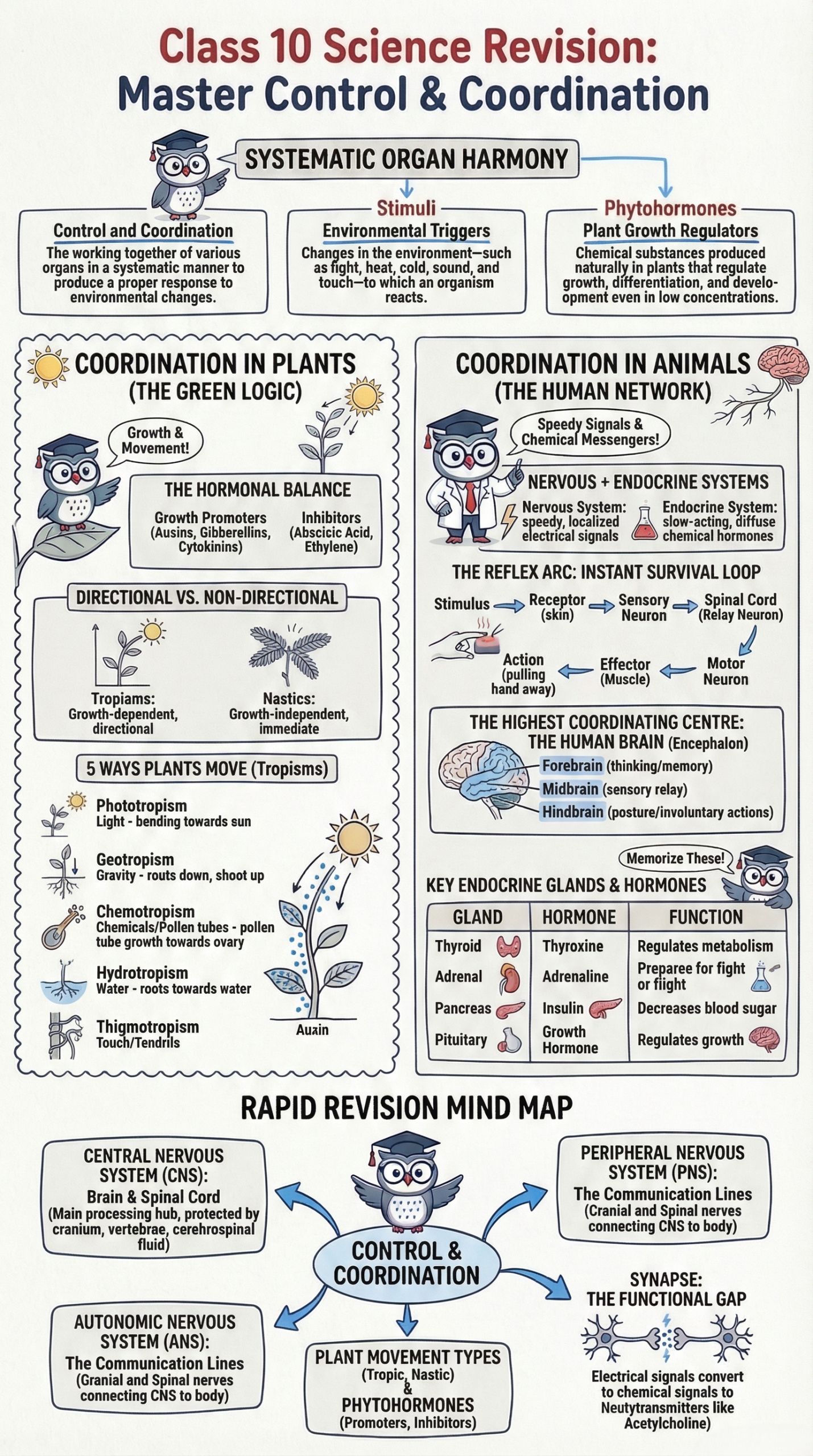
Control and Coordination Notes Quick Revision Summary
| Topic | Key Point |
|---|---|
| Coordination | Systematic organ cooperation in response to stimuli |
| Phytohormones | Auxin, Gibberellin, Cytokinin (promoters); ABA, Ethylene (inhibitors) |
| Tropism | Directional, growth-dependent movement |
| Nastic movement | Non-directional, turgor-based movement |
| Neuron | Cell body + Dendrites + Axon |
| Synapse | Gap between neurons; neurotransmitters bridge it |
| Reflex arc | Receptor → Sensory nerve → Spinal cord → Motor nerve → Effector |
| Brain regions | Forebrain (cerebrum), Midbrain, Hindbrain (cerebellum, medulla) |
| Master gland | Pituitary (regulated by hypothalamus) |
| Blood sugar | Insulin (↓glucose), Glucagon (↑glucose) |
| Emergency hormone | Adrenaline |
| Homeostasis | Negative feedback mechanism |