
Triangles are an important topic in Class 10 Mathematics, and they form the base for understanding many geometry concepts used in higher classes. In the Triangles Chapter 6 Class 10 Maths Revision Notes, students learn about similarity of triangles, basic proportionality theorem, and different properties that help in solving geometry problems. These Triangles Class 10 Maths Notes are designed to help students quickly revise the main formulas, theorems, and problem-solving methods before CBSE Board exams.
In triangles class 10, students mainly study similar triangles, criteria of similarity (AAA, SAS, and SSS), and how ratios of sides are related when two triangles are similar. These concepts are very important for board exam questions and competitive exams also. Many triangles class 10 maths notes questions are based on applying these rules step-by-step, so understanding the logic behind each theorem is very important.
These CBSE Class 10 notes provide a simple and clear overview of the chapter so that students can revise quickly without confusion. If students want quick study material, they can also use triangles class 10 notes pdf for easy access and revision anytime. Overall, this chapter helps students develop logical thinking and strong problem-solving skills in geometry, although sometimes students feel little confusing when they first study similarity rules.
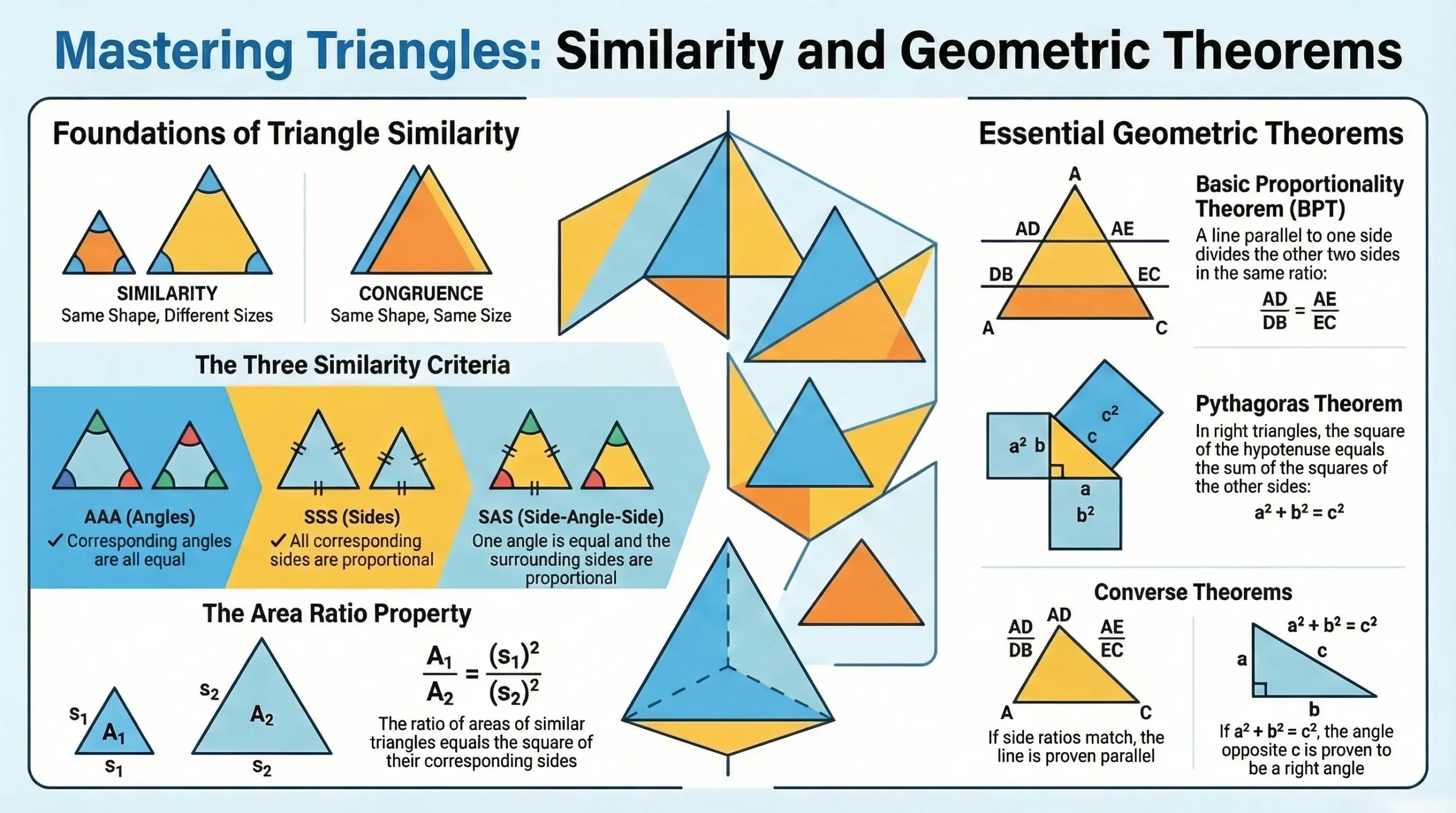
Introduction to Triangles Class 10 Maths
Triangles form one of the most foundational chapters in Class 10 Mathematics. This chapter bridges basic geometry with advanced reasoning, covering similarity, proportionality, and the legendary Pythagorean Theorem all of which are essential not only for board exams but for competitive entrance tests like JEE and NEET.
Triangles Class 10 Maths Revision Notes PDF Download
Fill the form to download this PDF
Congruent and Similar Figures
Understanding the distinction between congruent and similar figures is the starting point for this chapter.
- Congruent Figures: Two geometric figures are congruent if they have the same shape AND the same size. Think of two identical coins they overlap perfectly.
- Similar Figures: Two geometric figures are similar if they have the same shape but different sizes. A photograph and its enlarged print are similar proportional but not equal in size.
Insight: Every congruent figure is similar, but not every similar figure is congruent.
Similar Triangles
Two triangles △ABC and △DEF are said to be similar (written as △ABC ~ △DEF) if and only if both of the following conditions hold simultaneously:
Condition 1 – Corresponding Angles are Equal:
∠A = ∠D, ∠B =∠E, ∠C = ∠F
Condition 2 – Corresponding Sides are Proportional:
AB/DE = BC/F = AC = DF
Criteria for Similarity of Triangles
There are three fundamental criteria to establish similarity between two triangles:
(i) AAA Similarity (Angle-Angle-Angle)
If all three corresponding angles of two triangles are equal, the triangles are similar.
Since the sum of angles in a triangle is always 180°, if two pairs of angles match (AA), the third automatically matches. Hence, AA Similarity is sufficient in practice.
(ii) SSS Similarity (Side-Side-Side)
If the three corresponding sides of two triangles are proportional, the triangles are similar.
AB/DE = BC/EF = CA/FD
(iii) SAS Similarity (Side-Angle-Side)
If one pair of corresponding sides is proportional and the included angle is equal, the triangles are similar.
Results Based on Similar Triangles
When two triangles are equiangular (all corresponding angles equal), the following ratios are all equal to the ratio of corresponding sides:
| Property | Ratio Equal To |
|---|---|
| Corresponding Medians | Ratio of corresponding sides |
| Corresponding Angle Bisector Segments | Ratio of corresponding sides |
| Corresponding Altitudes | Ratio of corresponding sides |
Additional Results:
- If one angle of a triangle equals one angle of another, and the bisectors of these equal angles divide the opposite sides in the same ratio → the triangles are similar.
- If two sides and a median bisecting one of those sides are proportional to the corresponding two sides and median of another triangle → the triangles are similar.
Thales' Theorem (Basic Proportionality Theorem)
Statement
If a line is drawn parallel to one side of a triangle, intersecting the other two sides at distinct points, then it divides those two sides in the same ratio.
Given
△ABC where DE ∥ BC, with D on AB and E on AC.
To Prove
AD/DB = AE/EC
Proof (Stepwise)
Construction: Join BE and CD; draw DM ⊥ AC and EN ⊥ AB.
Step 1:
ar(△ADE) = 1/2. AD. EN and ar(△BDE)= 1/2. DB. EN
∴ ar(△ADE)/ar(△BDE)= AD/DB .... (i)
Step 2:
ar(△ADE) = 1/2. AE. DM and ar(△DEC) = 1/2. EC. DM
∴ ar(△ADE)/ar(△DEC)= AE/EC .... (ii)
Step 3: △BDE and △DEC share the same base DE and lie between the same parallel lines BC and DE.
∴ ar(△BDE) = ar(△DEC) ....(iii)
Conclusion: From (i), (ii), and (iii):
AD/DB = AE/EC
Corollaries of Thales' Theorem
If DE ∥ BC in △ABC:
| Result | Formula |
|---|---|
| Corollary 1 | DB/AD = EC/AE |
| Corollary 2 | AB/AD = AC/AE |
| Corollary 3 | AD/AB = AE/AC |
| Corollary 4 | AB/DB = AC/EC |
| Corollary 5 | DB/AB = EC/AC |
Converse of Basic Proportionality Theorem
If a line divides any two sides of a triangle in the same ratio, then the line is parallel to the third side.
This is the reverse logic of Thales' Theorem if you can prove the ratio condition, you can conclude parallelism.
Important Results and Theorems
| # | Theorem |
|---|---|
| 1 | The internal bisector of an angle of a triangle divides the opposite side internally in the ratio of the two sides containing the angle. |
| 2 | If D divides BC in ratio AB : AC, then AD bisects ∠A. |
| 3 | The external bisector divides the opposite side externally in the ratio of the sides containing the angle. |
| 4 | The line from the midpoint of one side, drawn parallel to another side, bisects the third side. |
| 5 | The line joining midpoints of two sides is parallel to the third side (Mid-Point Theorem). |
| 6 | Diagonals of a trapezium divide each other proportionally. |
| 7 | If diagonals of a quadrilateral divide each other proportionally → it is a trapezium. |
| 8 | Any line parallel to the parallel sides of a trapezium divides the non-parallel sides proportionally. |
| 9 | Three or more parallel lines cut by two transversals create proportional intercepts. |
Areas of Similar Triangles
Statement
The ratio of the areas of two similar triangles equals the square of the ratio of their corresponding sides.
Given
△ABC ~ △PQR
To Prove
ar(△ABC)/ar(△PQR) = (AB/PQ)2 = (BC/QR)2 = (CA/RP)2
Proof (Outline)
- Draw altitudes AM (in △ABC) and PN (in △PQR).
- Since △ABC ~ △PQR: ∠B = ∠Q, and ∠M = ∠N = 90°, so △ABM ~ △PQN (by AA).
- Therefore: AM/PN = AB/PQ
- Substituting into the area ratio:
ar(△ABC)/ar(△PQR)= 1/2. BC. AM ⁄ 1/2. QR. PN = BC/QR . AB/PQ = AB/PQ . AB/PQ = (AB/PQ)2
Properties of Areas of Similar Triangles
- Areas are in the ratio of squares of corresponding altitudes
- Areas are in the ratio of squares of corresponding medians
- Areas are in the ratio of squares of corresponding angle bisector segments
Pythagoras Theorem
Statement
In a right-angled triangle, the square of the hypotenuse is equal to the sum of the squares of the other two sides.
Given
△ABC, right-angled at B.
To Prove
AC2 = AB2 + BC2
Construction
Draw BD ⊥ AC.
Proof
△ADB ~ △ABC (AA: ∠DAB = ∠CAB, ∠BDA = ∠CBA = 90°)
→ AD · AC = AB² … (i)
△BDC ~ △ABC (AA)
→ CD · AC = BC² … (ii)
Adding (i) and (ii):
AC (AD + CD) = AB2 + BC2
AC . AC = AB2 + BC2
AC2 = AB2 + BC2
Converse of Pythagoras Theorem
Statement
If in a triangle, the square of one side equals the sum of the squares of the other two sides, then the angle opposite to the first side is a right angle.
Proof Strategy
Construct △DEF with DE = AB, EF = BC, ∠E = 90°. By Pythagoras: DF² = AB² + BC² = AC² → DF = AC. By SSS congruency: △ABC ≅ △DEF → ∠B = ∠E = 90°.
Results Derived from Pythagoras Theorem
| Case | Formula |
|---|---|
| Obtuse Triangle (obtuse at B, AD ⊥ CD) | AC² = AB² + BC² + 2BC · BD |
| Acute Triangle (∠B acute, AD ⊥ BC) | AC² = AB² + BC² − 2BC · BD |
| Median Formula (m_a = median to side a) | AB² + AC² = 2(AD² + BD²) |
| Sum of Medians | 3(sum of squares of sides) = 4(sum of squares of medians) |
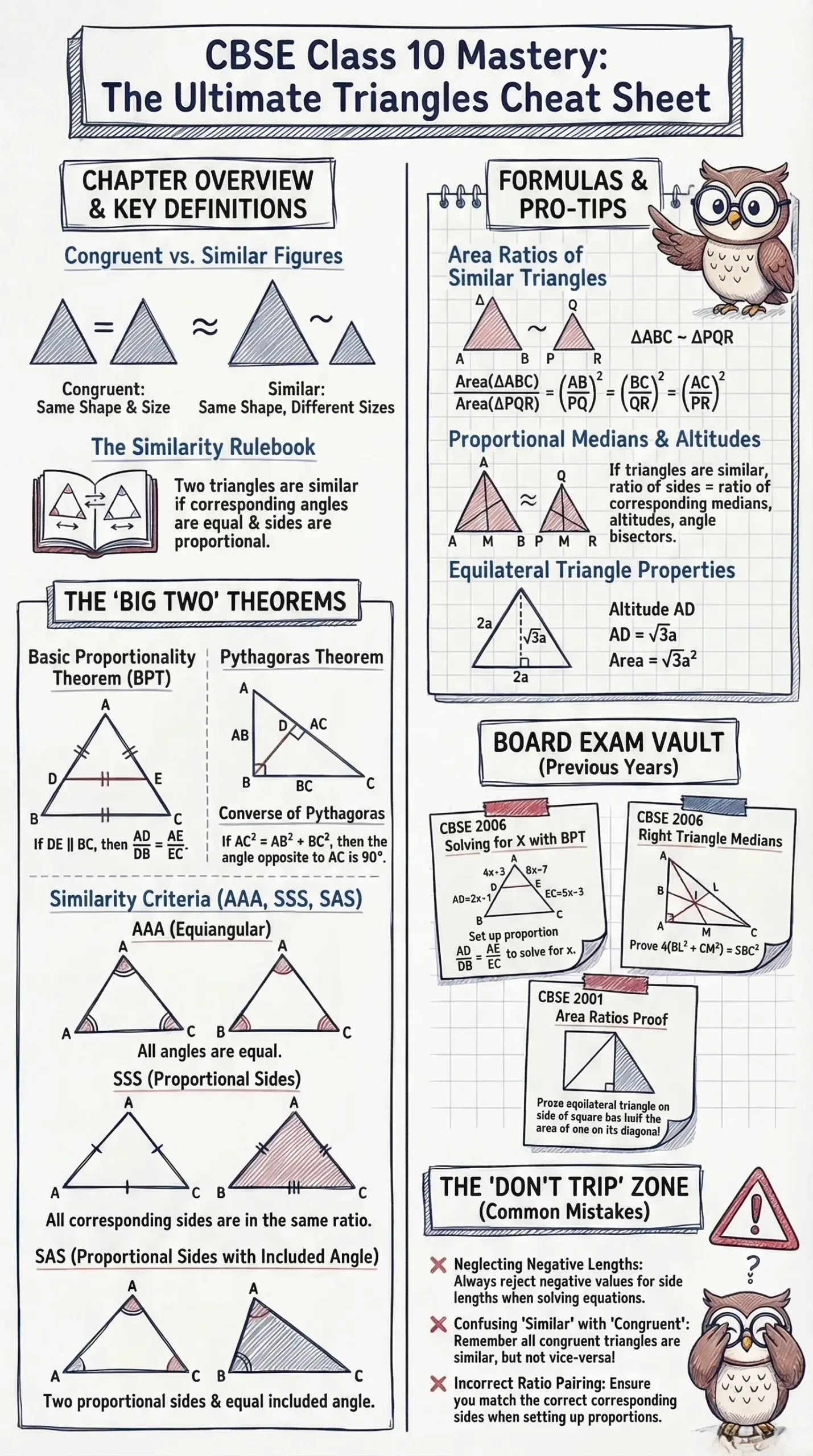
Triangles Class 10 Maths Solved Examples with Solutions
Problem (CBSE 2006): In △ABC, D and E are on AB and AC such that DE ∥ BC. Given AD = 4x − 3, AE = 8x − 7, BD = 3x − 1, CE = 5x − 3. Find x.
Solution: Since DE ∥ BC, by Basic Proportionality Theorem:
AD/DB = AE/C
4x - 3/3x - 1 = 8x - 7/5x - 3
Cross-multiplying
(4x - 3) (5x - 3) = (8x - 7) (3x- 1)
20x2 - 27x + 9 = 24x2 - 29x + 7
4x2 - 2x - 2 = 0
2x2 - x - 1 = 0
(2x+ 1) (x - 1) = 0
x = 1 or x = −1/2.
Since lengths cannot be negative, x = 1 is the only valid answer.
Problem: In △ABC, AB = 12 cm, AD = 8 cm, AE = 12 cm, AC = 18 cm. Show that DE ∥ BC.
Solution:
- BD = AB − AD = 12 − 8 = 4 cm
- CE = AC − AE = 18 − 12 = 6 cm
AD/BD = 8/4 = 2
AE/CE = 12/6 = 2
Since AD/BD = AE/CE, by the Converse of BPT, DE ∥ BC.
Problem: In trapezium ABCD, AB ∥ DC, DC = 2AB. EF ∥ AB cuts AD at F and BC at E such that BE/EC = 3/4. Diagonal DB intersects EF at G. Prove that 7FE = 10AB.
Solution:
Step 1: In △DFG and △DAB, since FG ∥ AB:
- ∠1 = ∠2 (corresponding angles)
- ∠FDG = ∠ADB (common)
- ∴ △DFG ~ △DAB (AA)
- → DF/DA = FG/AB … (i)
Step 2: In trapezium ABCD with EF ∥ AB ∥ DC, by proportionality:
AF/DF = BE/EC = 3/4
Adding 1 both sides: AF/DF + 1 = 3/4 + 1 → AD/DF = 7/4 → DF/AD = 4/7 … (ii)
Step 3: From (i) and (ii): FG/AB = 4/7 → FG = (4/7)AB … (iii)
Step 4: In △BEG and △BCD (since EG ∥ CD):
- △BEG ~ △BCD (AA)
- BE/BC = EG/CD
Since BE/EC = 3/4 → BC/BE = 7/3
EG = 3/7 . CD = 3/7 . 2AB = 6/7AB ... (iv)
Step 5: FE = FG + EG = (4/7)AB + (6/7)AB = (10/7)AB
{7FE = 10AB}
Problem: In trapezium ABCD, AB ∥ CD. Find x given: AO = 3x−19, OC = x−3, BO = x−4, OD = 4.
Solution: Diagonals of a trapezium divide each other proportionally:
AO/OC = BO/OD
3x - 19/x - 3 = x - 4/4
12x - 76= x2 - 7x + 12
x2 - 19x + 88 = 0
(x - 8) (x - 11) = 0
x = 8 or x = 11
Triangles Class 10 Maths Quick Revision
| Concept | Key Formula / Statement |
|---|---|
| Similar Triangles | Equal angles + proportional sides |
| AAA Similarity | 3 equal angles → similar |
| SSS Similarity | 3 proportional sides → similar |
| SAS Similarity | 1 proportional pair + included angle equal → similar |
| BPT (Thales) | DE ∥ BC → AD/DB = AE/EC |
| Converse BPT | AD/DB = AE/EC → DE ∥ BC |
| Area Ratio | ar(△1)/ar(△2) = (side ratio)² |
| Pythagoras | Hyp² = Base² + Height² |
| Converse Pythagoras | If c² = a² + b² → right angle at C |
| Angle Bisector | AB/AC = BD/DC |